Skybox

Skybox is used on video games as a background, it is a depth illusions and also an unreachable limit.
This limit produces a better immersion on 3D scene. It compounds the ambient scene of the game action due to parallax phenomenon, atmospheric perspective and glare. Even it can not replace the top view map, it can provide landmarks for player moves.


From other side, we can see it as a player’s moves limits, they can’t reach it, always hiding by arbitrary obstacle. A frustration come to this immersive background, players is trapped together in a box. For graphical artist and developer who made a game, we can see all endeavour to make this skybox realistic, a dream of reality in a virtual surrounding as desire to get out the binary world.
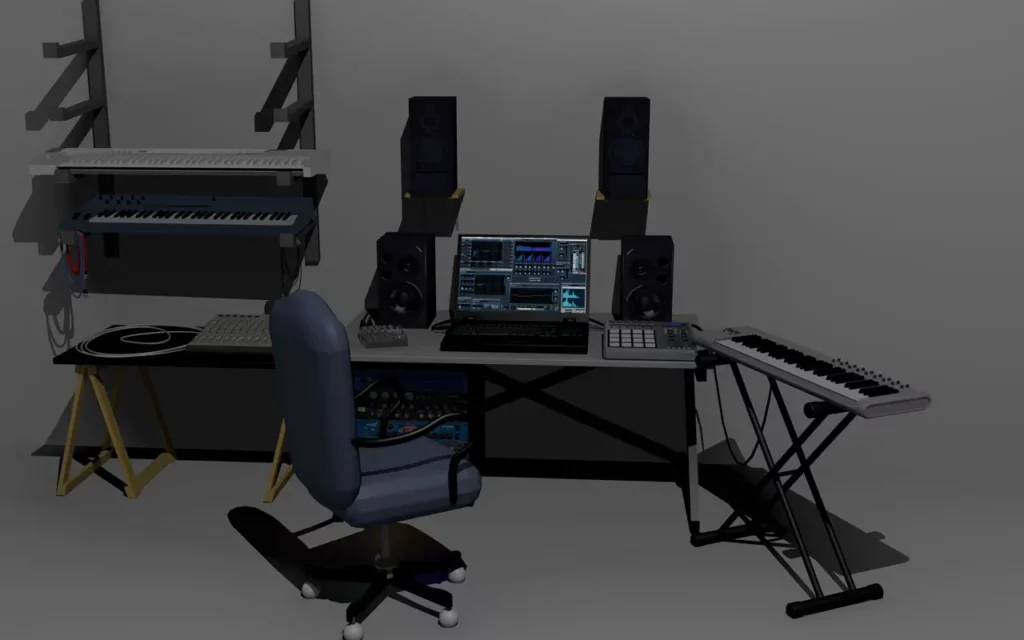
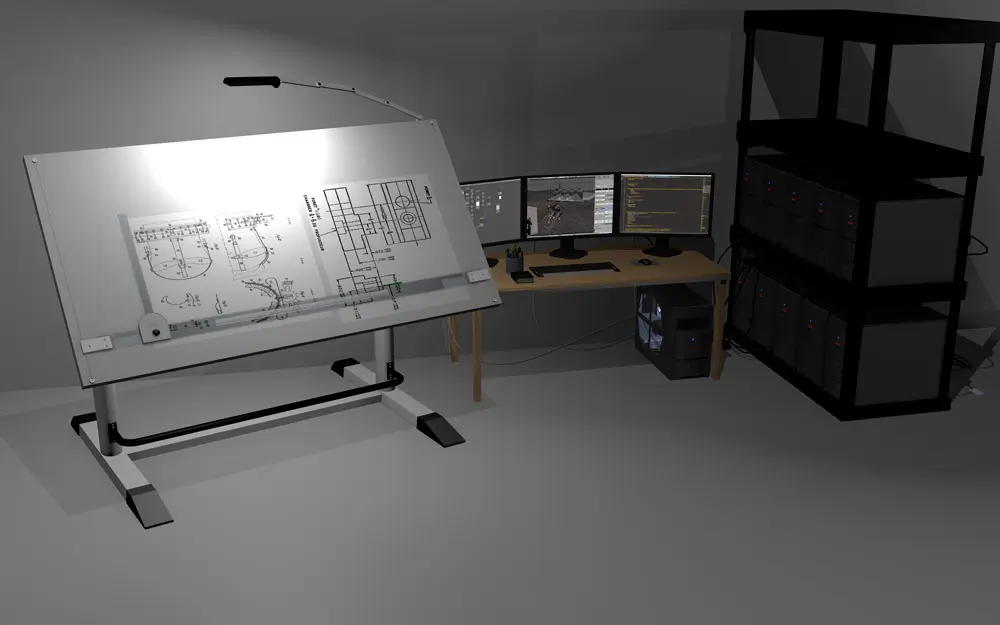
The project Skybox take a step back with this object with replacing this decoy on new perspective, this time real or physical. The simulation effect is neutralized by a transposition of this object in a new scale. The skybox empty become filled, it becomes reachable with a specific size and medium.


The switching of state, from tool to object, freeze the skybox, it get out from a real time moves, from a constant distortion. Before player was on it center as a zero of this triangulation between eyes, perspective and environment, now his moves to browse it can be a rotation on himself.

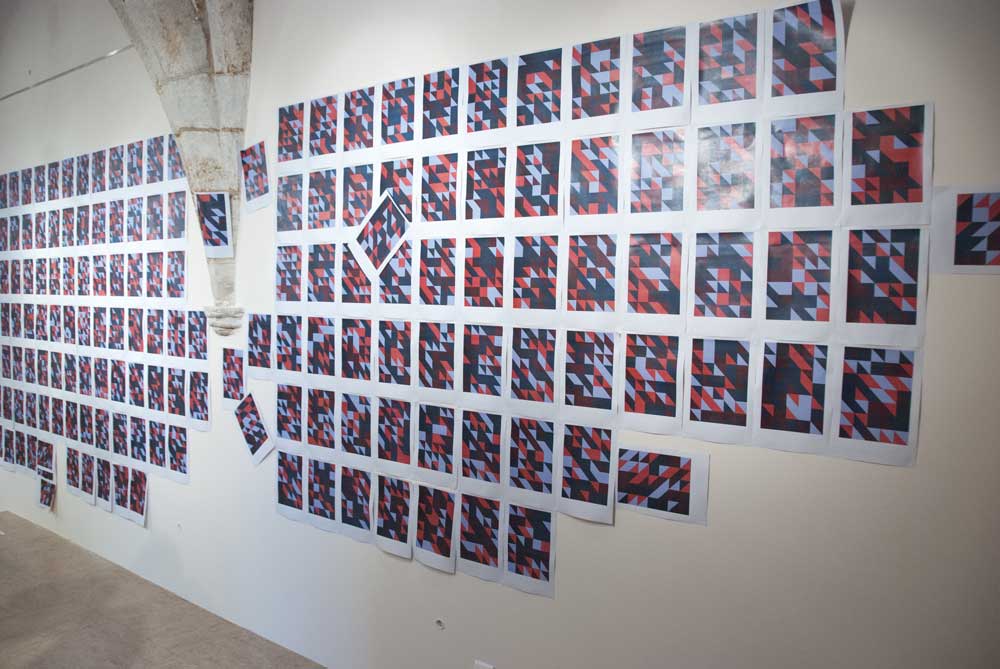
Random Triangle Variation

Iteration 2015 Nicolas Lebrun

This installation highlights artistic production as a moment. It depict an semi-automated creation process made with random picturiale choices and visitor action. To understand this works, we have to watch this piece, not as a single printed representation but in the whole production and then we can be overcome with randomness, in fact this piece study it.


Randomness is an unknown number which is set when visitors decide to create a new trace. The thinking of this works, based on protocol, come from Generative Art, and produced various pieces as Random() 2012, (Aperto gallery and 59th Salon de Montrouge), Reflection and Reverberation (created during a residency at Espeyran Castel on 2013).


With two switches, visitors can join the creative process: the first to create or change a drawing and the second to print it. He can be sponsors (drawings commissioned by him) and the person who hangs the exhibition: once the drawing is printed he have to put it on the wall as he went.

Reflection

Reflection is a projected video installation, its title uses the polysemy of the term. First of all, with its video capture system, it visually restores the space in which it is exposed like a mirror. Then, in a second time, it testifies of the path of thoughts which led me to its elaboration, reflections on our conscience of time, on the nature of time.

reflexion-texte-nicolas-lebrun

Reflection consists mainly of a program that captures images in real time for analysis. The program interprets the differences in brightness and cuts the video capture into a number of faces. It places these faces on cubes in a 3D space by placing the brightest cubes in front.

This installation questions our relationship to time, it retransmits video cubes with a delay of about ten seconds. Thus the image of the spectator is first captured by the device before he becomes aware that this capture is retransmitted.

This process of capture in real time and retransmission in deferred time which is a reference to Going Around The Corner by Bruce Nauman or Present Continuous Past(s) by Dan Graham, where the feeling of the duration developed by Bergson in the Creative Evolution (with the example of the sugar which melts in the water) is put in abyss. Indeed, in this book Bergson hypothesizes that objects and things have a duration similar to our inner duration.


Let us relax now, let us interrupt the effort that pushes into the present as much of the past as possible. If the relaxation were complete, there would be neither memory nor will: this means that we never fall into this absolute passivity, nor can we make ourselves absolutely free. But at the limit, we glimpse an existence made of a present which would start again and again, no more real duration, nothing but the instantaneous which dies and is reborn indefinitely. Is this the existence of matter? Not quite, no doubt, because the analysis resolves it into elementary shocks, the shortest of which are of a very weak duration, almost fading, but not null. One can nevertheless presume that the physical existence inclines in this second direction, as the psychic existence in the first.

– The Creative Evolution Henri Bergson (1907) p122-123

Reverb

Réverberation / ReverbThis program renders ambient sounds in a visual way. It projects the sounds as a spectrum of frequencies, creating a three-dimensional landscape. This landscape is made up of planes: the most distant curves are the most recent and the closest are the oldest. Thus, at one point in the projection, Reverberation stages different temporal layers of sound. These temporal layers advance quite rapidly and finally leave the field.

The installation broadcasts randomly chosen recordings, creating a shift with the process of real-time capture. These soundtracks, in which artists and physicists intervene, have inspired me throughout the creation of this piece. To this group of recordings another one is added: samples and loops of orchestral or digital music which come to give rhythm to the interventions of the first group of recordings.

It is a question of placing the spectator in a double temporality, its sound acts are retransmitted to him in the present and in the past through the various strata which form the video-projected landscape.

Before a sound is emitted by the spectator, during the tiny lapse of time in which the injunction of the conscience runs through our nerves, we can see this event as belonging to the future.

Random()

Random() is an installation and also a digital exhibition (Aperto gallery): about twenty artists have chosen to integrate this installation in networks. The principle is to delegate the choices usually made by a curator to a program and to the spectators.

Every ten minutes, this program selects four works from the forty or so in the database for display in the gallery. The viewer/interviewer can select additional works within this time frame to replace those already displayed.

Beyond the randomness, the ambition was to create a work of art from a plurality of artistic approaches as if an artistic proposal became a material or a medium to constitute another gesture, another form.

This installation contains quantifiable elements: 40 projects, 21 artists, a 10-minute countdown that triggers the random function, dimensions of projections, measurements of the physical place (Aperto gallery) transposed into its virtual reconstitution, the geographical coordinates of the place and the dates or periods of the exhibition. On the other hand, the incessant calculation made by the program is also quantifiable, but is updated and fluctuates according to the choices of the Internet users.

If we take a step back from the interactive aspect, from the immediacy of the device / spectator relationship, we can see the image of the spectator as an art consumer who chooses his exhibition menu. This installation is therefore part of a post-modern attitude of erasing the figure of the curator as a determined person who makes the choice of the pieces presented and their placement in space.

On the other hand, it also questions the notion of author and paternity. Randomness is also in the encounters one makes. This selection of artists does not come from a choice of themes, but is an invitation to people I know or have known.

Even if there is a pre-selection of works in the choice that the spectator makes, his free will is involved in the process. This is what the second part of Random() shows, the log or journal (the generative part of the project that interprets the collected data) shows that there is indeed interaction with spectators, symbolized by their IP address.

It should be noted that when the installation is not projected in a place by its author, the 3D view is no longer accessible to the Internet user. He can therefore make exhibition choices, but his action will only be visible in the place where the exhibition is shown. The physical gallery remains indispensable and is not the target of this discourse.

Going beyond simple interaction, the appropriation of the device by the public makes this installation efficient, but its choices disappear every ten minutes under the action of the random() function.

This aesthetic choice puts the spectator at a distance, whether he is an actor or a passive participant in relation to the choices of representations proposed by the programme.

In the end, the viewer’s will is opposed to the random() function.


See Random()

Yottabit perspective

If he doesn’t already know it, I recommend Hans Belting’s book Florence et Bagdad, une histoire du regard entre l’Orient et l’Occident. [Florence and Baghdad: Renaissance Art and Arab Scienc] to Nicolas Lebrun. But he surely knows this book published two years ago by Gallimard [2011 for the English edition] and I don’t doubt that he has also studied the publication by the same Hans Belting L’Histoire de l’art est-elle finie ? [The End of the History of Art?] because it is a question that concerns him visually. Belting’s book was published in 1989 [1987 for the English edition] at a time when performances and installations threatened the visual arts with fatal implosion. Belting suggested that, the idea having swept away history and since a new meaning had been given to it, art could do without a narrative.

It was in a way immobilised. The Internet was going to immaterialize it. This “Copernician Revolution”, if it does not rekindle the lost history of art, does bring us back to Blaise Pascal who, jealous of the wonders created by the painters of perspective, invoked for the moral the same search for the point that, like the vanishing point, would be the place of truth from which to think of things. Four centuries later, is art the point of truth of the canvas?

Let’s face it, Nicolas Lebrun has not come to Montrouge to show his works but to think them, and to make us think them, and make us think of the works of others, who surround him, precede him, dominate him, and question him, or not, on essential issues: How “to make” art, and how to exhibit it at a time when all creation is simultaneously uploaded, printed in 3D, circulated infinitely, enhanced by numbers of views whose record is the heart. Here, the artist welcomes being dispossessed of his work which he sees changing its nature to suit the cybernetic orthodoxy.

A veritable IT sponge, Nicolas Lebrun’s project questions the circulation of works, their place here, it would be sadly useful if he had come out of his liquid element: the exhibition, its context, what you are doing in wondering what are those screens, those random projections, that are moreover very elegant, almost design, giving the eye a comfort, a geometry, in short he means you no harm. Organizer of a virtual party, he sends his thinking immaterialities to search engines that cannot, but. Certainly, he defeats curators and collectors because his proposition, as soon as it’s clicked, is collected by all the dumbfounded internet users. But his system has the great, paradoxical merit, of placing the visitors to the Salon de Montrouge outside the canvas, as lost rebels. Just like the painting from beside is in the history of art a point like another, the virtual organization that Nicolas Lebrun is trying to introduce in your mind is another point “like another” of this history. But a point that inevitably changes the perception of it. He threatens, he cruises, he implores, and even if you refuse him: “I don’t understand anything about it”, you cannot hurt him at all.

– Christophe Donner, writer and critic of Montrouge’ Salon
Workshop

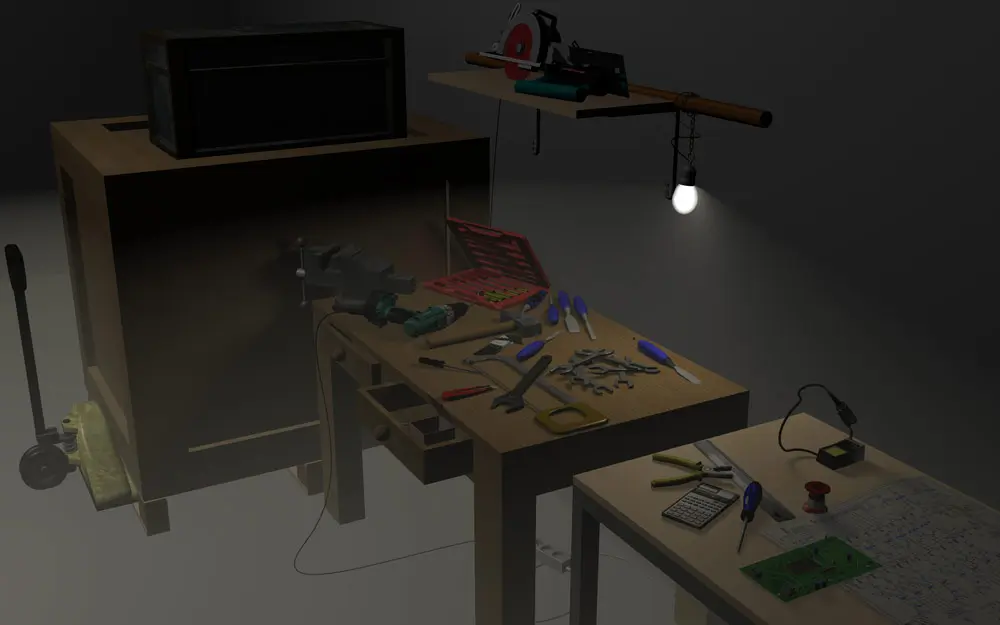
Workshop is a young artist’s piece, an absurd search for a space with means of production. This place is materialized in the prints, but, at the same time, these same prints, these same workshops, evolve according to the whims of an online market.

This market is that of 3D files belonging to the scene of each workshop. These tools, inoperative, having only a figurative function, can inhabit other creations that do not belong to contemporary art: architecture, interior design, video games, communication.


This is not an open source creation, the rights of diffusion, of modifications are given in exchange for a sum of money and being digital files, they can be sold as many times as the request will be made. The sales take place on a third party site where there is no mention of the bias of this piece and this in a more generative approach than participatory.

The relationship that exists between these 3D files and the workshop prints is one of interdependence. The objects come from the workshops and the prints evolve according to the sales of the files. When the sum of the sales corresponds to the manufacturing price of a print, the 3D scene changes (addition of object, change of framing, etc.), a new image is produced, printed and laminated.

Thus these 3D renderings are to be seen as inventories or inventories of the workshop. Atelier produces a shift: the tool is no longer a means to obtain a shape, but it becomes the shape itself.


Still Life

Still Life is an installation that uses a biological reaction, the natural redox on potatoes. Each potato must produce about O.8 volts, the fact of gathering them by zinc/copper connections is for me the illustration of a network in operation.

The electromagnetic communication, at work in this installation, functions with the aim of emitting a sound. This crackling, very subtle sound, similar to that of a radio when navigating between FM stations, is produced by the circulation of ions between the polarities (anodes and cathodes: copper and zinc). This process is found in humans through fatty acid biosynthesis, the mitochondrial respiratory chain and gluconeogenesis. The fact that this process lasts only fifteen hours gives a performative aspect to this installation, which will be shown in an exhibition in the form of a video trace captured during the opening.

The name given to this installation is a positioning in the art world: this citation of the still life style is for me a desire to show living representations and not frozen in a standard format. Moreover, the chemical reaction which is more important than the visual aspect aspires to a scientific realism independent of any subjectivity.

Misery


This animation project seeks to confront the collective unconscious that emanates from horror films, science fiction and virtual spaces. These representations which tend to a photo-realistic aspect are to be seen not as a film with a narrative, but as a frozen moment or a three-dimensional painting.

The characters present on the scene are not animated, they do not really have a role, so they must be seen as prisoners or dummies of this 3D decor. In this confrontation, the name given to this series of videos, Misery, is a precious indication. In the background appears the face of Annie Wilckles, played by Kathy Bates, this woman who sequesters the writer Paul Sheldon so that he continues the story of Misery, his heroine, whom he wanted to kill. This video, which will be extended to other settings, focuses attention on the space of digital creation, its potentialities or its improbable finitudes and its virtuality.

I see this project as an obsession to recreate virtual spaces having the same trigonometric laws as ours, so it is a work in progress, a never-made which is generated from vectors. Even if they are videos, the interest lies in my approach, these worlds exist only when I modify them, their immediacy is effective only when they interfere in real time. This piece is in margin of other productions which interfere with the real flows (networks, audio, electric, spectators).

It was composed in 2010 of a diptych, but in 2013 another scene appeared. The principle is simple a circular tracking shot allows me to describe the space around which I project my drawings.

Szamár Madaár

This animation originates from a clip by Chris Cunningham, “Szamár Madaár” (soundtrack: Venetian Snare, Rossz Csillag Alatt Szùletett, Planet Mu, 2005). This clip fascinates me, beyond the technical aspect, because the virtual space it describes has some strange characteristics. The study I made of the movements of light, objects and camera revealed to me that it is double, has no sides. At the end of this study, we can isolate two spaces from all the other elements of the scene, one is a tower whose staircase evokes the Tower of Babel, the other Stonehenge. One of the last camera movements suggests that they are horizontally opposed, as if the Earth were flat and had very little thickness.

My intervention consists in putting one of them back upright: they are on the same plane, embedded in each other. There is no real camera movement, the two buildings turn on a platter (similar to a vinyl turntable).

Instant T of Art/Instant Tweet

This installation is above all digital, it retransmits through texts and an artificial voice, the tweets or statuses of Twitter users. The program collects the tweets by searching for the word “art” or more precisely the expression “#art” which is used to classify the message in the art category of Twitter. This information is then retranscribed in the form of a frequency spectrum that also reproduces the sound environment of the room (captured by the microphones).

Thus the visitor of the art center sees a scroll of names of artists and events that give a very broad sense of art, more extensive than what we see in museums (culinary art, Nail art, etc.).

The viewer therefore sees a sound representation of the art shared on Twitter, although the microphones do not amplify the sound coming from the room, he can influence this representation by producing any sound.