This creation was produced thanks to a random system of fragmentation of plans. The process starts with a single plane and at each iteration of the algorithm, a plane is split in two, this process is repeated and the parts obtained during the first fragmentation are itself re-fragmented. The randomness intervenes in the choice of the plane to fragment, in the axis of the cutting and in the choice of the lengths of the two parts.
This process allows to quickly obtain a composition similar to Piet Mondrian’s paintings. As the title indicates, the process must stop as soon as the initial plan has been divided into twenty-four parts, then this composition is transferred six times onto the faces of a cube.
This experimentation is itself repeated twenty-four times, resulting in twenty-four different compositions and thus twenty-four cubes. These variations are not autonomous, they share the same support: a sheet of A1 paper. It is thus a series where each composition has value only if it is interposed between these similar. All the interest of this work lies in the diversity and in the similarity of the compositions obtained.
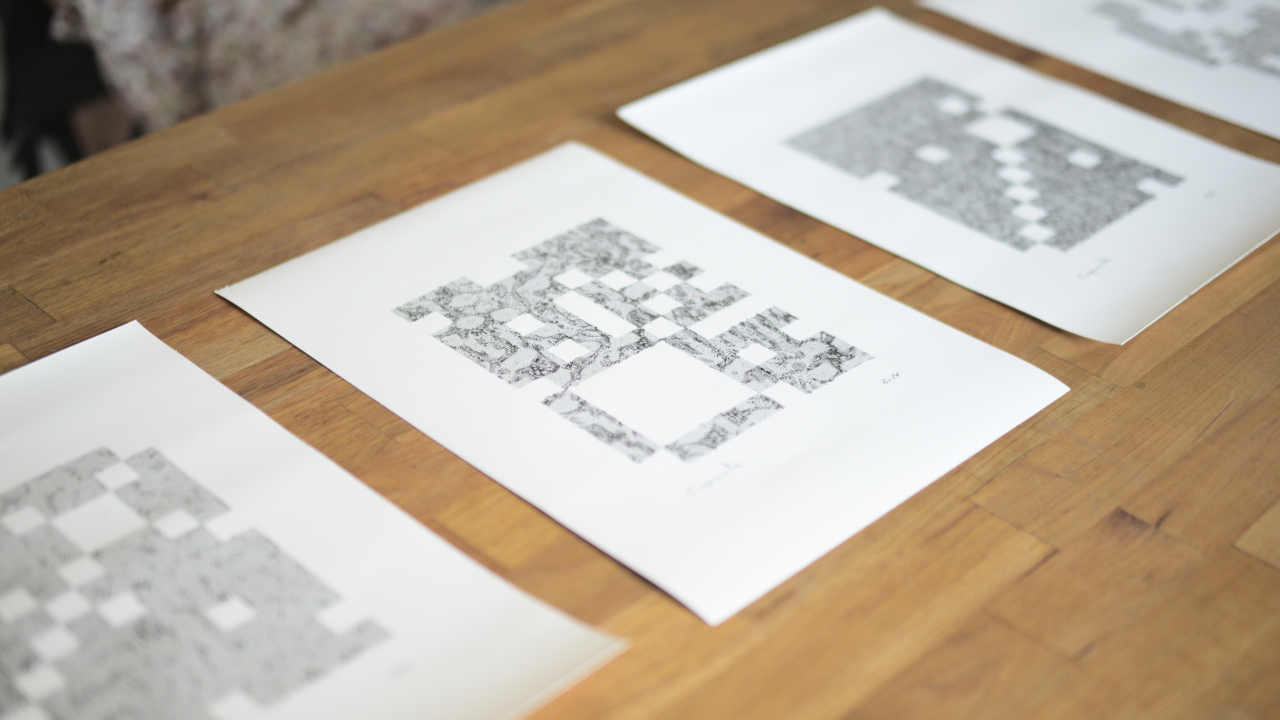
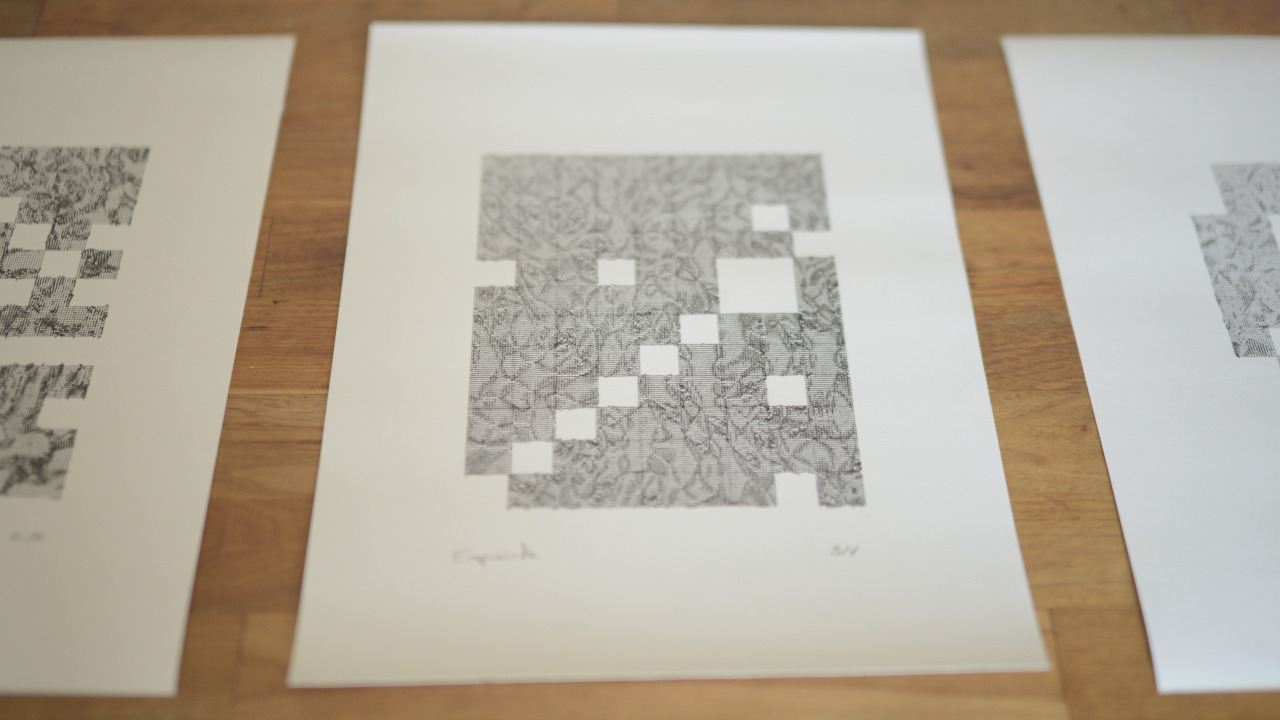
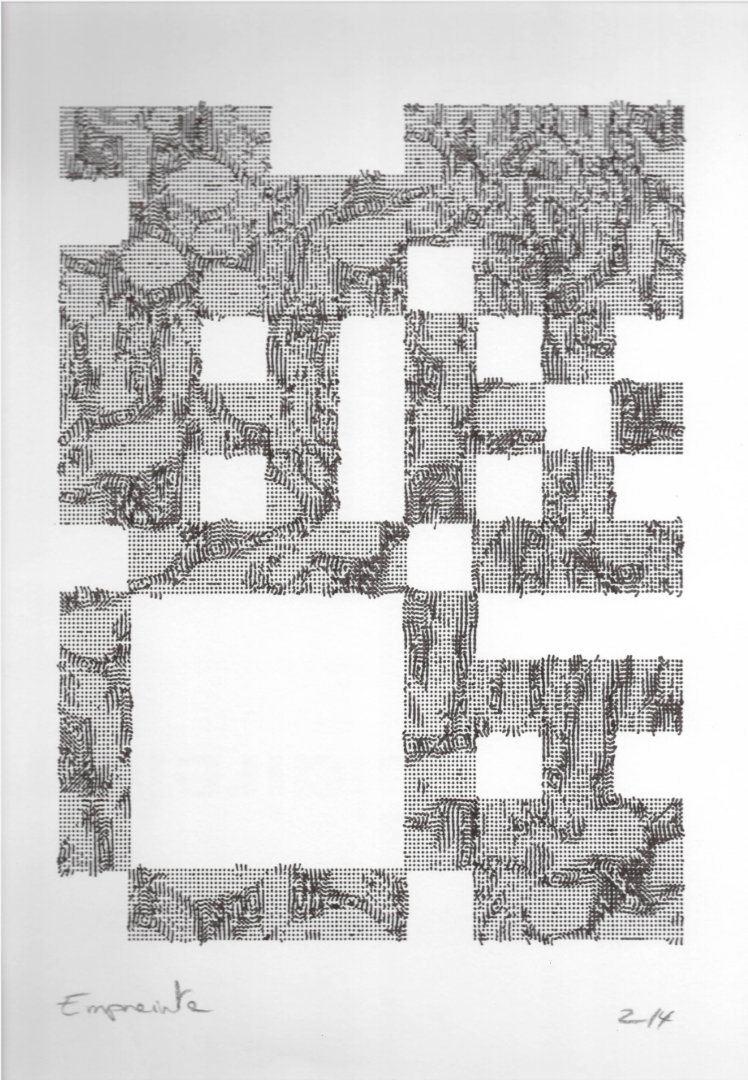
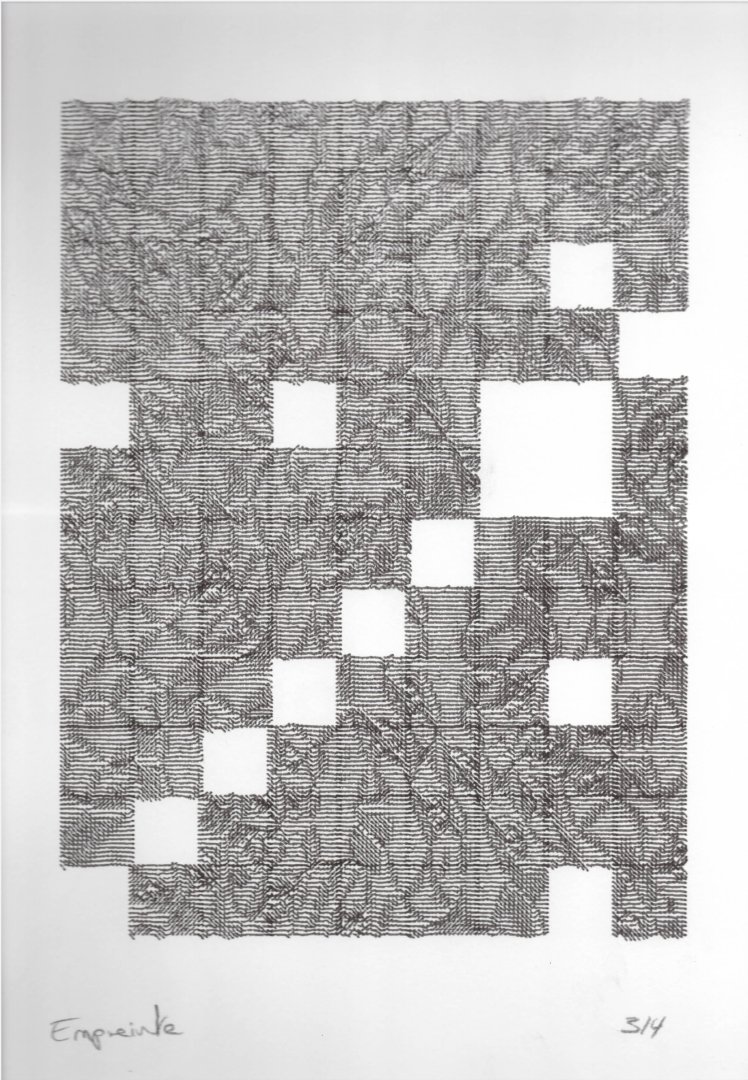
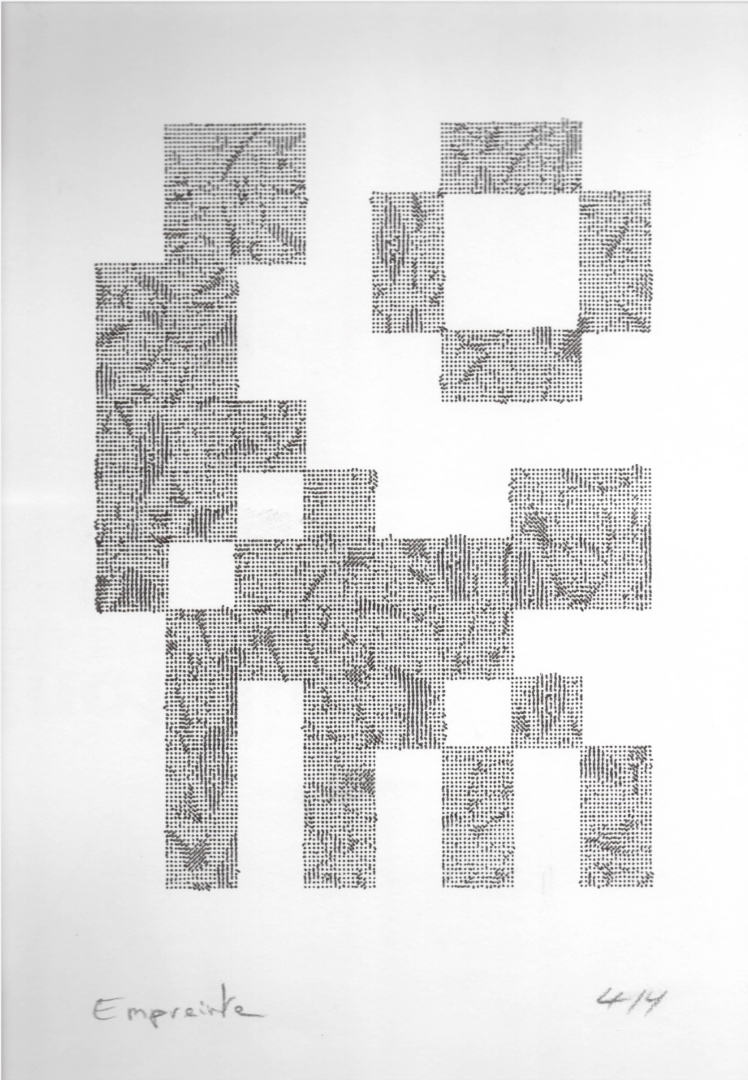
These four shapes, which can be compared to pictograms or QR codes, are constructed in two stages. A grid with a pattern of different sizes will compose solids and hollows, then this structure will serve as a support to place points that will grow by forming lines. This phenomenon of growth imitates organic forms that respond or oppose the regularity of the grid. There is an ambiguity between these two motifs, we do not distinguish if they are superimposed or if they form a single element.
This grid is it fragmented or then absorbed or composed by organisms?
We find a dualism between the common and the singular of a generative work in series and a form which resembles a sign: letter, figure or pictogram, altered by a process which imitates nature. Imprint speaks to us of these tiny interstices where otherness develops.
This short film evokes the work of Giovanni Battista Piranesi, Carceri d’invenzione, a series of engravings of imaginary prisons with prodigious dimensions and labyrinthine forms.
The camera moves in the direction of an interior courtyard, flying over corridors, arches and staircases, it tries to advance to the center but by an arrangement of interlocking or entangled shots, it always returns to its starting point. The outside is thus found inside and the beginning is the end. This prison, like that of the 18th century engraver, is above all mental.
This video loop, this travelling ahead, shows a space that repeats itself like a fractal figure. We find the structure of the whole by enlarging a part of the model.
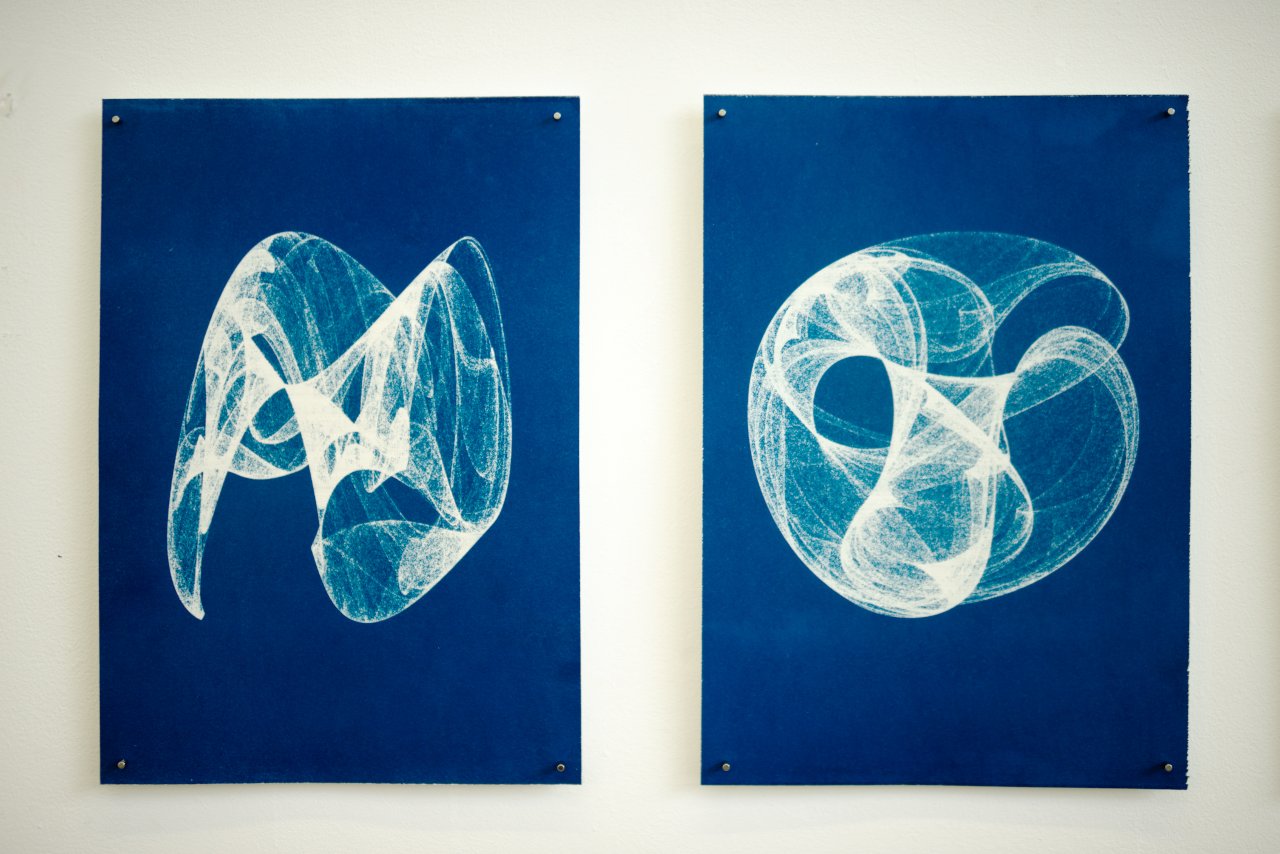
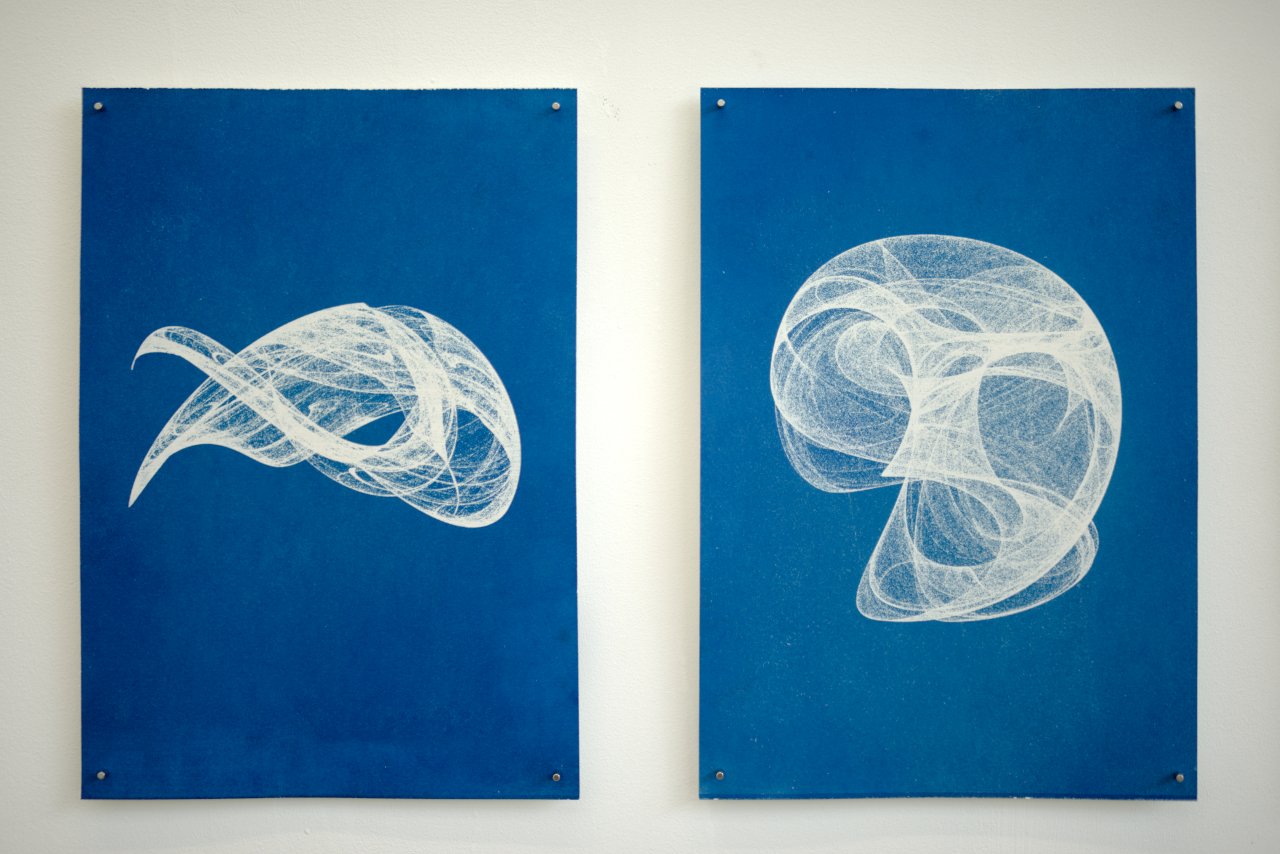
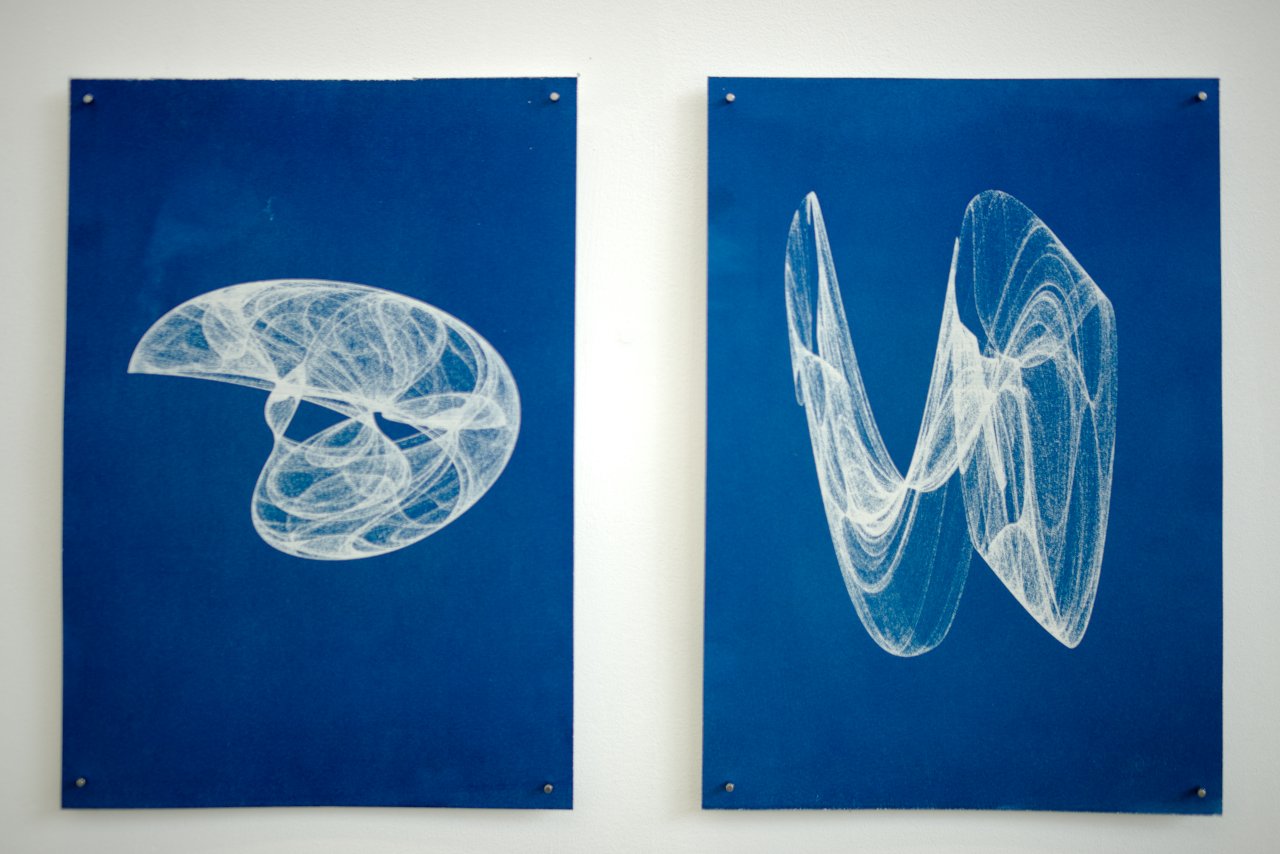
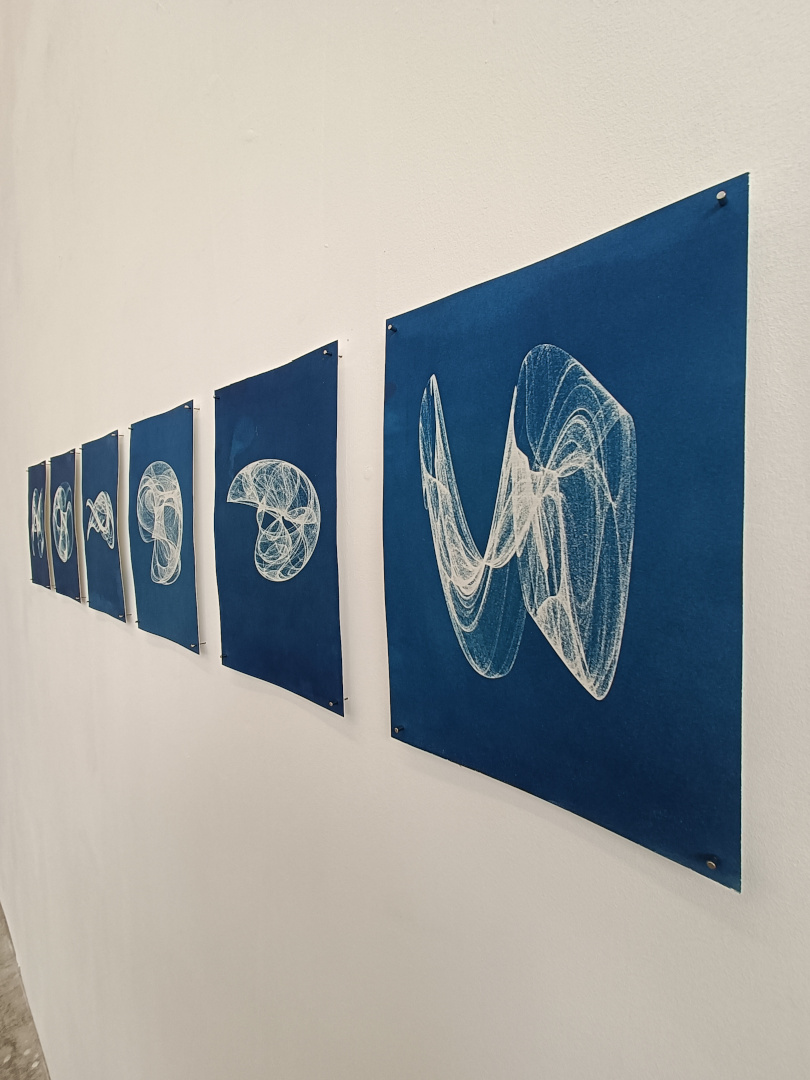
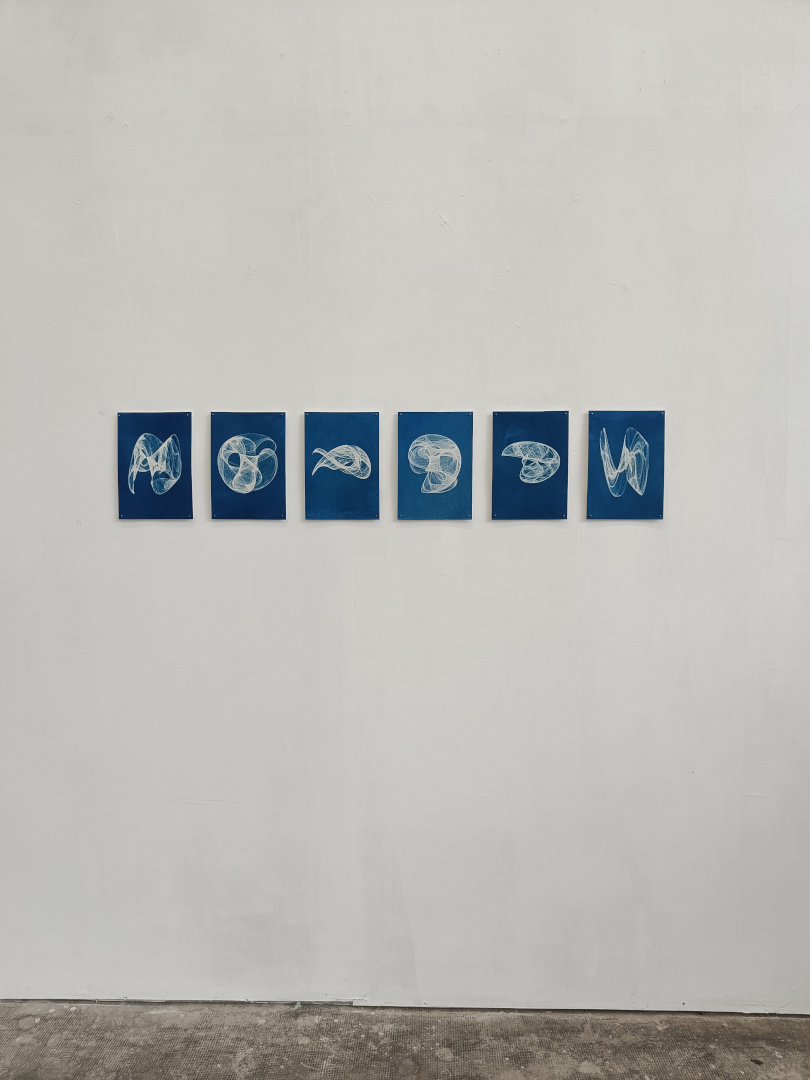
These representations are the result of the use of a mathematical formula discovered by Clifford A. Pickover. The pickover is a practical object inherent in dynamic systems, systems that evolve irreversibly with time (climate, weather, solar system…). Chaos theory is essentially based on this theoretical object that is the attractor. The attractor provides a model for predicting the behaviour of several elements within a system subject to deterministic chaos, i.e. without having a precise knowledge of the initial conditions of the said system, the attractor makes it possible to define the behaviour of a large number of elements.
These are therefore visual representations of the action of an attractor, but this does not determine the behaviour of a large number of particles, but of a single one. Indeed, to draw a drawing, only one point was placed in the centre of the plan at the start of the programme. The aim is to show how the attractor has determined the position of this point, this particle (from its previous position) a million times.
The differences in the plot shown in the series are due to the variations in the initial conditions from one visualization to the next. These conditions were chosen randomly in previous simulations and their values were recorded according to the plastic or graphic quality of the result obtained and the success of the simulation (it is possible that with certain conditions the point does not move).
The use of the cyanotype as a reproduction procedure aims to integrate into the first experiment a second determinism, this time chemical, which under the action of ultraviolet radiation will give substance to the representation.
Swirl is a simulation of the movement of organisms. It moves lines with a system of polarities that evolves over time. The program creates curves and clusters, thus producing shapes.
These abstract and autonomous representations evoke their intrinsic virtual nature through the liquid aspect of their environment.
It is easy to perceive in this ballet of lines, our own progression on digital networks, and it is in the updating of this system, in this rhythm given by the machine, that this metaphor is the most striking.
Viewing the Swirl program is comparable to observing clouds or Rorschach tests, the subject becomes almost more important than the representation itself. However, it tries to seduce the spectator by means of tricks. The three-dimensional aspect given by the movement and the voids is completely illusory, all the elements are in the same plane, it is the brain that interprets the evolution of the curves as the cause of a relief. It is through artifice that the program seeks to provoke seduction, and although it offers itself to the eye, it remains elusive because neither the spectator, nor even its author can interact in its functioning. These are autonomous graphic elements that are self-regulating.
This program leads to an incessant fall across a corridor. The movement in this geometric, minimal and linear space is punctuated by a sentence that gives the title to this piece, So far so good. This tirade by Hubert (Hubert Koundé) from the film La Haine (Mathieu Kassovitz, 1995) is projected endlessly in this tunnel. The observation could be that of the program checking that the construction sinking along the bends is coherent. However, if we base ourselves on the film from which this sentence is taken, we realize that it is not in fact an observation.
It’s the story of a man who falls from a fifty-storey building. The guy, as he falls, he keeps repeating himself to reassure himself: so far so good, so far so good, so far so good, so far so good. But what matters is not the fall, it’s the landing.
It is a way to relieve the stress of an extreme condition, to close your eyes to an imminent danger. Nevertheless, this sentence evokes a particular situation in Hubert’s mouth, that of the future of a suburbanite similar to a Greek tragedy where the characters do not seem to be in control of their destiny and inexorably run to their doom. This sentence returns at the very end of the film no longer as a metaphor because the subject described is no longer a man but a society.
In this program, the story seems fixed before its end, the observation is repeated but the fall never occurs.
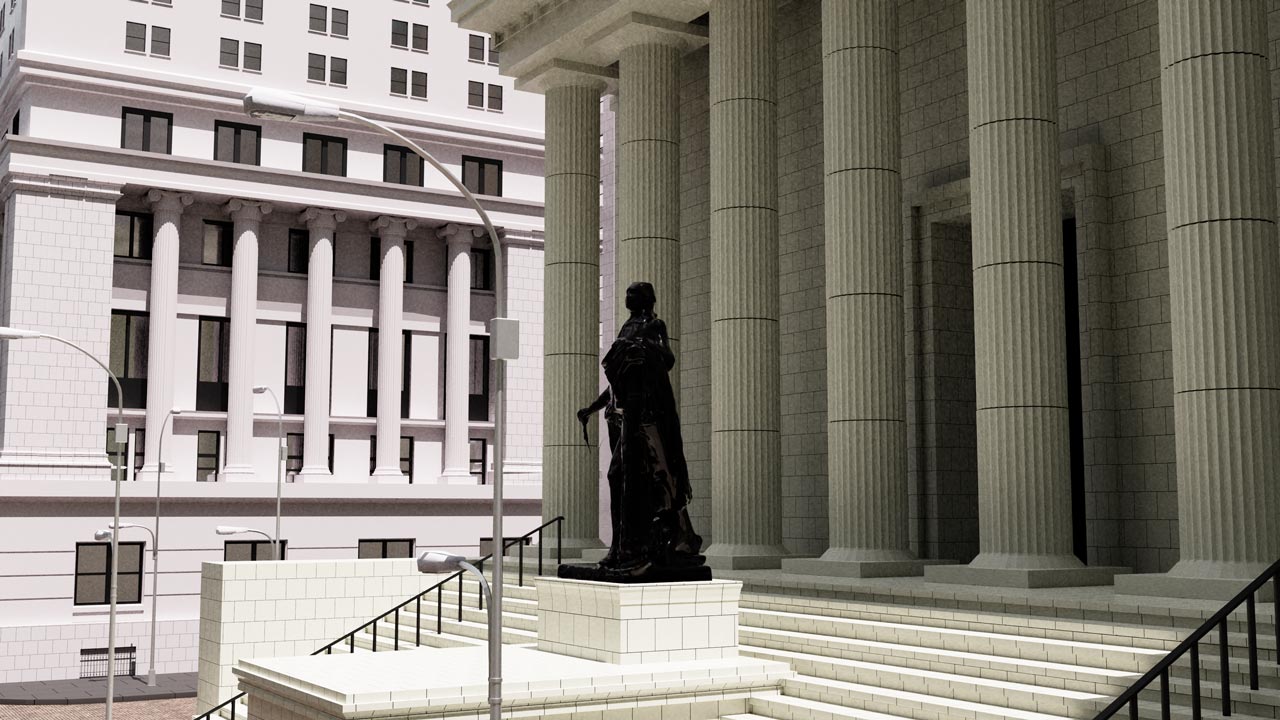
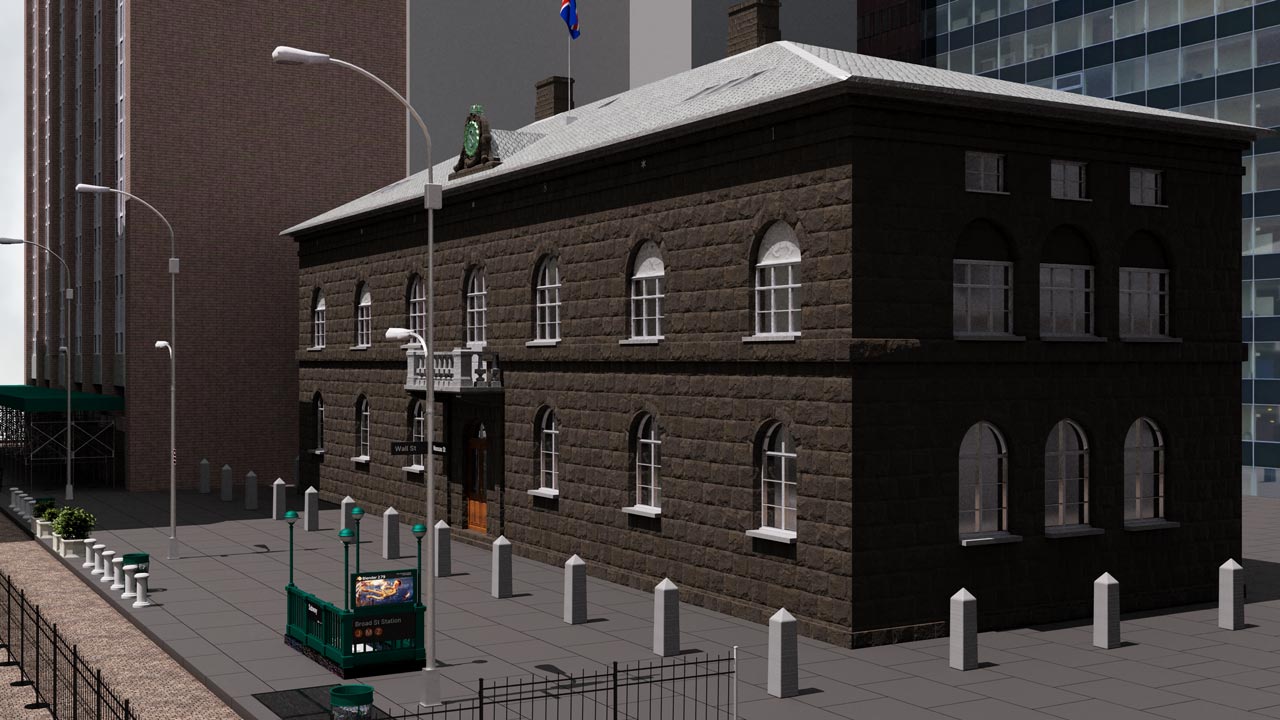
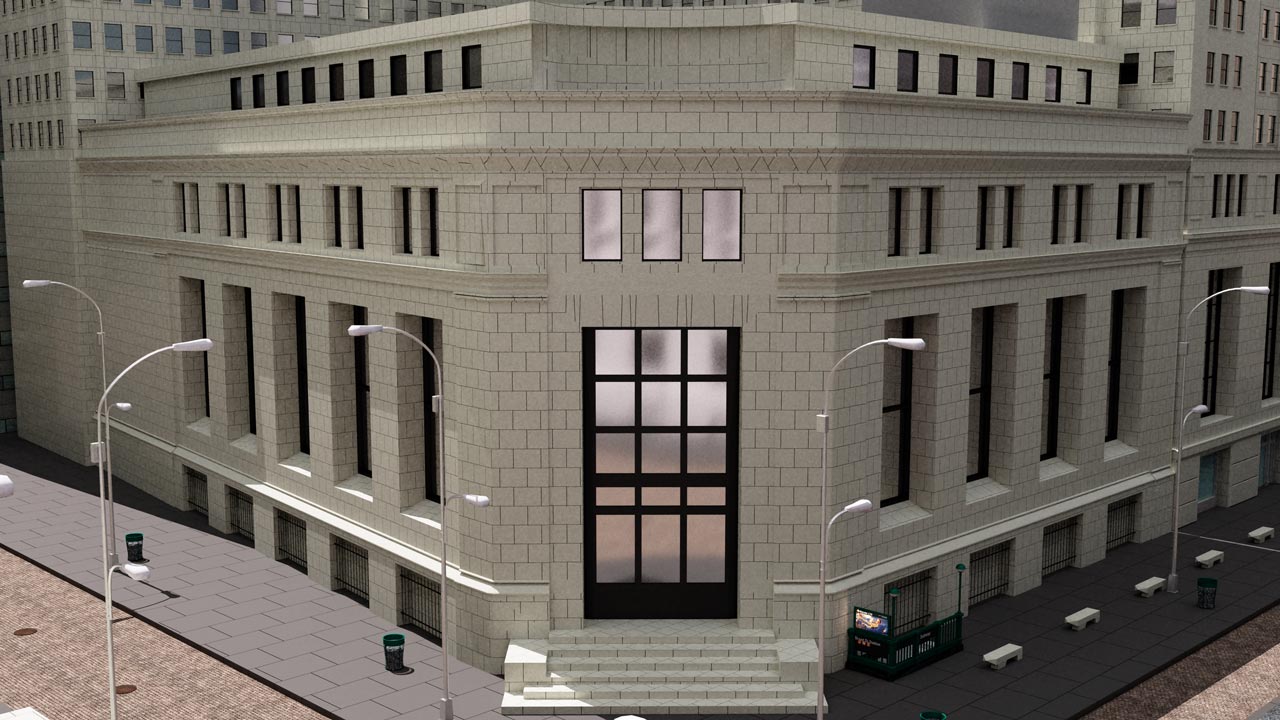
This project takes as its starting point a detail of the 2007-2009 crisis commonly referred to as the subprime crisis. It concerns the implementation of capital controls by the Icelandic government from 2008 to 2017 which prevented foreigners holding Icelandic krona from selling them. One currency, one territory. The New York Stock Exchange, an emblematic building of the market economy, was modelled end-to-end in 3D. The virtual stroll that is proposed here was built in an analogy with the trading systems of world markets.
Between A and B, a purchase order, a camera moves, it passes the controls, the identity and authenticity of A and B must be verified, orders are issued by electrical way between different components of a system and are reflected on the others. Between servers, mobile terminals, from underwater cables to LED screen. This animation shows a pause in this frenzy, it shows a power grab, the architecture here becomes a symbol of the different forces at work in the economy.
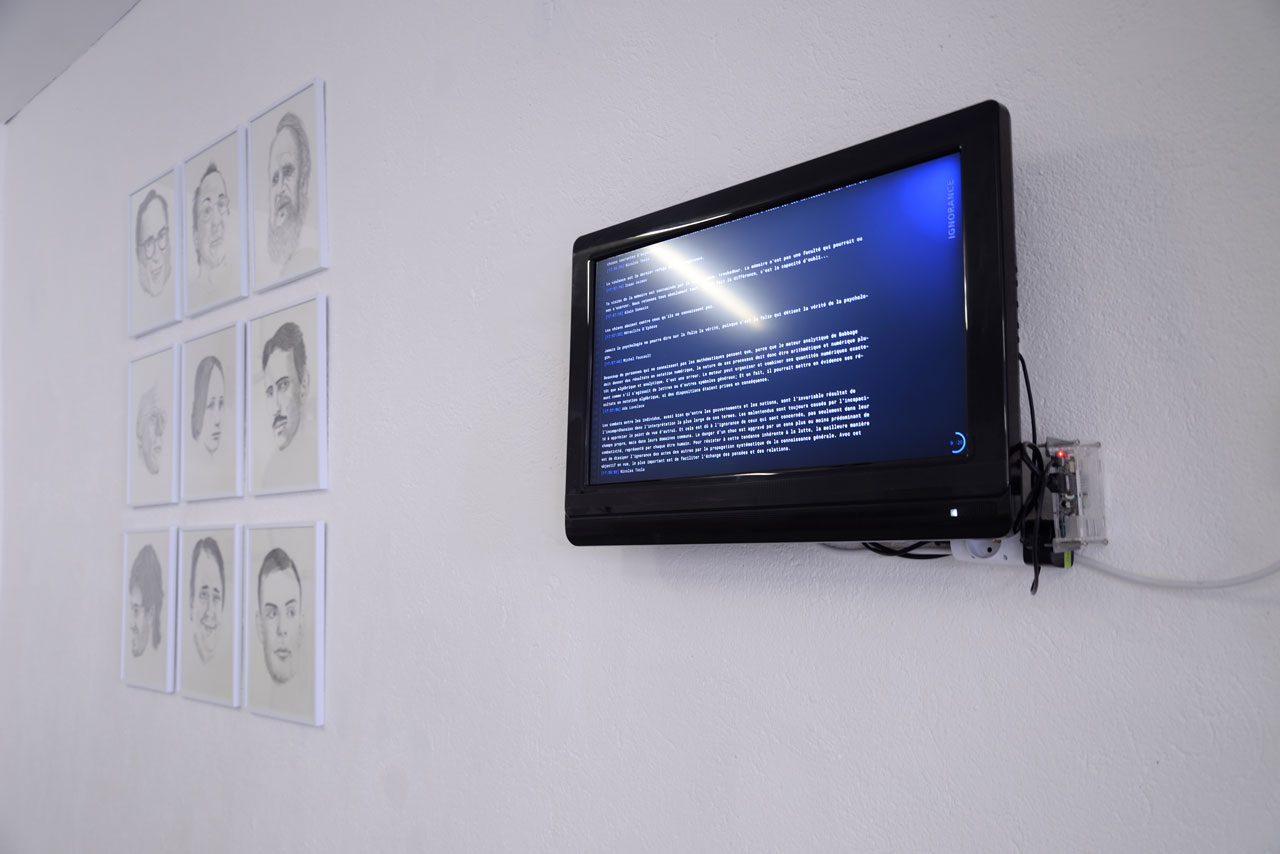
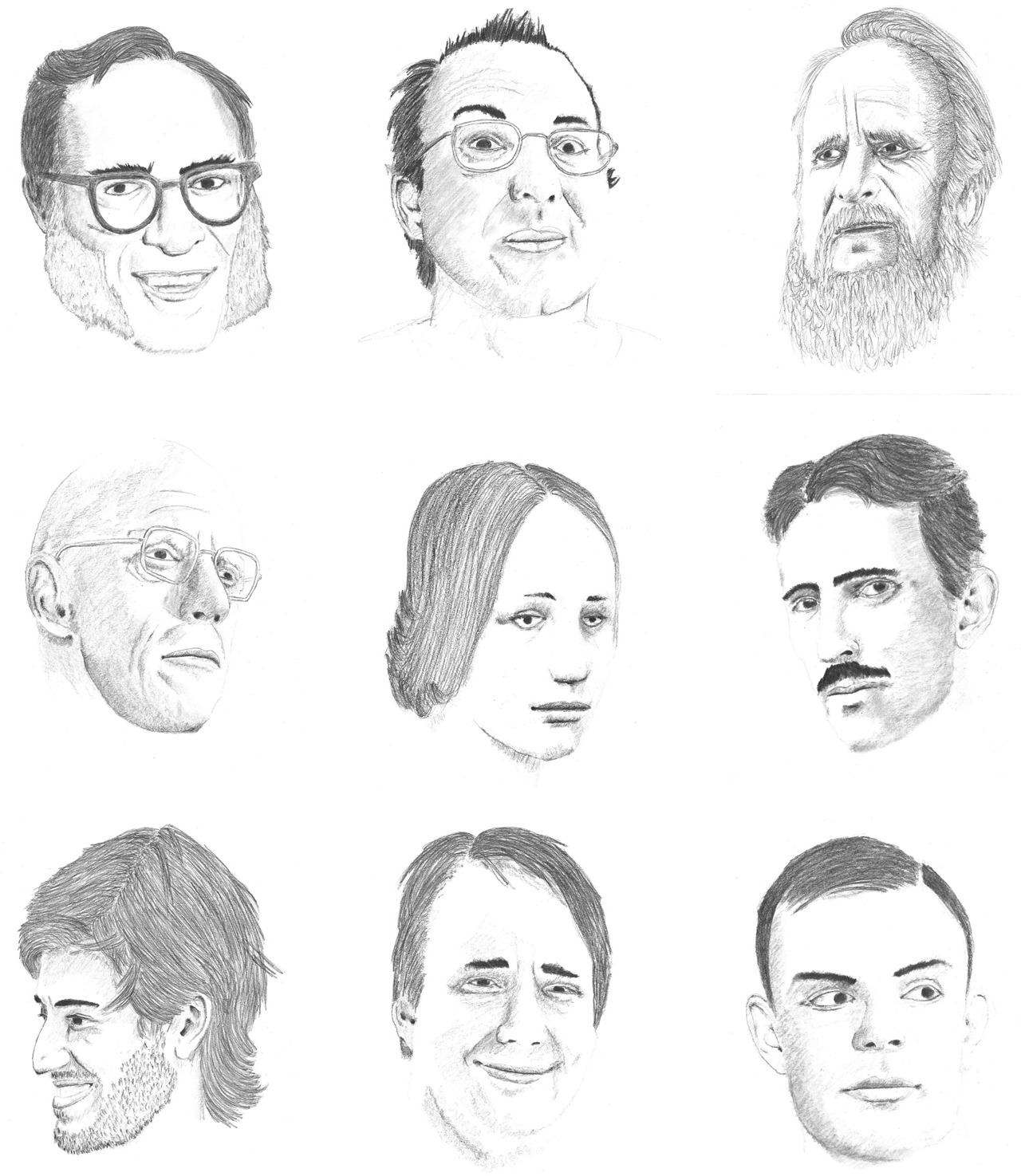
This project, which connects pencil drawing and coding, speaks about knowledge, this group of men is constituted of inventors, scientists, philosophers and writers. They represent differents kind of knowledge.
The digital side of this works uses the look and features of a chat or instant messaging.
The internal function of the chat is corrupted: the different protagonists are not connected right now to the interface. They exist or, in most case, they existed, theirs comments come from archives, then, this chat is not instant, at least, only screen events or animations are directs because these texts existed before the creation of this chat. These messages are chosen by an algorithm to be displayed. This basic artificial intelligence shows us writings of people who have worked or are working for knowledge.
How can we imagine the dialogue or at least these exchanges of comments?
Firstly, even if a text existed, this exchange between these different authors is less clear, for some of them, whose didn’t live at the same time, we can imagine the exchange as nonmutual, previous text can reach the more recent author but not the other way. That is exactly what this program indicates, so, it depicts a temporal discontinuity, we can imagine the place where authors discuss as a utopia, in the etymological meaning: a non place. The purpose of this piece is also differents evolutions of the internet, this is a step backward. Chat is a concept of the web 2.0, the one of social network and interactivity but I used the first version of it, the internet as archive or place to share knowledge, to build a fake chat, a social network parody.
To understand this performance, we have to see it as an happening, the installation of a home sound studio in a shop, not as an attraction for visitors but as a potential place to work, this workshop is functional and it is always show running, a track composed by samples and scores was played by a musician. The interest of this piece is not on the quality of music but in the fate of this matters, the performer plays draft version and modifies it until it sounds good, several operations occur, composition, musical arrangement, mix and mastering. All I do is to set hardware in place with a row track, in fact, we don’t need sounds to understand the purpose of this piece but we need it to trust that this is live composed music or live working musician.
This project is a rework of a previous work, Workshop.
The Island comes from 3D modeling and texturing work. It speaks about digital aspect, changing and fluid. The sea and the clouds remind us a constant move and the ambivalent nature of the island.
For western people, they mean liberty, nakedness, naturalism and permissiveness place. For states, island means isolation. That’s why states use to place prison on it (Alcatraz, If Castle, St Marguerite Island, colonial era prisons…).
The english pronunciation of this word, « I land » should give us the meaning of introspection place or territory, but to understand what island is we have to stop thinking about the merged land and focus on bodies of water.
This island, with its virtual origine deals with isolation, but this empty and closed microcosm might be the place for a new start.
The island is what the sea surrounds and what we travel around. It is like an egg. An egg of the sea, it is round. It is as though the island had pushed its desert outside. What is deserted is the ocean around it. It is by virtue of circumstance, for other reasons than the principle on which the island depends, that ships pass in the distance and never come ashore. The island is deserted more than it is a desert. So much so, that in itself the island may con- tain the liveliest of rivers, the most agile fauna, the brightest flora, the most amazing nourishment, the hardiest of savages, and the castaway as its most pre- cious fruit, it may even contain, however momentarily, the ship that comes to take him away. For all that, it is not any less a deserted island.
– Gilles Deleuze (1953-2002) Desert Islands and Other Texts, Edited by David Lapoujade, Les Éditions de Minuit (Paradoxes)