More random Moiré

This creation is special; it is part of a specific period called #genuary. It’s a month during which creative coders (who want to participate) must create a program every day based on a given theme or prompt.

Each day, hundreds of people share their works on social media, seeking to learn new techniques or applying the ones they have already acquired, invoking their creativity to provide a unique response to the theme using their sensibilities and cultural backgrounds.

More Random Moiré was created within this framework. It corresponds to January 23rd and the theme “More Moiré,” but it is the result of a longer process as it is a creation that I remixed and readapted multiple times during the code challenge.

January 11th / Suprematism

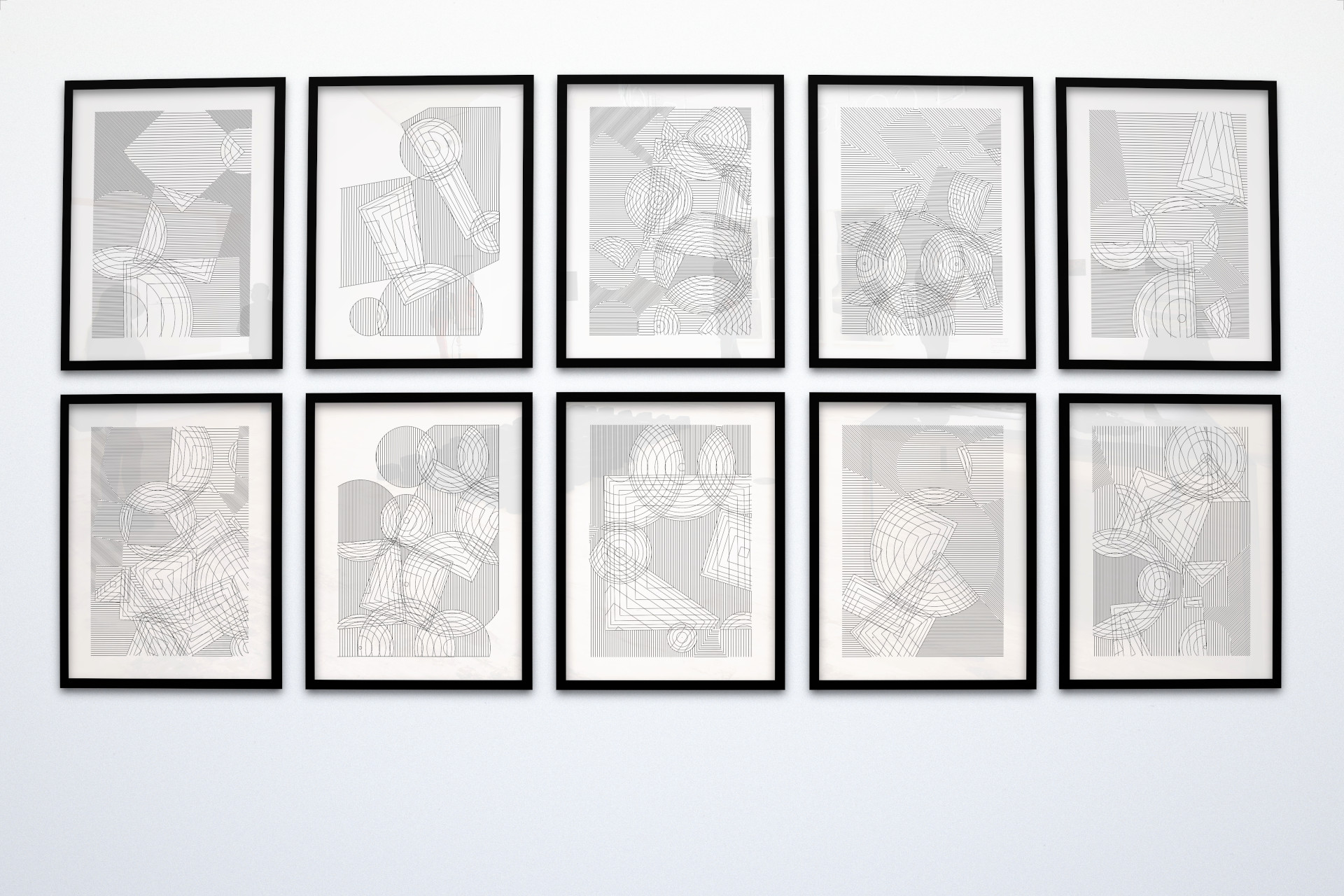
Being a great admirer of Kasimir Malevitch’s work, I decided to recreate his compositions using JavaScript. What strikes me about his compositions is the impression of movement, even though they are just simple geometric shapes stacked on top of each other. To create the illusion of stacking, the program randomly places them while restricting their rotations (by adding a global rotation to the composition).

January 22nd / Shadows

The concept of shadow implies the idea of volume for me. The idea of representing volume intrigued me in relation to Suprematist compositions, specifically the representation of volume rather than actually creating volume.

Therefore, the goal is to simulate volume, which is simpler to achieve without a vanishing point. Cavalier perspective or isometric grids allow distances to be translated and extrusions to be made without dealing with complex formulas. In this program, everything is calculated in two dimensions. It is only necessary to identify, among the six faces of these blocks, the three that will be visible and therefore traced.

January 23rd / More moiré

The idea of using the Moiré pattern on these planes came to me quite quickly, perhaps because I felt the need to correct something. The smooth aspect lacked interest since there were no textures to attract the eye, no gestures or movements for the eye to wander across the composition.


The Moiré pattern then adds depth to these flat shapes, somewhat endangering the impression of volume. Normally, Moiré patterns are created using parallel lines, but here a small amount of randomness makes them intersect. This overlapping creates a texture that gives the faces a rhythm, a sketched aspect that immediately appealed to me. The title here functions as a slogan: “a more random Moiré,” “For a different Moiré.” The idea of using non-parallel lines and thus breaking the main rule of this pattern also seemed very artistically conceptual. After all, who better than Art can break free from rules?
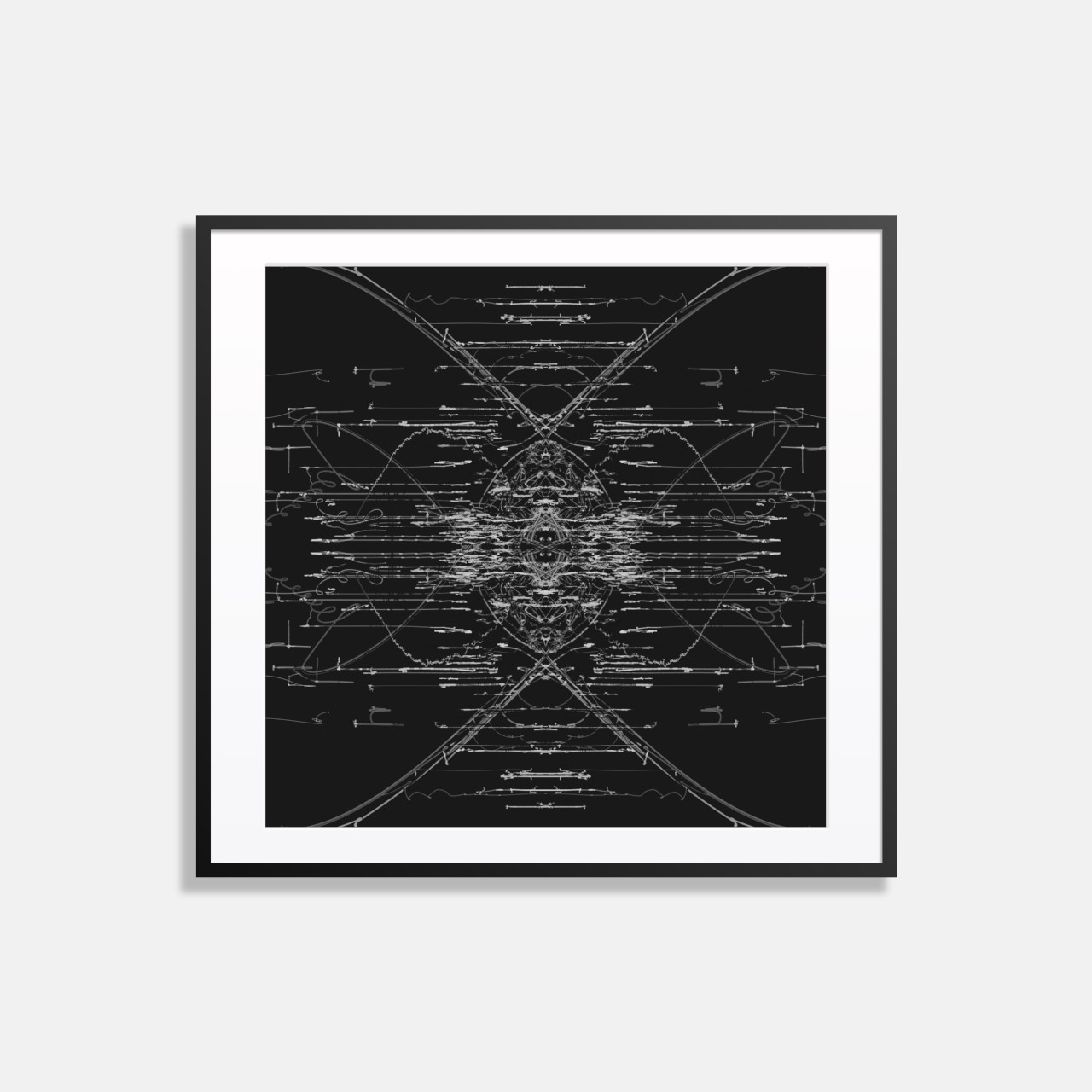
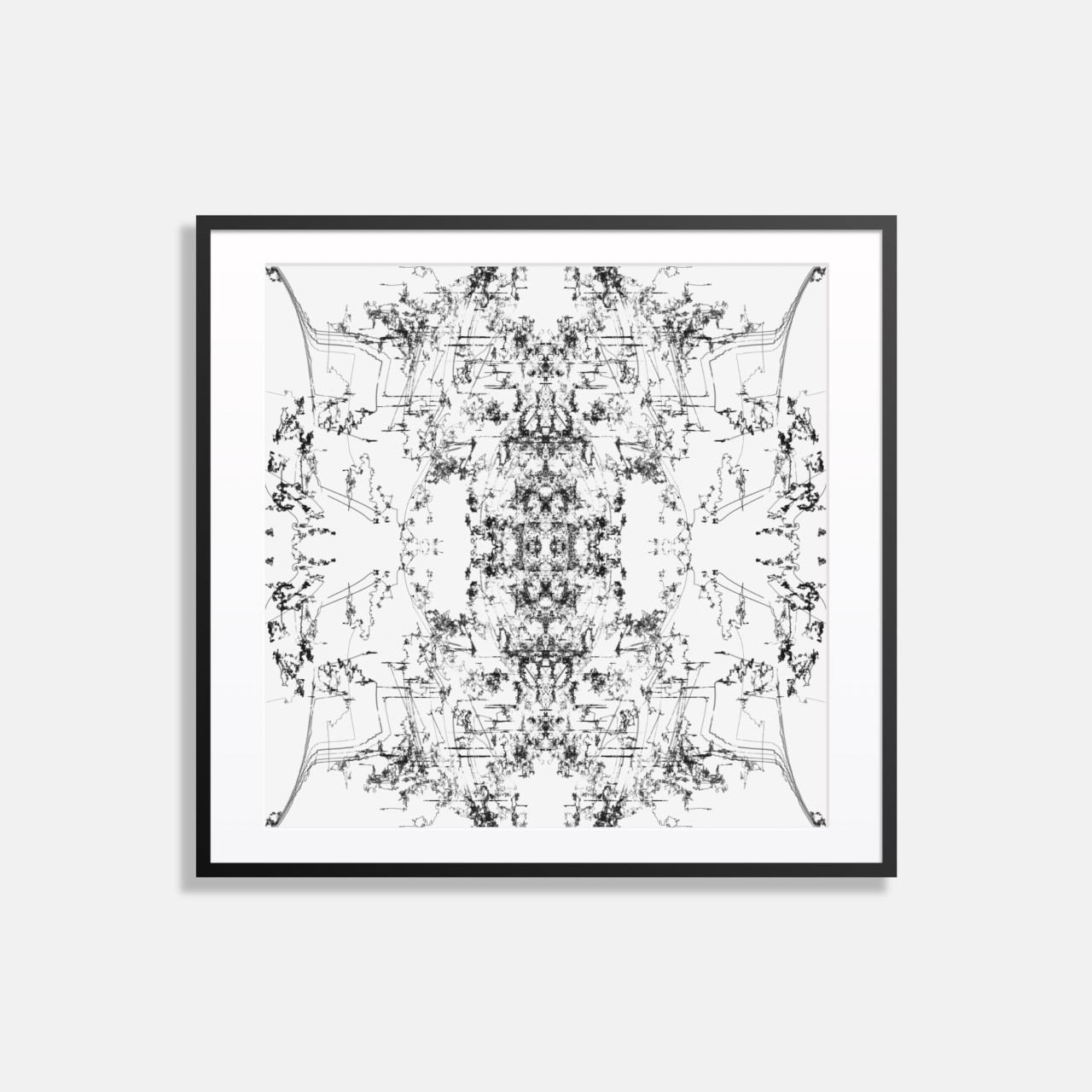
Lost in the attraction / abstraction

In physics, chaos is not synonymous with disorder. Here we are referring to deterministic chaos, which reflects the existence of a group of nonlinear physical phenomena in nature that are sensitive to initial conditions and whose geometric structures are fractals. In deterministic chaos, there is a certain order within apparent disorder.

Lost in attraction / abstraction (single edition on frame)This project utilizes the Clifford attractor to move points. The Clifford attractor is a mathematical formula that allows a point to be moved from its current position using four constants (four numbers that never change). You can see a possible application of this attractor on Paul Bourke’s website.


Most visuals generated with attractors involve a point placed at the center of space that is moved X number of times, often thousands, millions, or even billions of times, while changing its color. With each movement, the point stretches the line, creating curves and convolutions. Everything is determined by the four constants, which are typically within the range of -2 to +2. Sometimes, certain values of the constants can cause the point to never move.


Lost in attraction / abstraction (single edition on frame)The idea behind the Lost in the Attraction/Abstraction program is to use random constants. The problem is that, in some cases, as described above, nothing happens. To address this, a list of possible constants can be created, and random selection can be made from that list. This idea is already employed in the Attractors series, but I wanted to experiment further by evolving these constants. This involves introducing a tiny value to each of the four constants with every movement. As a result, the sketch no longer draws just one attractor but an interpolation between many attractors. In the movement of each point, you can perceive sudden jerks, abrupt changes, and moments of pause.


Entangled shapes

This generative work of squares and circles is a project that explores the intersections between shapes. By using a random approach to arranging the shapes, the artist has created a visual intrigue that invites the viewer to get lost in the details and discover new compositions with each glance.

The protocol for achieving the layout of each shape is relatively simple. The shapes are reduced and each time they are resized, it is observed whether all or part of the shape is inscribed in another polygon. The method used here, “brute force”, is to consider and test all possible combinations. Mainly used to find/crack passwords, here it is used for another purpose.

This approach is above all exploratory, through the randomness and variations offered by the series, the artist himself becomes a spectator of his own practice, since with each execution of the program he obtains a different result. This gives the whole an almost living quality. The progressive reduction of the sides of the forms also adds a dimension of movement and dynamism to the work.

Through this minimalist language of simple geometric forms, the artist deploys a spatial organisation. In these compositions, the shapes are drawn in relation to each other. This system can be seen as a metaphor where each form, each individual is defined or described in relation to its fellow human beings, so that we can see in each of these intertwined forms a relationship with our own existence as human beings.

Formes intriquées / Entangled shapes (43-52.)

Offchain generator

Tes désirs sont désordre

This program takes place in two stages.

Different colored lines are drawn by connecting the cells of a grid. Each line is created by moving from one cell to another without crossing other lines (eight possible directions for each movement).

From these initial drawings, particles of the same color are emitted from the initial paths. These particles follow more curved, organic trajectories (Perlin noise/flow field) than the initial lines.

Thus, we have two gestures that are very different in the trajectories they take. The first organizes the composition based on a grid, while the second projects or diffuses the initial construction. Although these two gestures contradict each other, they allow for the creation of a coherent composition.

The colors for this project are not known in advance. They are generated by randomly placing a first point on a color wheel and placing one or two additional points equidistantly to obtain complementary colors.

During the second phase of the program (animation), the colors merge and blend like acrylic paint, creating new intermediate shades and sometimes shadows.

The triangle balance

This work is an attempt to create arbitrary colors and shapes from three triangles that emit particles (of cyan, magenta and yellow colors). During their short lives, these particles will be pushed to the sides of the grid cells.

Here the palette is not used to fill in shapes, the palette is used to create shapes.

Nested grids

This work is inspired by the work “Pi et plis” (Pi and folds) by François Morellet.

The program starts by defining a main grid, it chooses between a regular grid (where each cell has the same dimensions) and a modular grid (iconic element of Piet Mondrian’s painting and of the De Stijl group).

The program continues by cutting cells from the grid. It determines random lines, which, if they intersect the sides of the cells, will cut them. With each cut, it fills the resulting shapes with another grid. These shapes are added with different blending modes (xor, multiply, difference, screen and multiply) and four different colors.

Degenerative grid

The grid, from my point of view, is an archetype of Minimal Art, this works tends to bring disruption in this rectilinear/straight design.

The program first creates a grid (by randomly selecting a palette from the 18 available). It creates a checkerboard pattern with four rows, each containing four cells.

Next, it copies parts of the grid and repeats them on the composition, following curved movements. It resembles spreading paint, but the initial pattern is not significantly altered. In this process, the copy is pasted at a smaller scale than the original, thus creating new details instead of erasing them.

It is also important to note that each modification it makes can be subsequently copied and duplicated. It is a recursive process, a self-feeding machine running on its own activity.

Entanglement

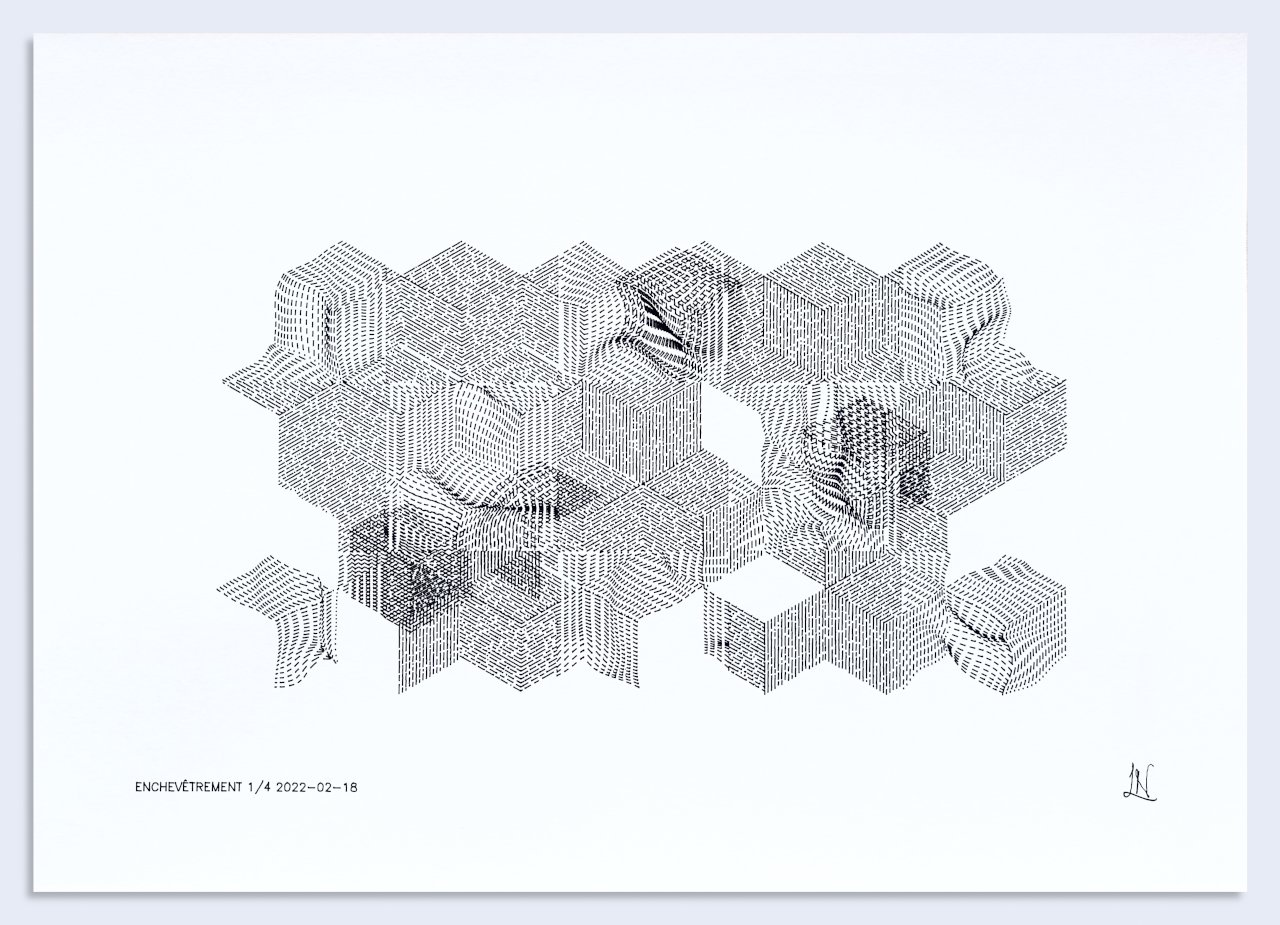
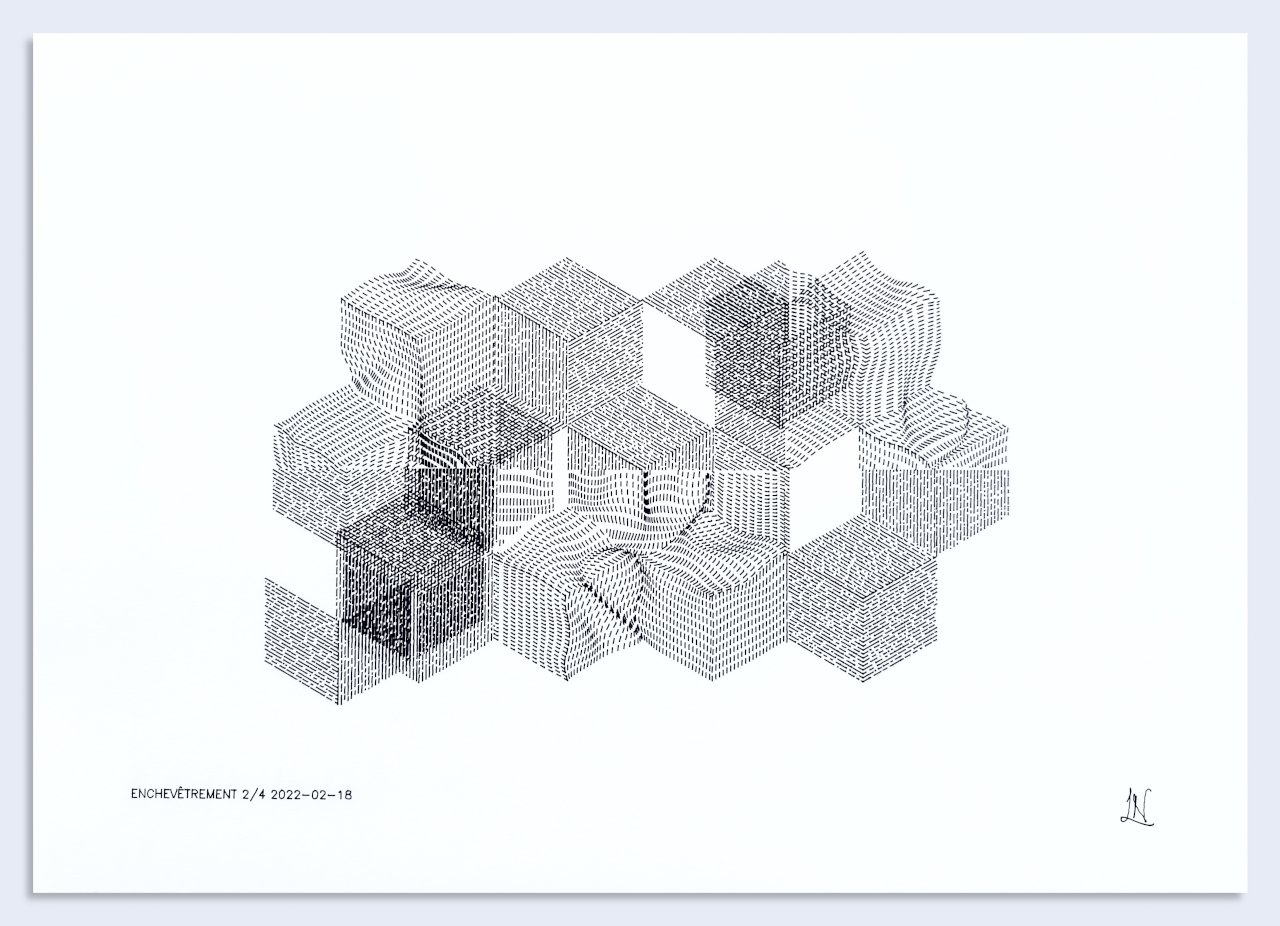
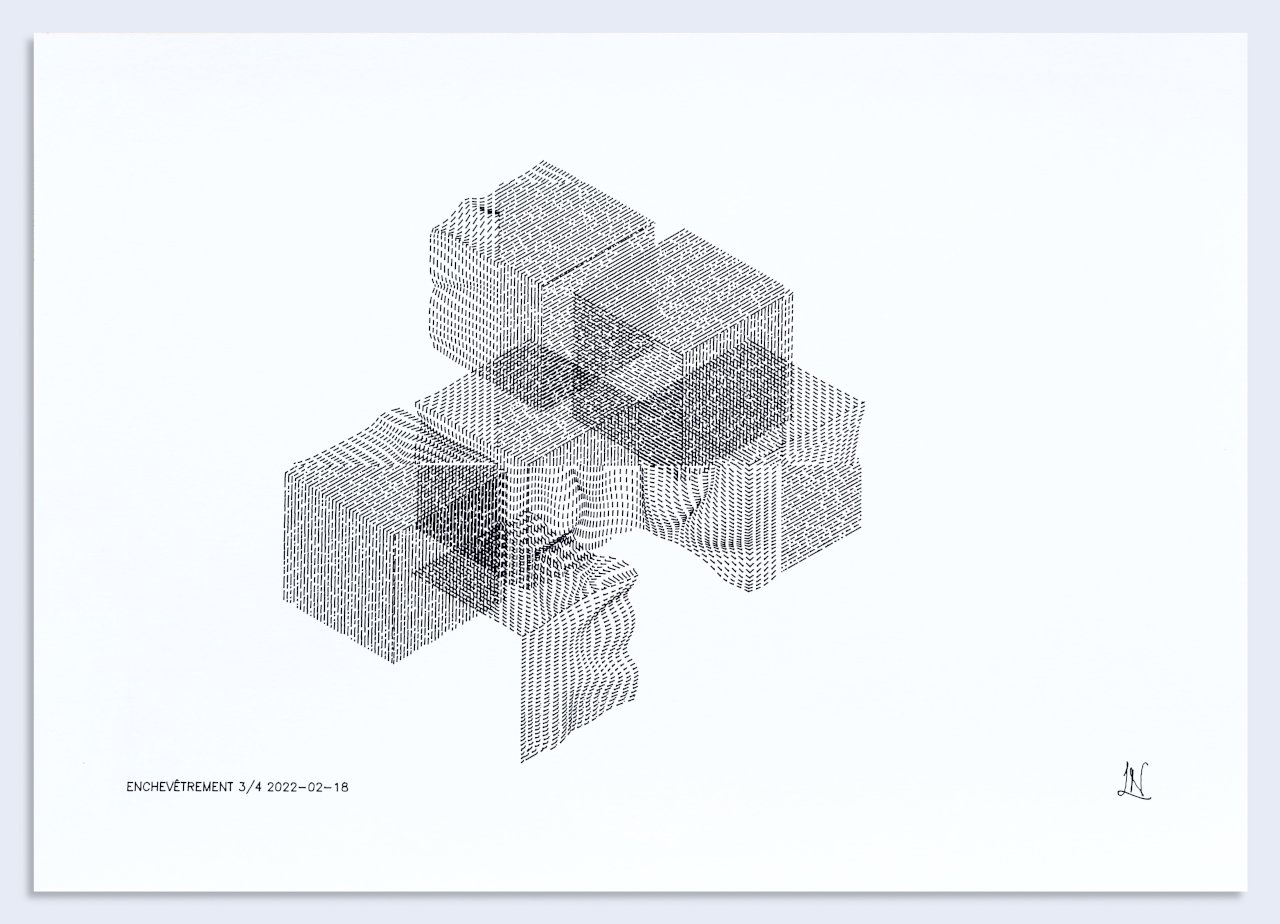
These four drawings are composed of two projections, the first one has three dimensions (isometric projection) and is made of cubes. The other one is less perceptible and flat and resembles a checkerboard. The sides of the cubes are drawn with different types of lines: regular or irregular, and straight or curved, depending on their position in the grid.
If the square is dark – if the sum of the row and column numbers is even – then the lines will have the same spacing and length, and a twist will be applied to them. Otherwise, they will be drawn straight with strokes of random spacing and length. It is less a question of superimpositions than of making two organizations of forms coincide. One of the two projections is underlying, supporting the other which makes it visible.


Vanishing points

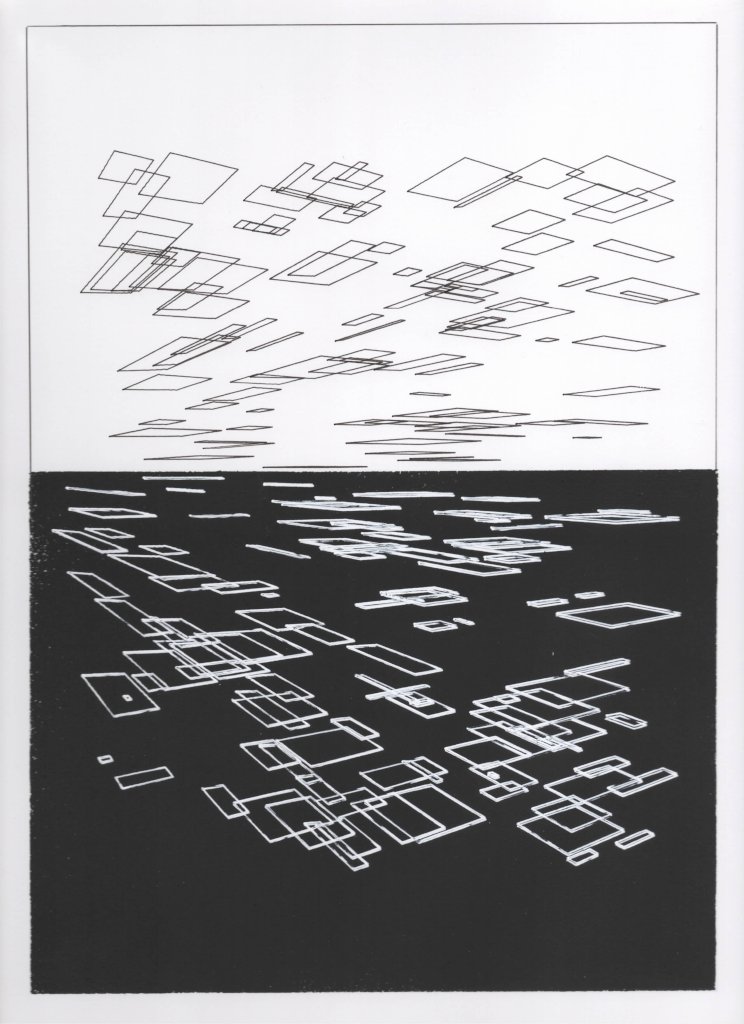
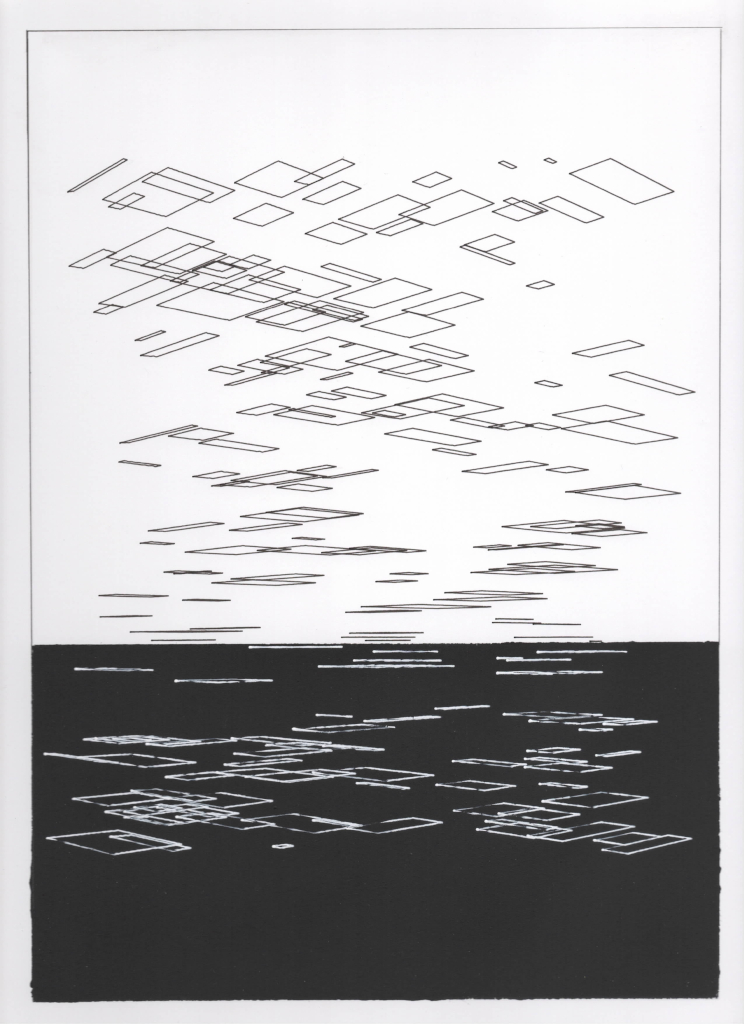
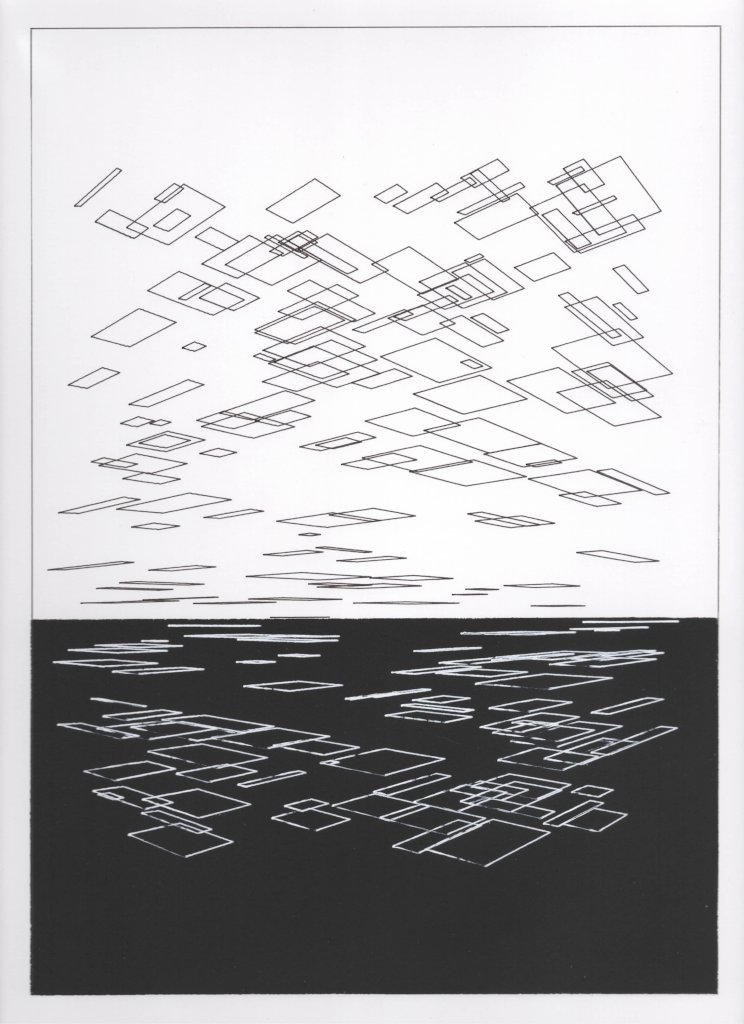
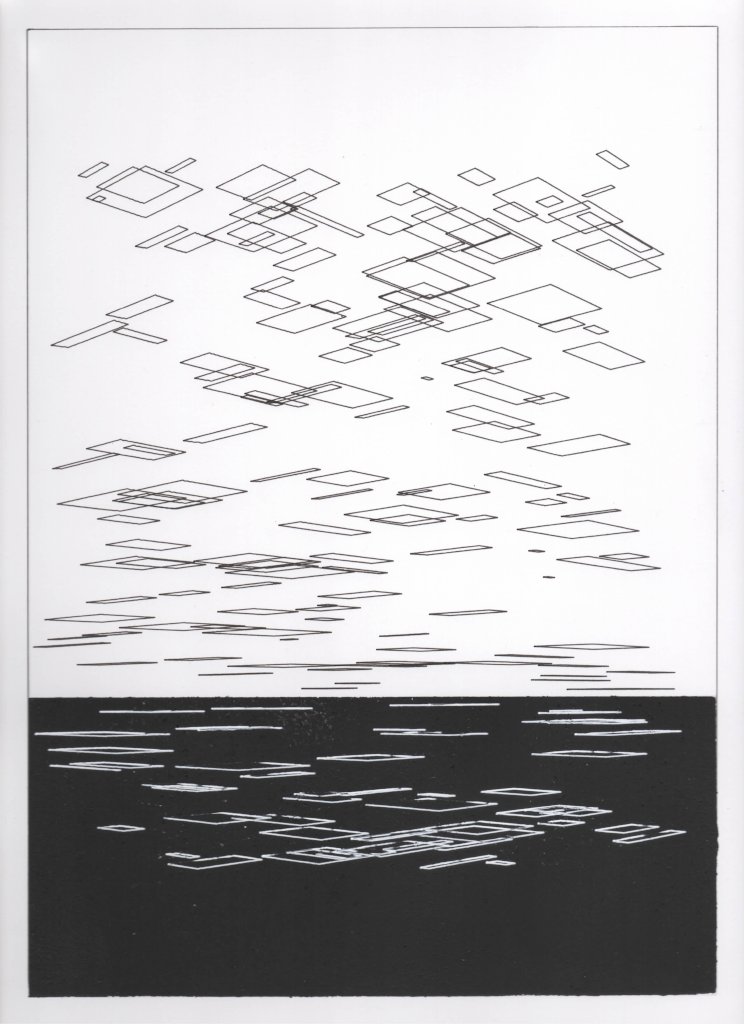
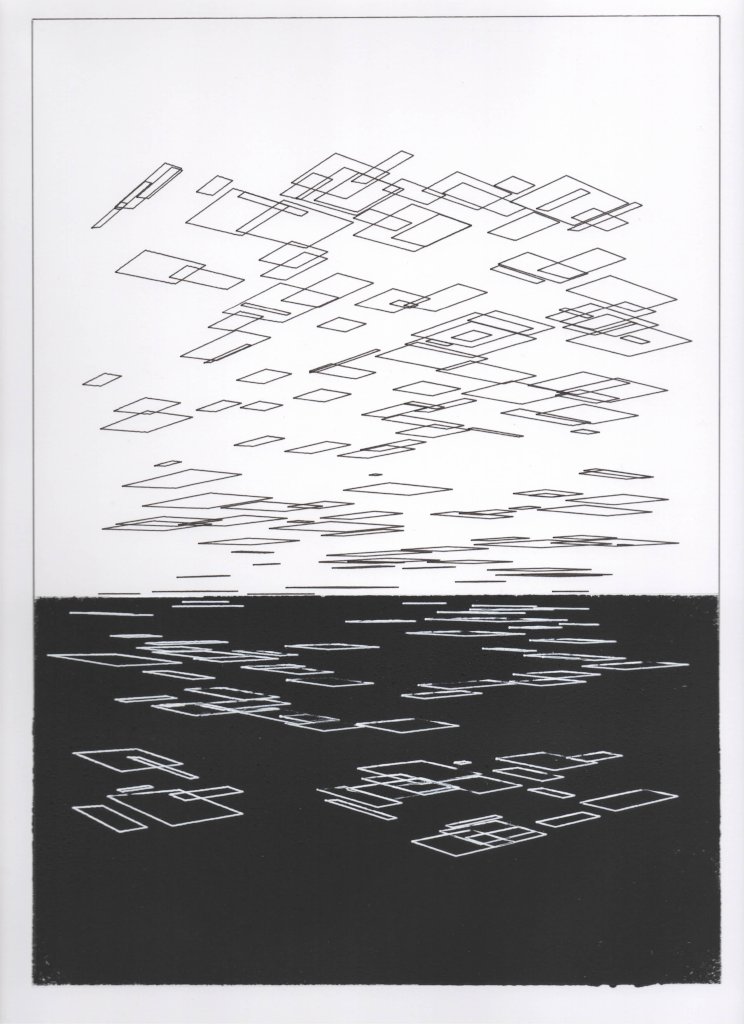
Four hundred rectangles are arranged on either side of a horizon line. Despite the seductive aspect of the entanglement of these forms, the subject is indeed space and the way humans perceive it. Each drawing has a frame that is composed of an upper part where the sheet is raw and a lower part painted in black. On the five variations that make up the series, one can distinguish that the horizon is more or less high or low. This is due to the generative nature of this composition since the two vanishing points have random positions, therefore, different from one drawing to another. The rectangles are also randomly placed and their main function is to point to the vanishing points located outside the frame (on the right and on the left). There is a kind of interdependence between the visible points – the vertices of the rectangles – and the invisible points where the vanishing points converge, each existing only because of the other.


Degenerative architecture

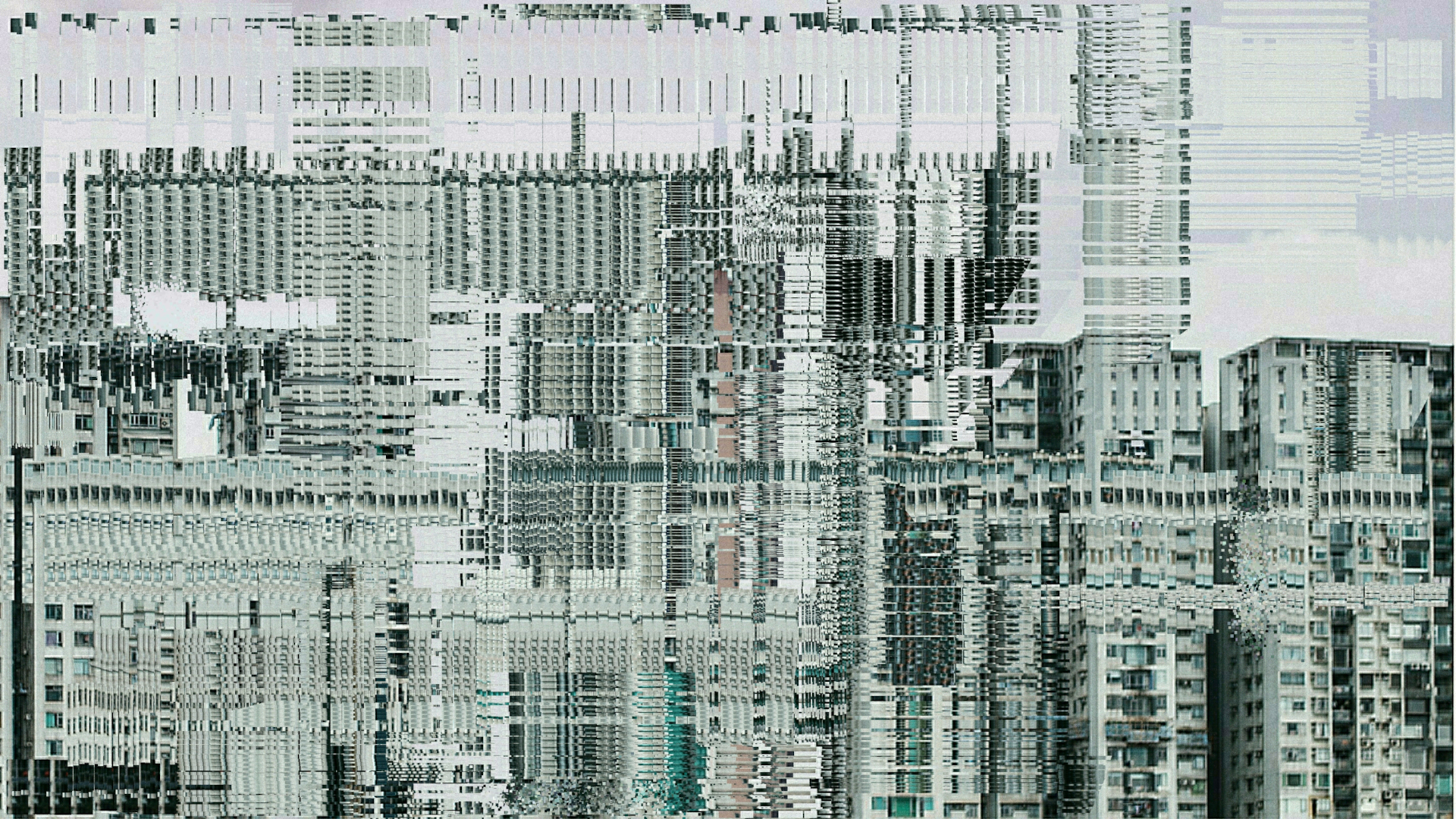
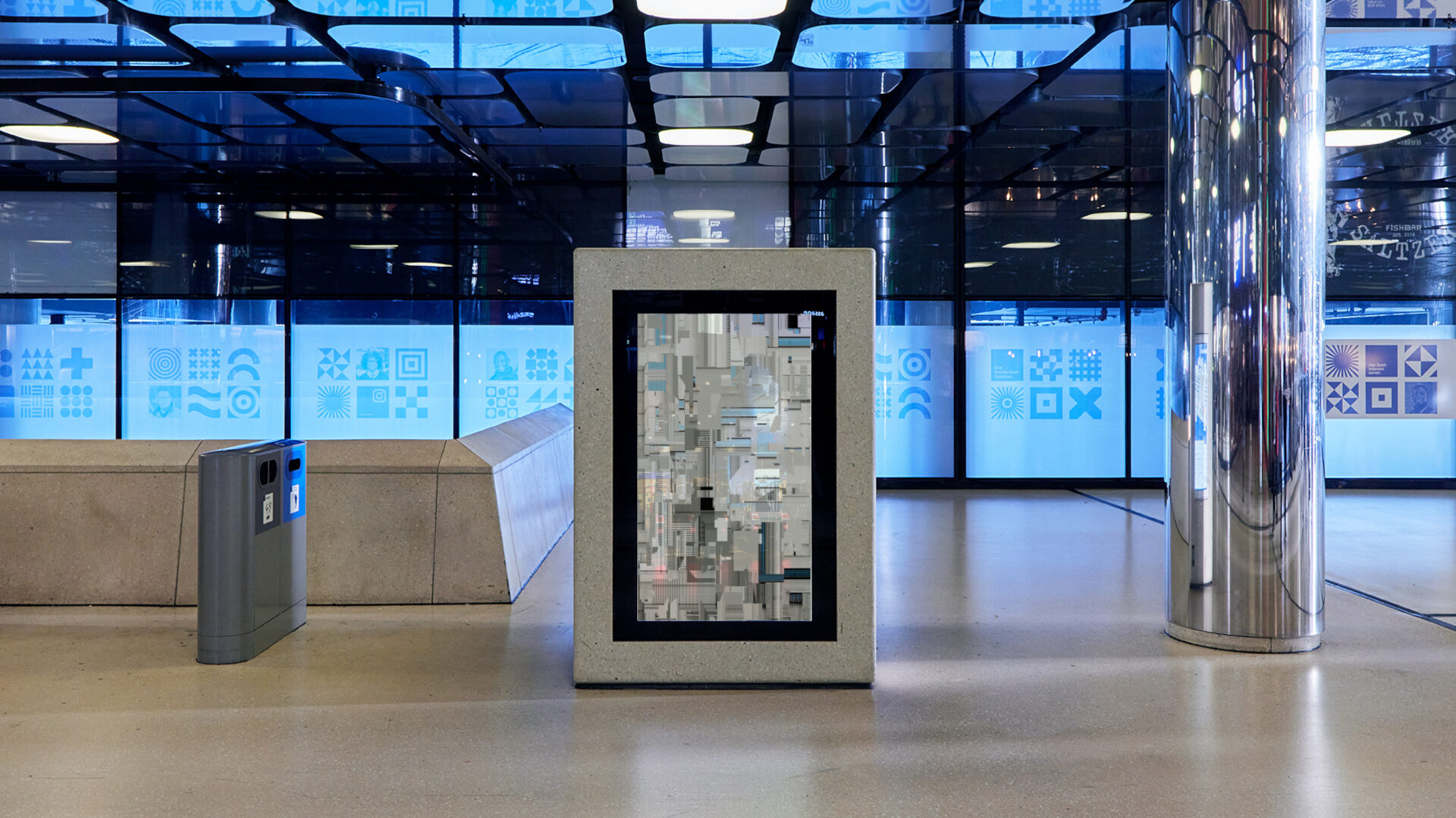
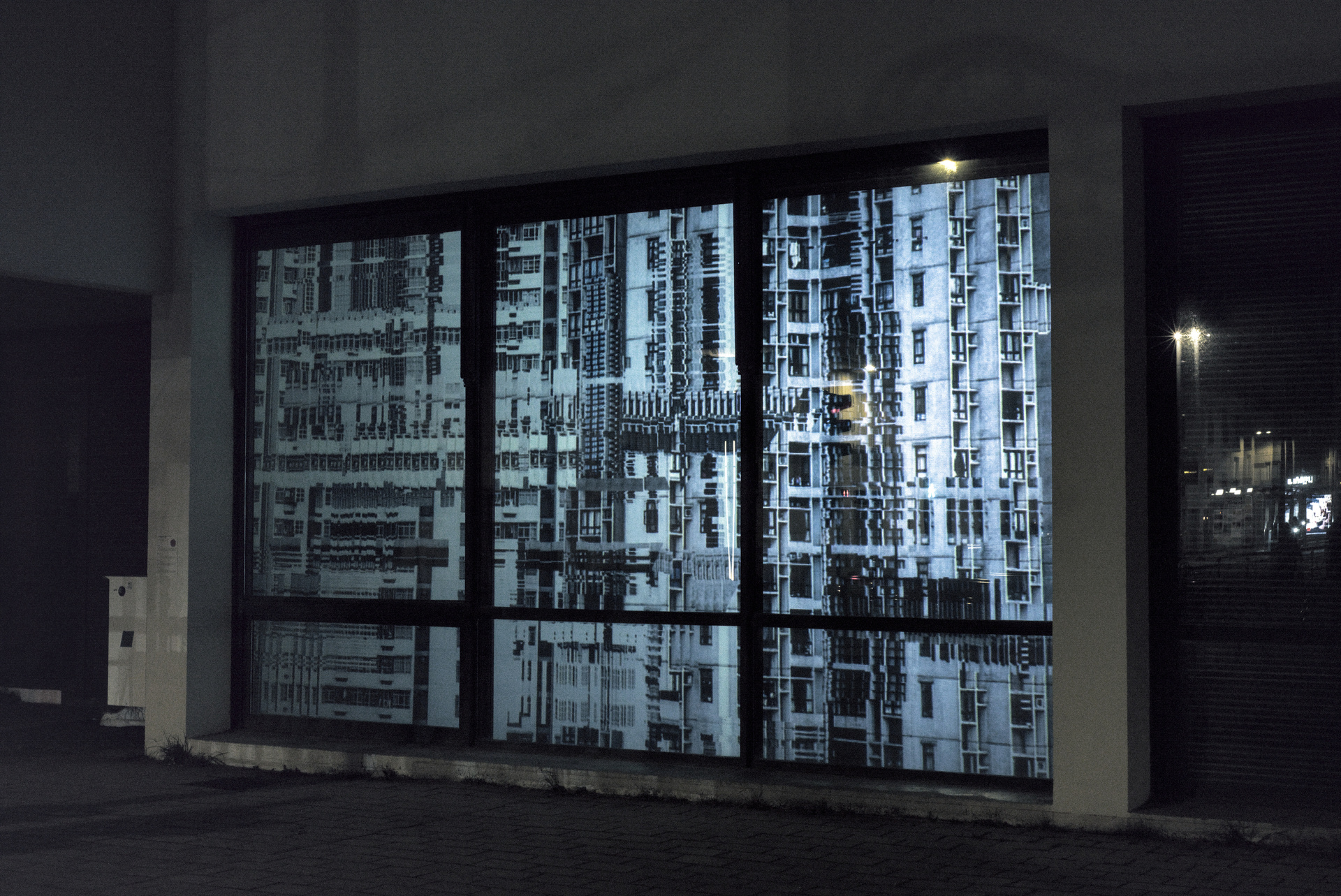
The starting point for this project is a group of residential buildings. Each façade, each plane, is altered by a program that duplicates portions of the image on a random axis. Each time this phenomenon occurs, a sample, this time sound, is played by the program.

The sequences are thus orchestrated in a synchronous manner between the alteration of an image and the triggering of a sound. This process is repeated in a parallel montage between several locations as if a phenomenon were occurring at the same time in different places.

The sequences alternate between different buildings (Hong Kong, San Francisco, Guangzhou, Shanghai, Chicago). The alteration continues, this process is irreversible because from a certain point where the programme has used all the sources of images available to it, it will replace the original image with an image that it has produced itself. It is a machine that runs on empty and in which each photograph is exhausted by its own copy.

The habitat is segmented, contracted, until it no longer becomes a reality but a representation. Halfway between a science fiction illustration and a constructivist painting, this experimental animation shows the construction of a painting that never stands still.


 Photography sources

PlacesAuthorsLinks
Hong KongAnnie SprattMdijqynYQg8
UnkonwnCarl Nenzen Lovenmbfile7XE44
ChicagoChris Quintero1vRSJP2V9Nw
San FranciscoDaniel AbadiaeQUEEHYmLCE
Hong KongJohannes MändleJttyHMcXAns
ShanghaiPete WrightmT9d7GFl1Zs
GuangzhouScarbor SiuUYG5IUPoWIo
Hong KongTimelab ProxfDnqMh__UQ