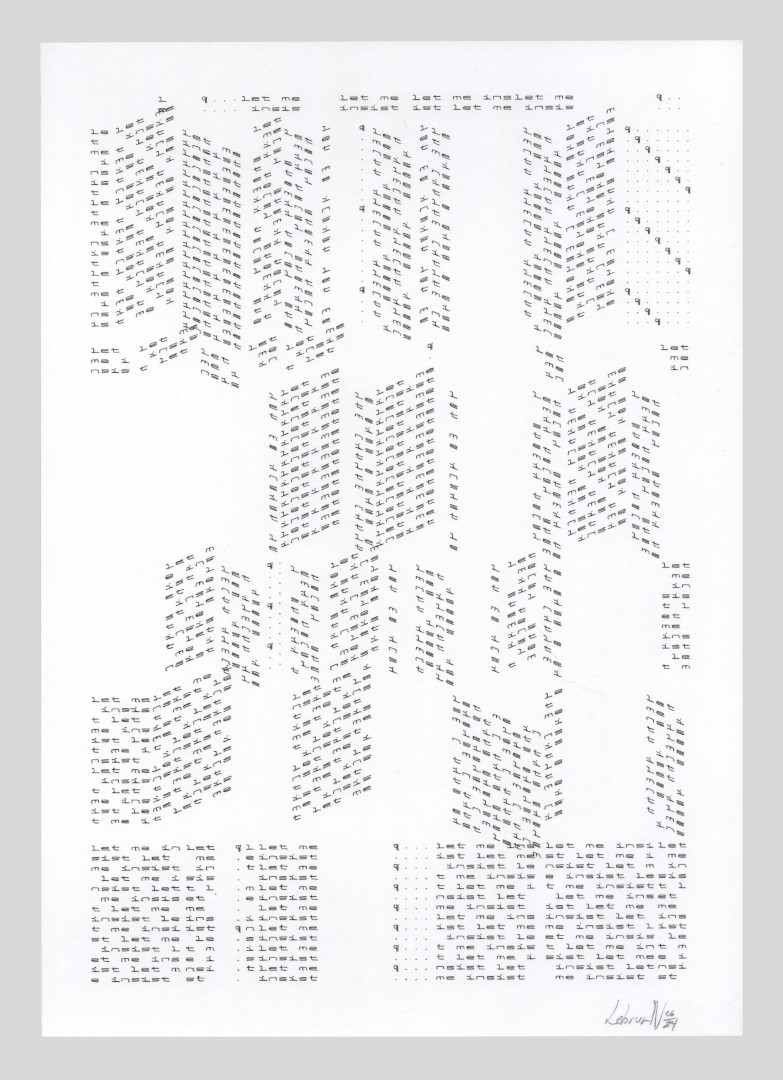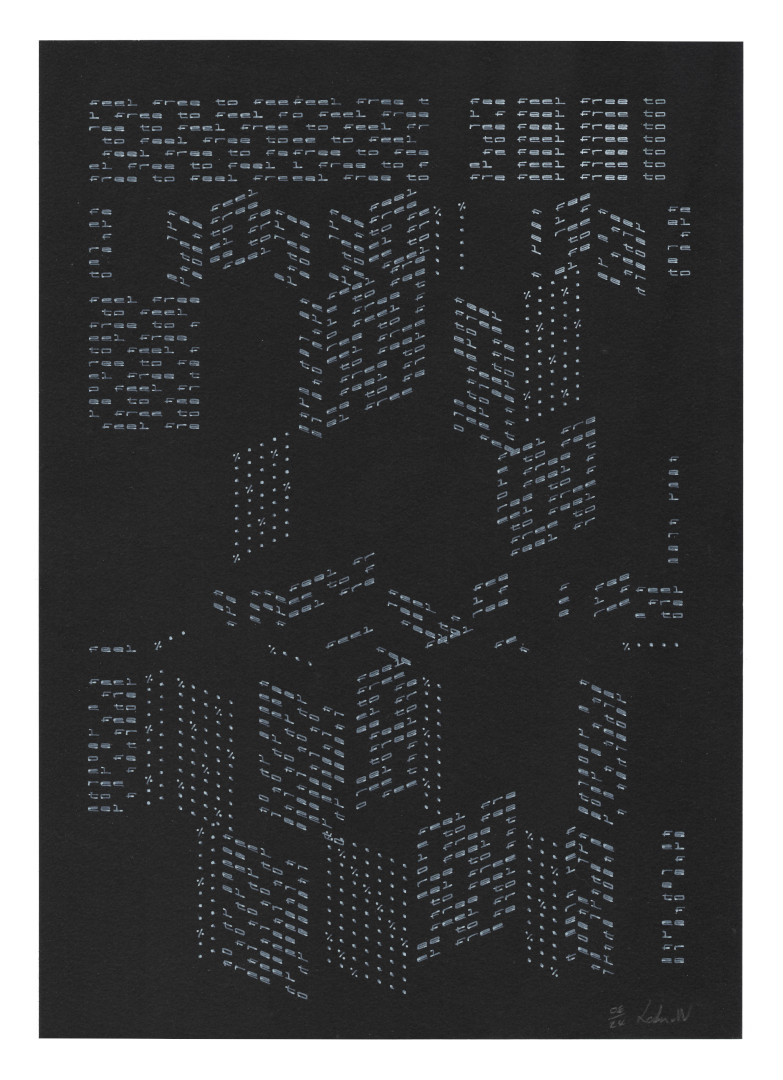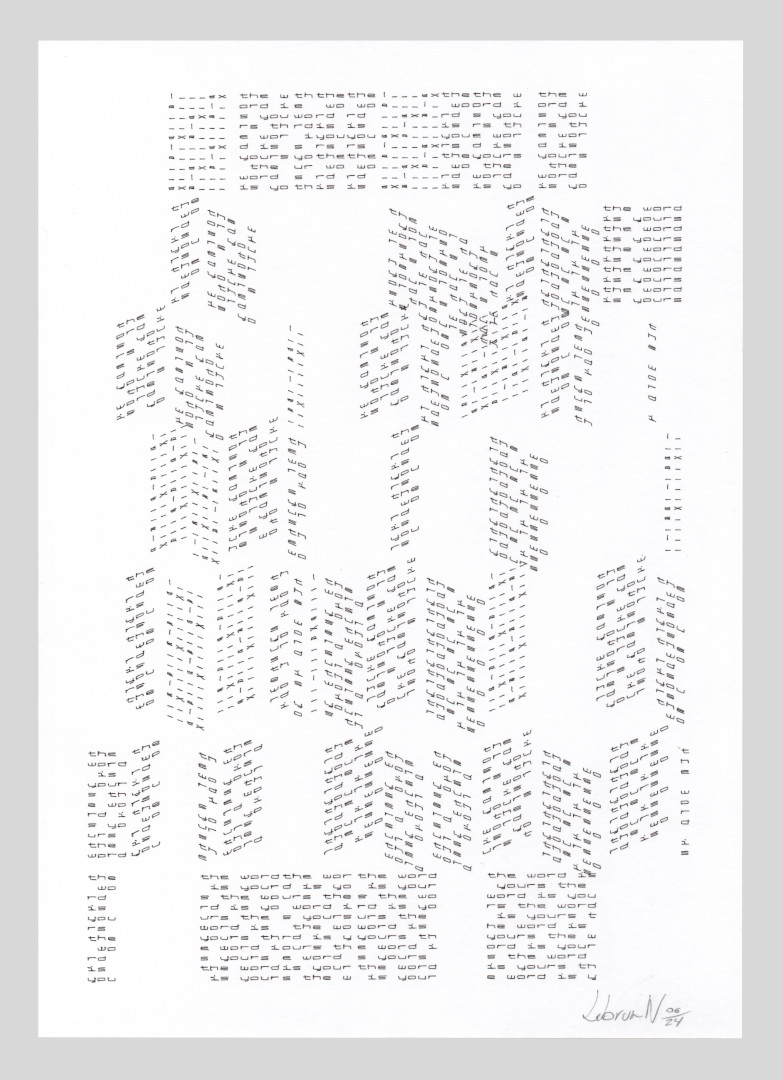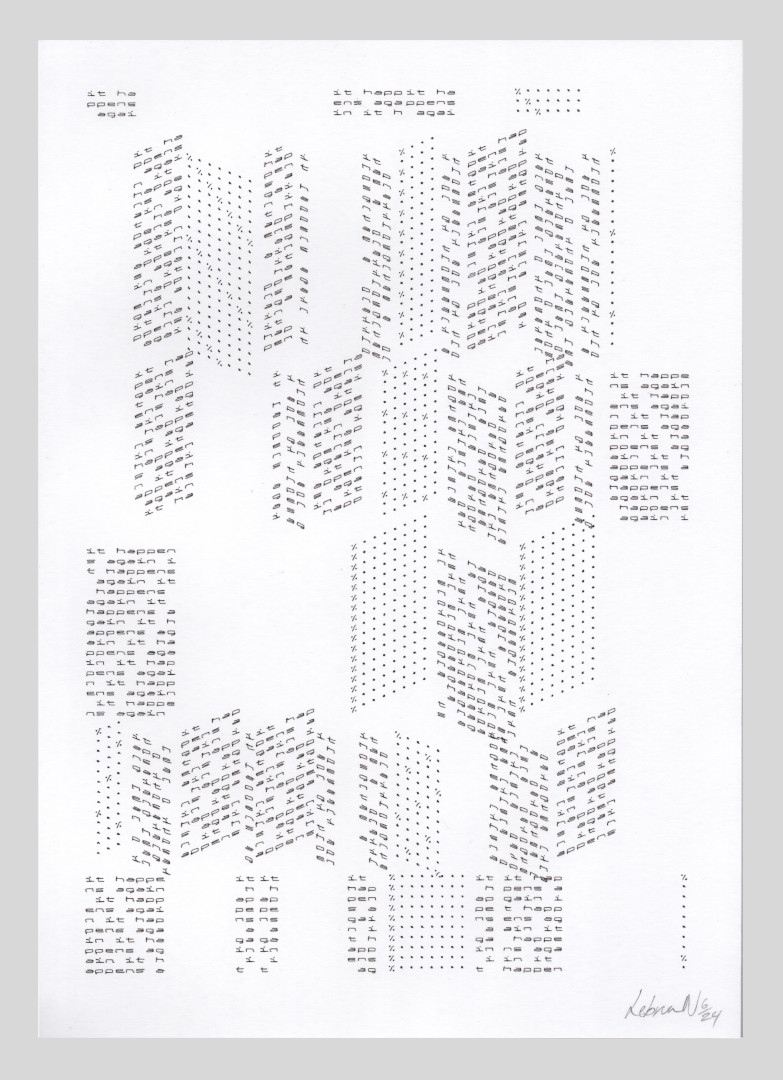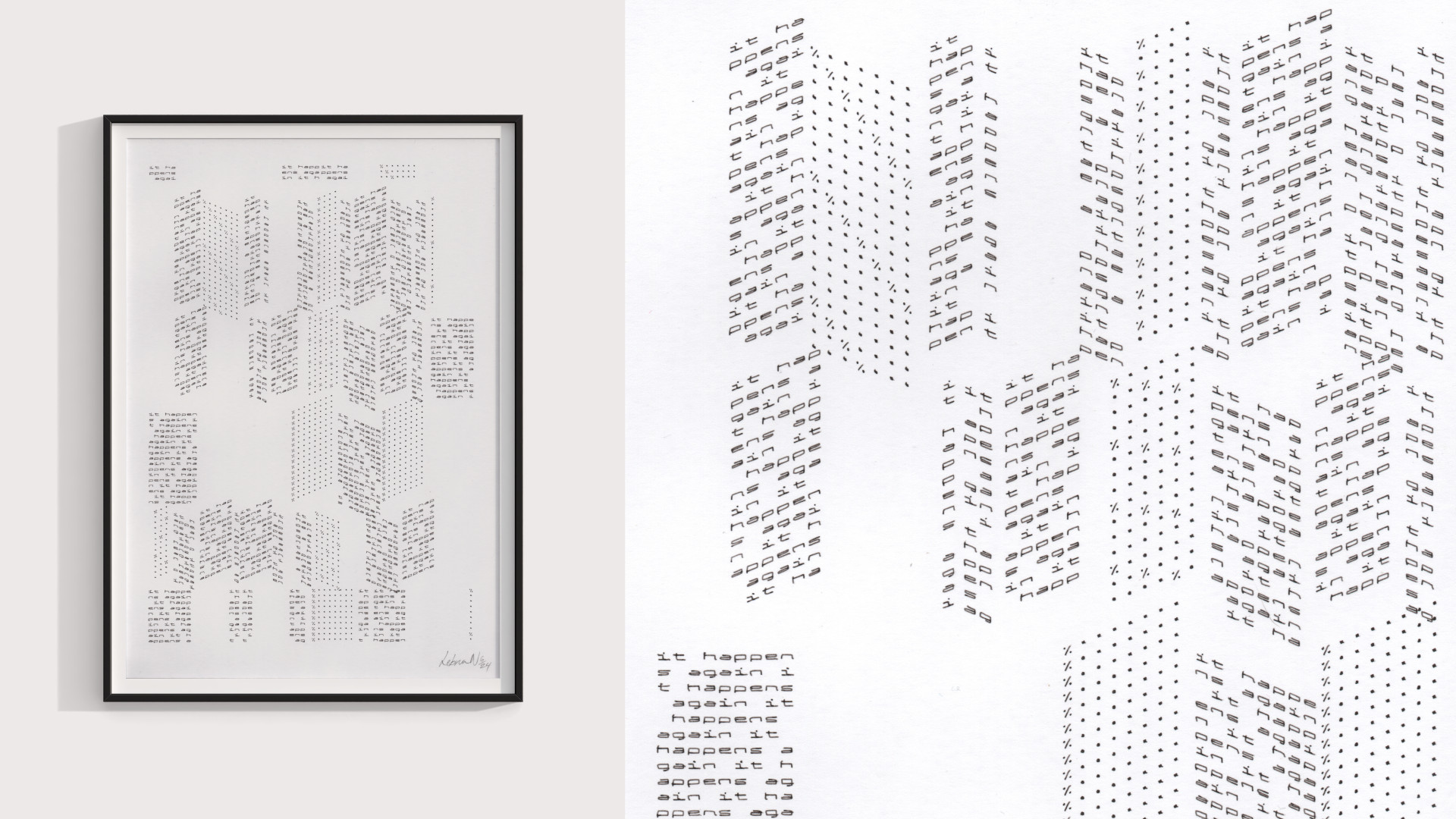
Rotring (plotter), Bristol paper, 21 × 29,7 cm, 2024.
This series of program-generated calligrams operates through a dual textual system: one sequence produces rhythm and motif, while another deploys phrases or nominal groups. Sentences are distributed across a grid where some cells remain empty while others contain text or isolated punctuation. The cells are sometimes tilted, creating the illusion that language has been projected onto cubic surfaces—a visual device that transforms the flat page into an implied three-dimensional space. Text repeats within each cell as long as space permits, forming patterns that literalize the computational logic of the loop.
The work situates itself within the genealogy of 1960s-70s generative art while exposing a fundamental property of computational text processing. Through systematic repetition constrained by grid cells, language approaches exhaustion: the written word progressively loses its semantic charge as letters transform into purely visual signs. What begins as readable content degrades into pattern, texture, material. The loop—that fundamental programming structure—becomes both compositional principle and instrument of semantic dissolution.
The tilted cells establish a crucial tension between surface and depth. By suggesting projection onto cubic faces, the composition creates a perpetual instability between reading (which requires a stable plane) and viewing (which registers depth and rotation). Flat text forced into implied volumetric space generates a spatial ambiguity where language can never fully stabilize as either meaning or image. The grid becomes simultaneously a reading surface and a projection screen, each cell a facet of an impossible object.
This process materializes a fracture internal to language itself when subjected to algorithmic processing. The grid enforces a spatial logic indifferent to syntactic coherence—cells filled or emptied according to programmatic rules rather than narrative necessity. Punctuation isolated in its own cell becomes abstract notation; words repeated until rhythm supplants sense. The instantaneity evoked by the composition suggests not the speed of comprehension but the instantaneous collapse of semantic stability when language becomes iteration.
What remains is a visual archaeology of computational logic: the loop made visible, the grid as organizational principle, the cube as projection surface. These calligrams do not mourn the transformation of text into material but observe it with clinical precision. In an era where language is increasingly fragmented and recombined by algorithms, these compositions reveal the operational substrate beneath all linguistic exchange—the moment when words cease to communicate and begin simply to occupy space, to repeat, to pattern, to materialize the mechanical processes that now constitute so much of our textual environment.