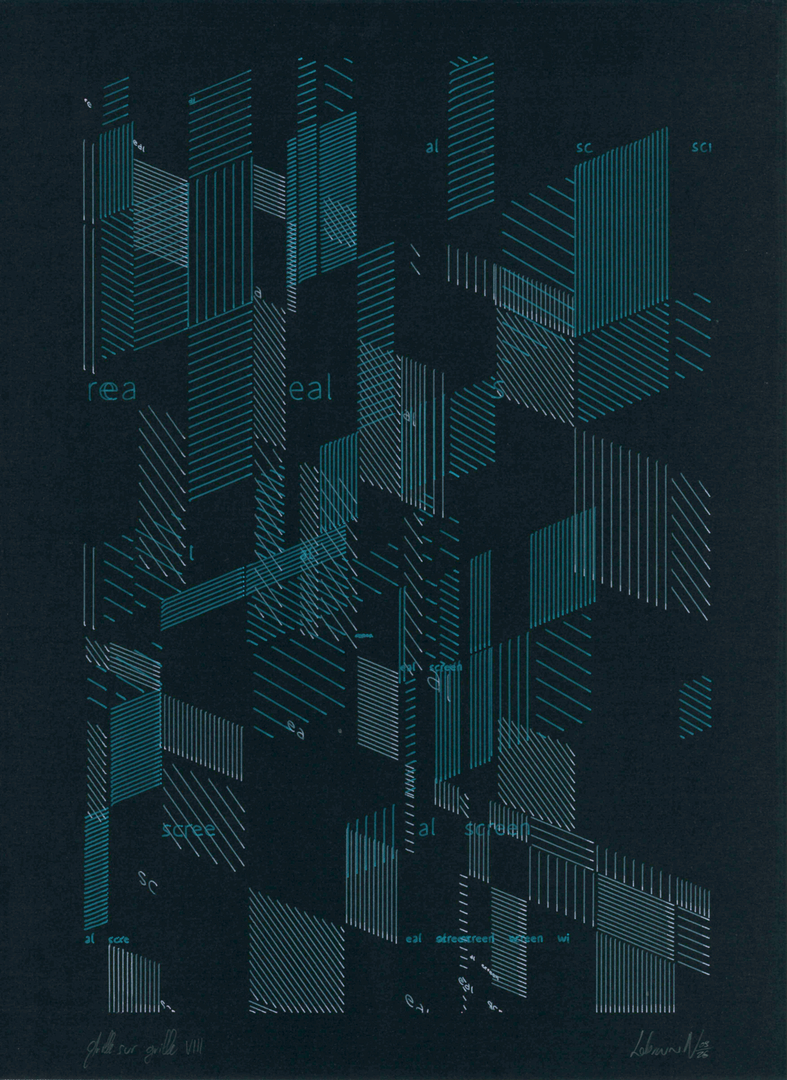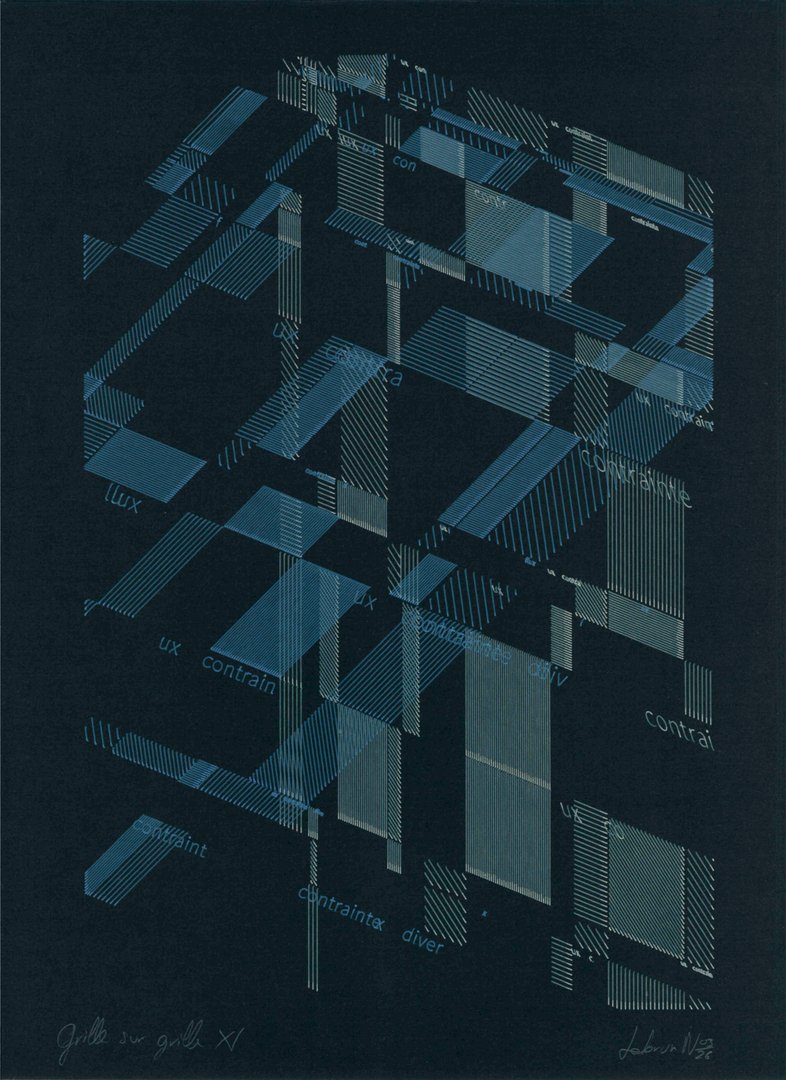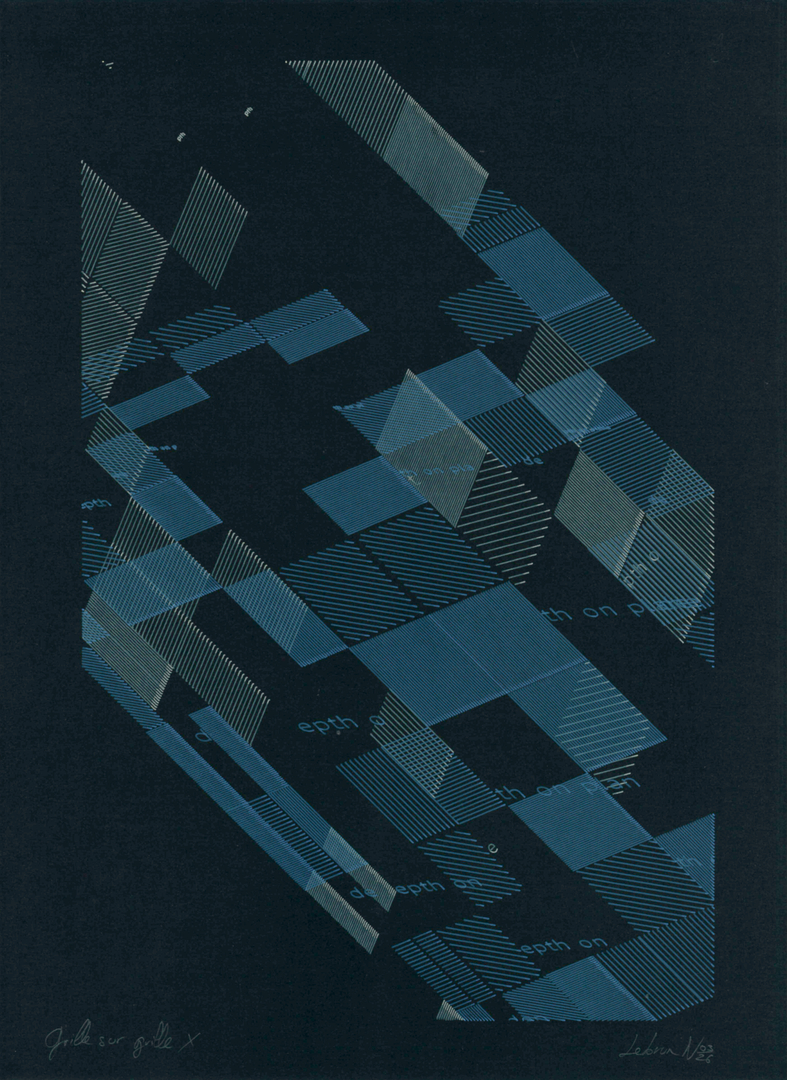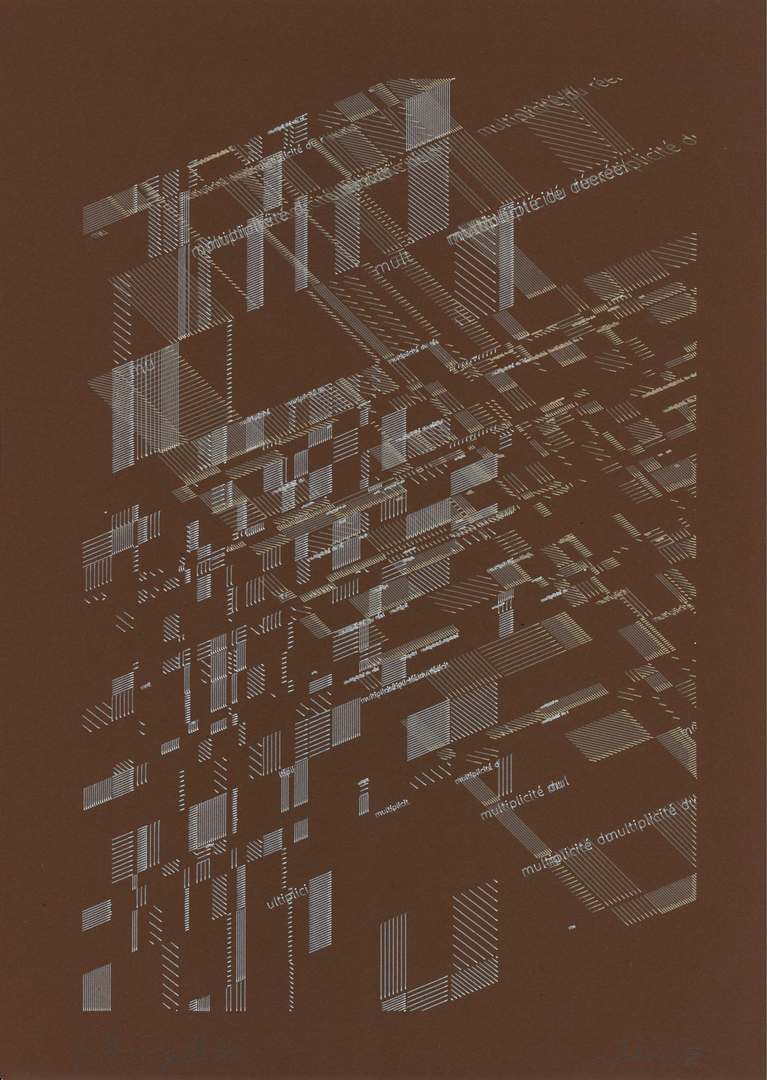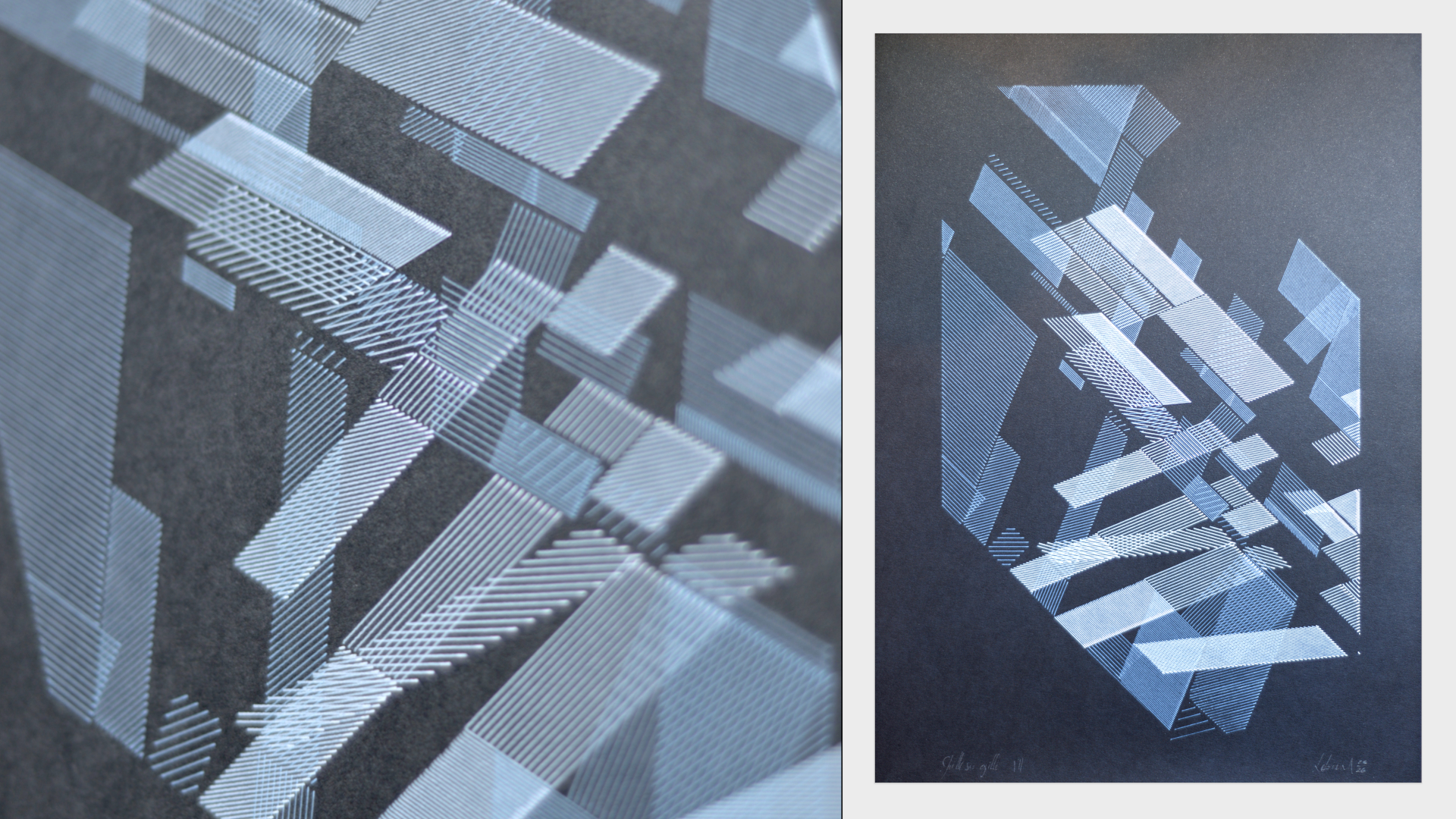
JavaScript programming, plotter, Rotring, 12 editions, multiple inks, various papers (weight and colors), 29.7 x 42 cm, 2026.
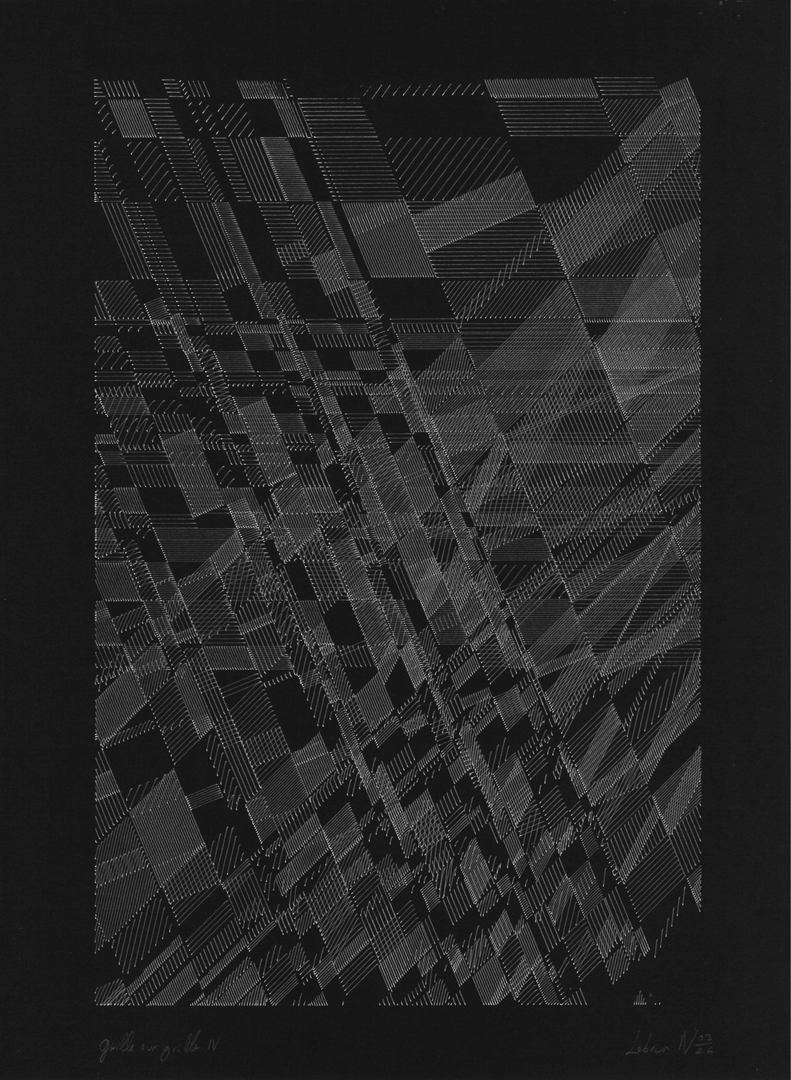
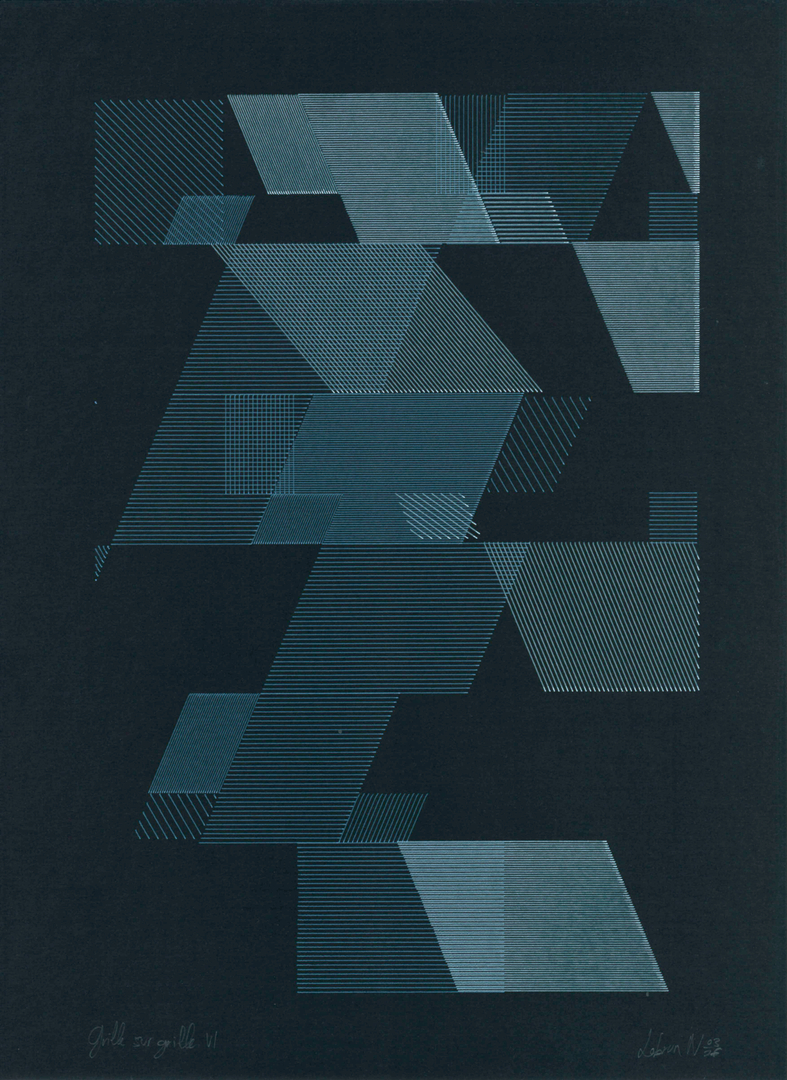
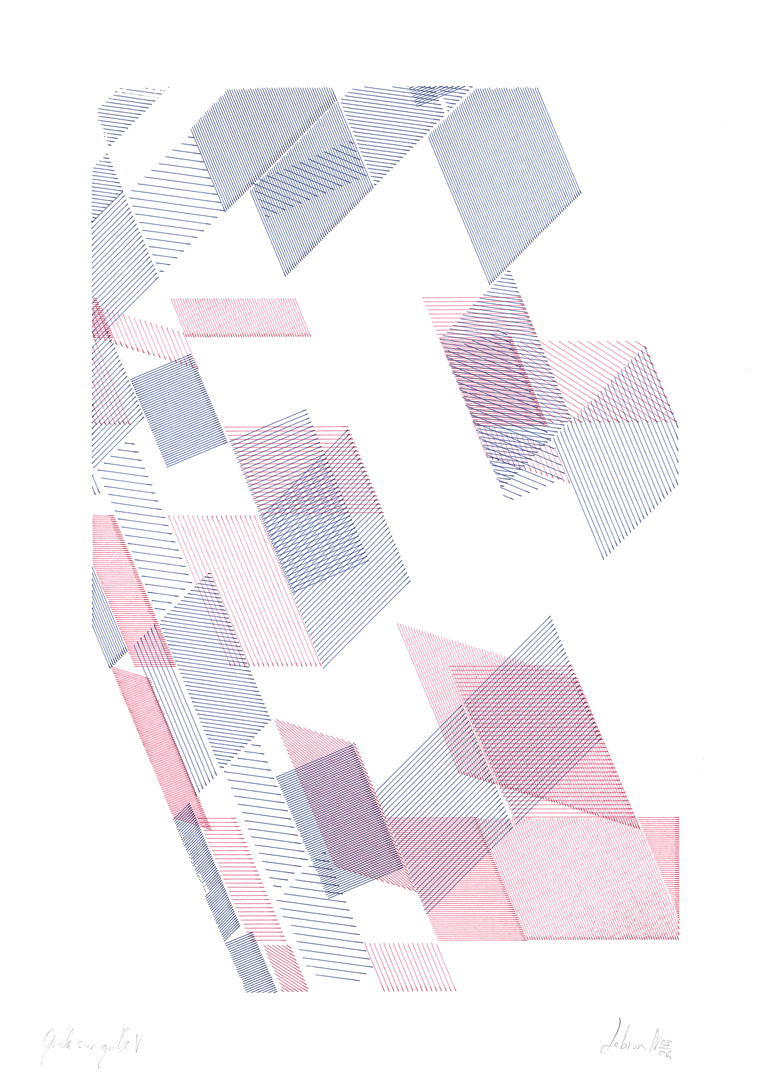
This project is, as its name suggests, a visual game of superimposition. The grid is superimposed on itself: the same grid is reproduced twice, or the cells of the original grid are redistributed randomly onto its copy, or onto itself. The two grids share the same construction, but the voids of one are the solids of the other — they overlap or interlock perfectly, like two complementary states of the same binary system.
The title alone summarizes this experimentation: a structure (the grid) and an operation (superimposition). The rest of the protocol that generates these compositions is entirely determined by this initial choice. Each grid and each cell are randomly tilted, inscribed in a plane of their own or belonging to that of their parent grid. These simple tilts are enough to produce a third dimension — they suggest depth, and more formally, introduce dynamics and void between elements. One thinks here of the research into axonometry in concrete art, of the way Theo van Doesburg, or later the members of Unismo, explored the capacity of two-dimensional drawing to simulate space without resorting to traditional perspective. But where these movements sought total compositional control, here the protocole introduces randomness as co-author: the tilt is random, and it is precisely this controlled irregularity that gives each edition its singular character.
Hatching serves to indicate the presence of the grid’s cells and recalls, through repetition, the structure that carries them. The grid here is not a motif but an epistemology: a way of organizing space, of cutting it into addressable units, of applying rules to it. This is the founding gesture of computation — the discretization of the continuous, the transformation of space into an array of values. Each cell operates according to its own rhythm in the orientation and spacing of the hatching, producing variable densities that optically create tonal values where there is only black on white — or white on black. This principle of the hatch pattern as a producer of tonal value was already explored by Bridget Riley in her early optical works of the 1960s, but here without the pursuit of an immediate retinal effect: the vibration is slower, more architectural.
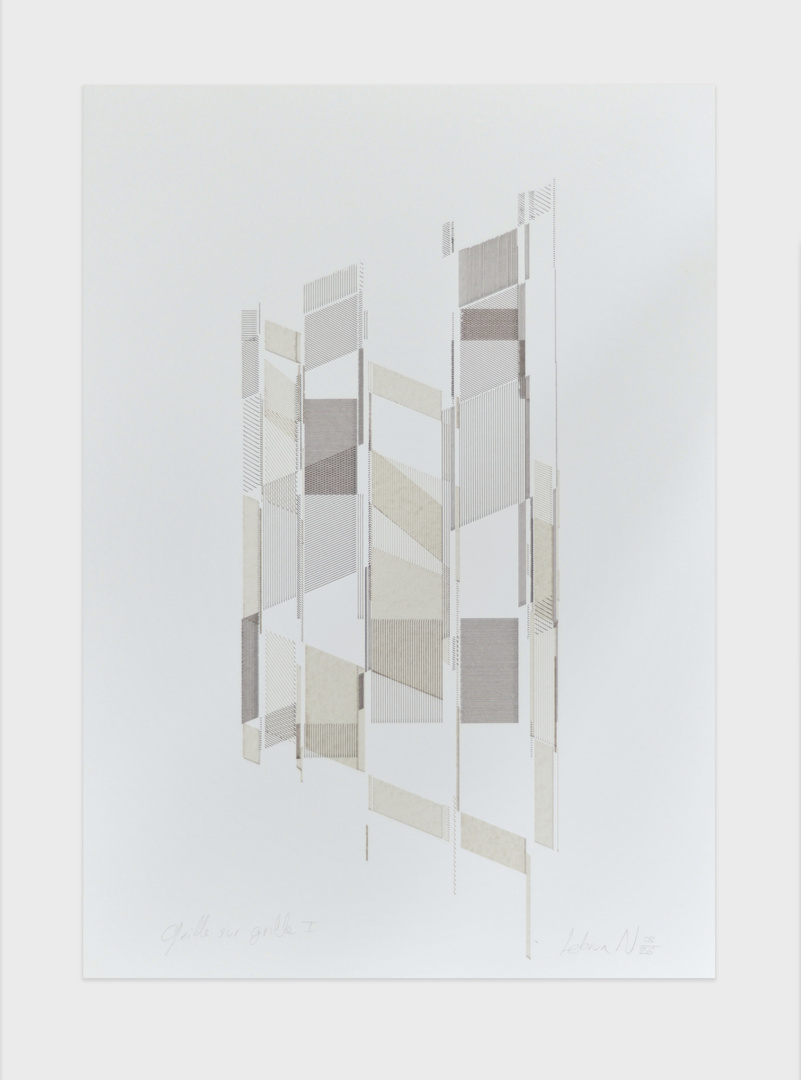
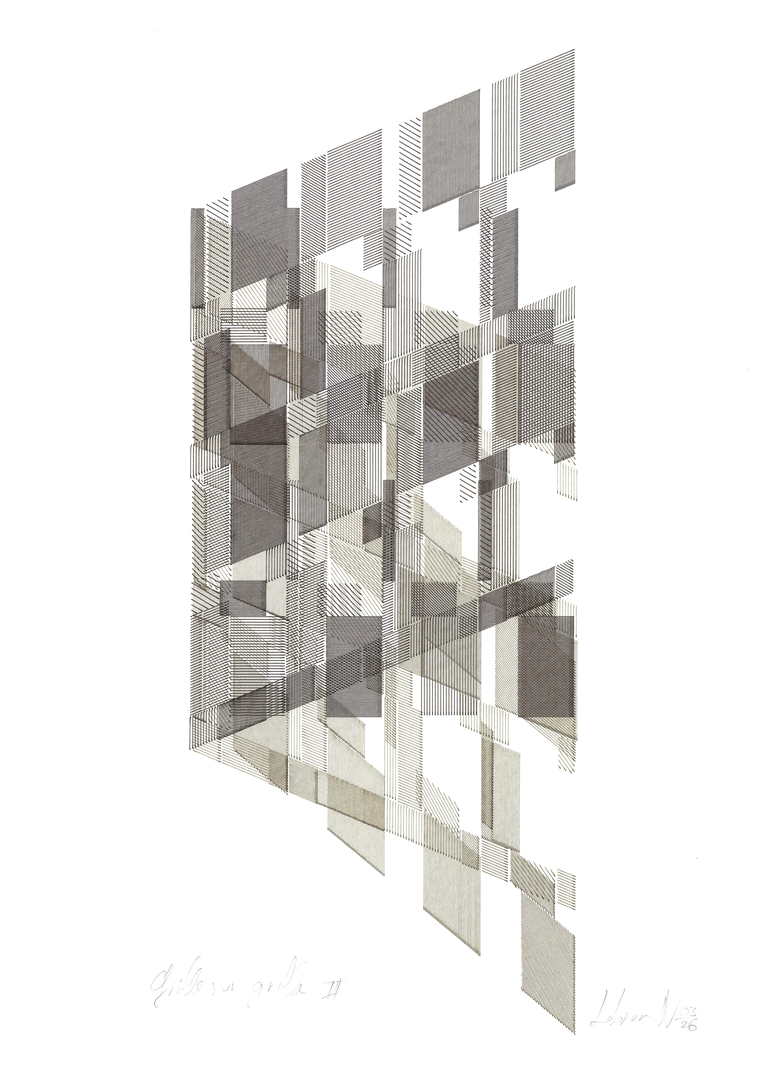
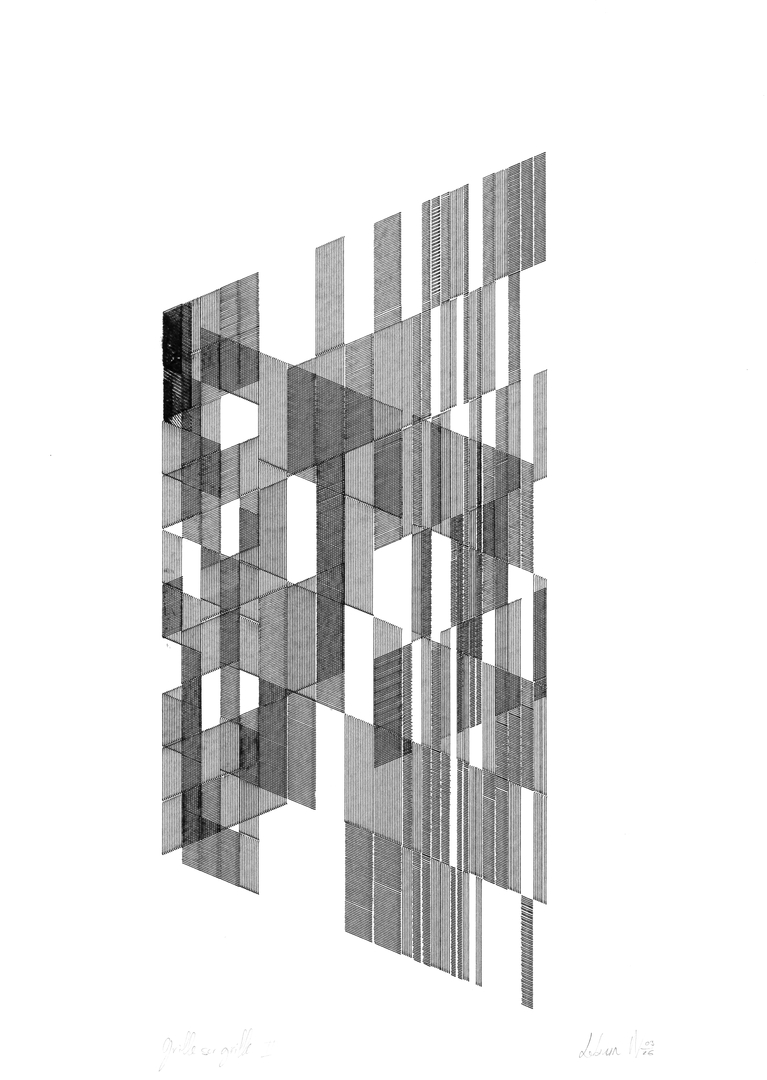
The hatching also reveals the process by which an algorithmic calculation materializes. The plotter is the right instrument to show this, because, unlike the screen, it cannot lie about its own physicality. When hatch lines cross, they genuinely accumulate in the fiber of the paper. When one rectangle overlaps another, their zone of intersection is genuinely denser — light passes through it less. Opacity is not simulated; it is constructed, line by line, by a mechanical arm that leaves traces: slight irregularities of pressure, hesitant stroke beginnings, corners where the ink has slightly bled. These are not flaws — they are proof that something happened physically, that the drawing was made rather than rendered.
This is perhaps the most interesting aspect of the series: what resembles depth, volume, perspective, is nothing but accumulation. The grid does not organize space — it occupies it. And it is in the gap between organization and occupation that the artifice lies — and, in a certain way, all the beauty of the process.
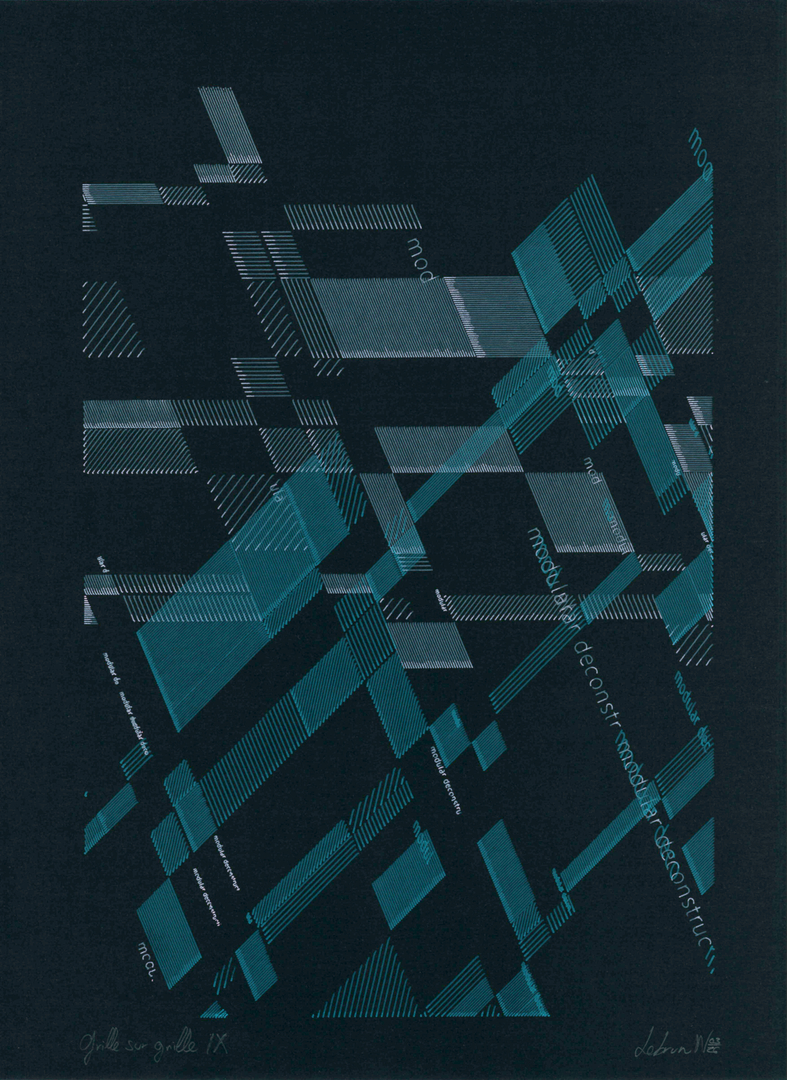
Some editions include text. These words are rarely whole, never centered, never legible at a single glance. The grid cuts them apart, distributing them as orphaned syllables, isolated letters. It is also already present in earlier projects like Barrage, where text circulates through the compositions without ever settling.
Here, the words are superimposed formally on the other marks, but also symbolically, since the chosen terms describe precisely what the piece is doing formally. Moduler déconstruire, contrainte, or fragments that resemble JavaScript code — real, offscreen, screen — insert themselves into the various editions as if the protocol were rising to the surface of the render, as if the program wanted to make itself visible in what it produces. This superimposition of metalanguage onto image raises a question that runs through all creative coding practice: where does the origin of creation reside? Is it in the protocol that generates the editions — itself evolving, modified throughout the development of the series — or in the final render, the signed and numbered physical object? The series does not resolve this. It holds both levels simultaneously legible, like its two grids: neither one nor the other, but their superimposition.