Signal zero

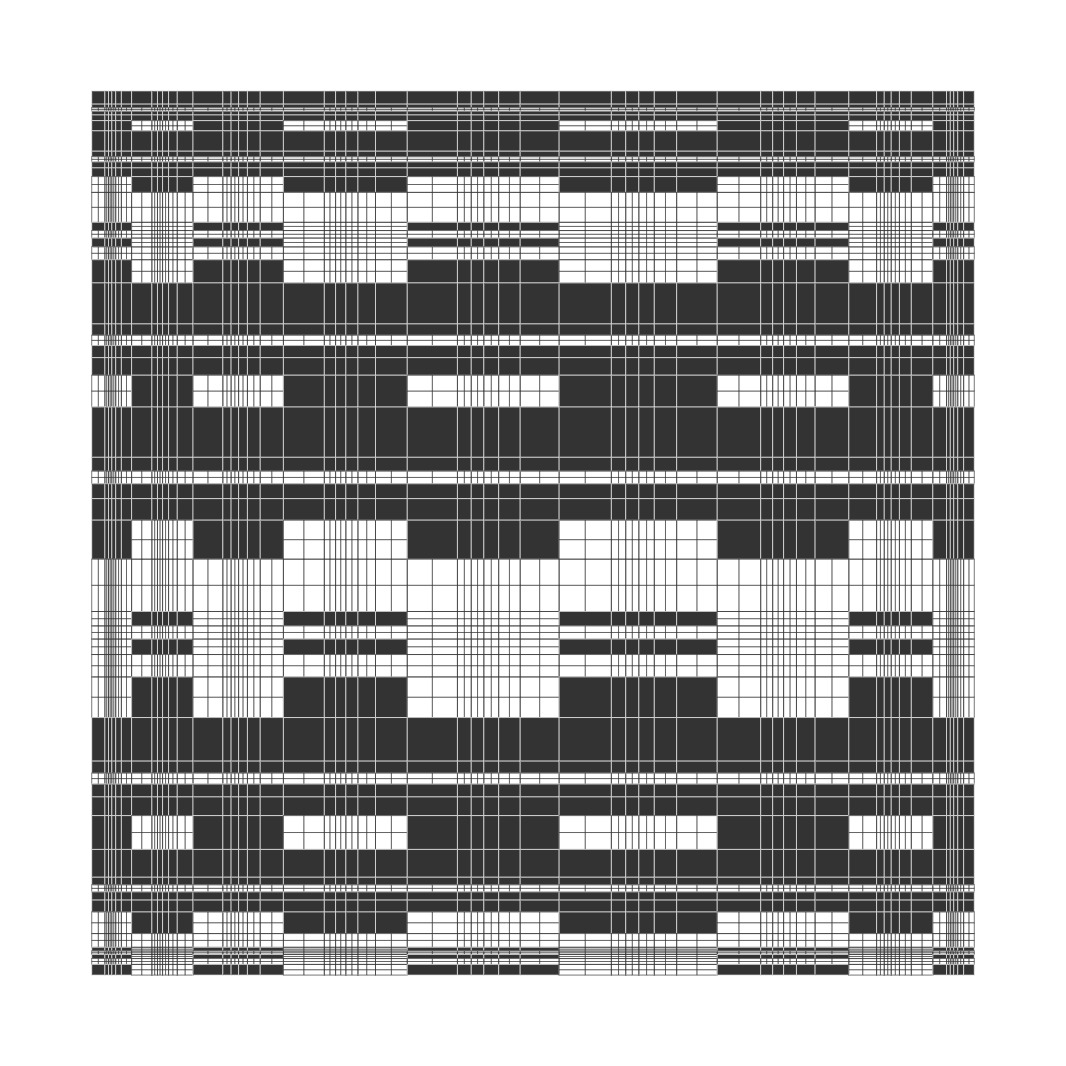
These animations work on the basis of two elements: a somewhat special font created in 2023 for a series called Barrage, and a grid.

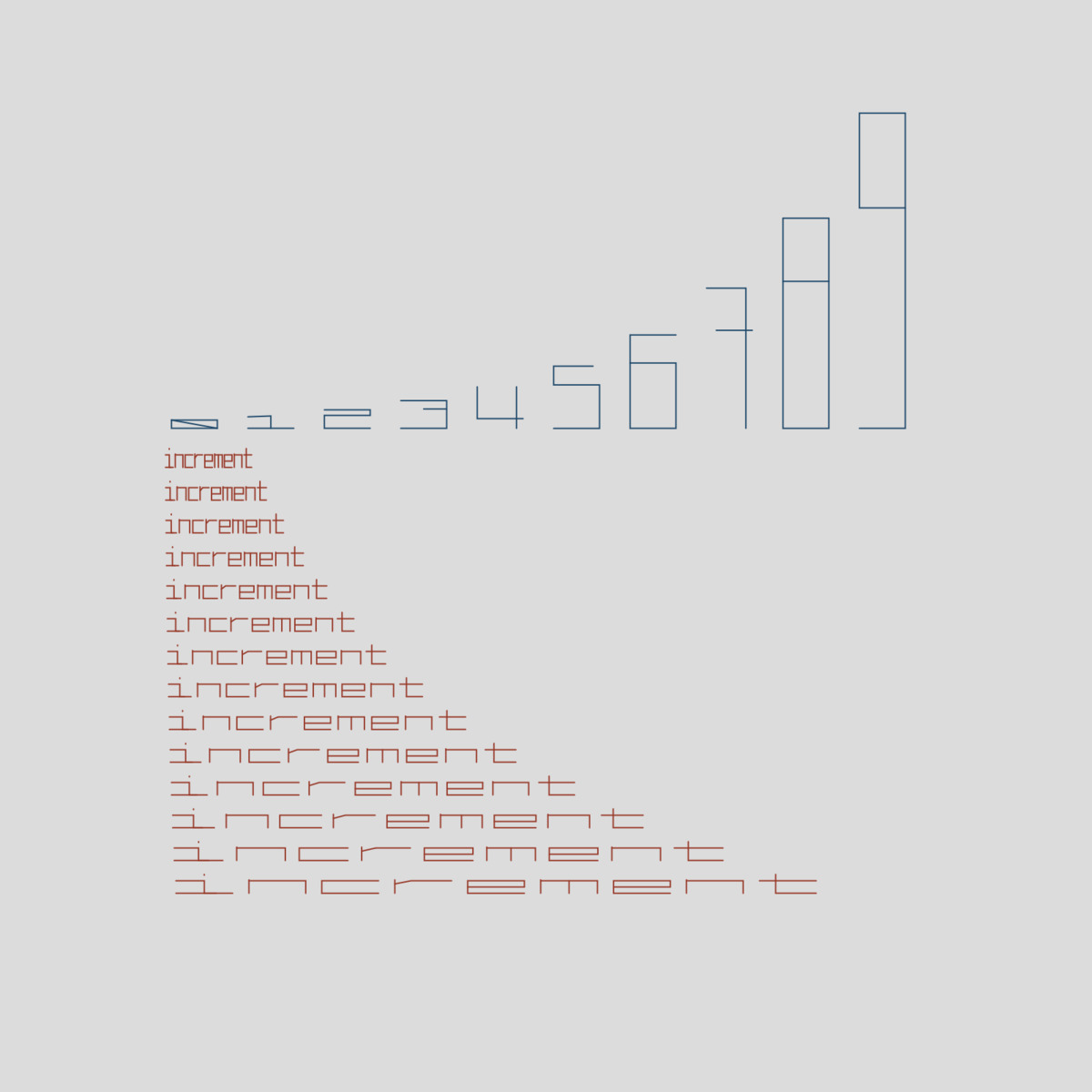
This font is not really a font in the traditional sense, since it cannot be used in a word processing application. It works like a program — you give it a letter or a word along with dimensions, and it returns a list of coordinates used to draw the letter or letters. The outlines are never filled, so if you change the text dimensions you will get different coordinates, but this will not affect the stroke width. The second characteristic of this font is that you can give it two different sizes for height and width. Flexible, it extrapolates and adapts to the frame you give it.

The second fundamental element in this project is the grid, and this grid has quite an interesting feature: whatever the width and height of each cell, it will resize them to preserve its own dimensions — the grid neither shrinks nor grows even if the column or row sizes change abruptly. As with the font, the grid reflects a certain flexibility; it absorbs and organises internal disorder to maintain its own coherence, its own dimensions.
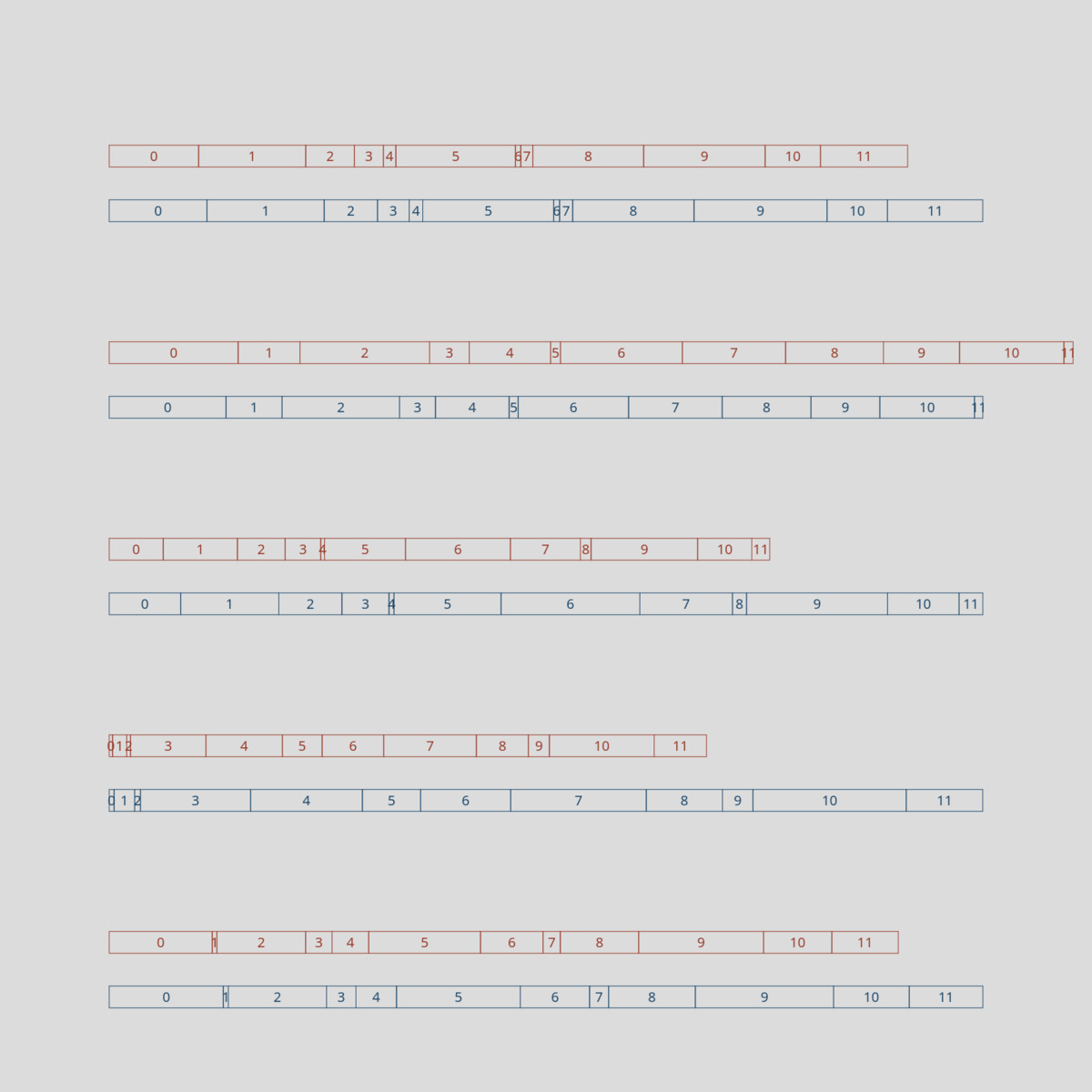
The creation and animation of the grid cells happen in two distinct processes. For each of these two stages, the program has a palette of possible choices, a list of available functions from which it can draw a type of organisation and a type of animation — so the program contains two families of algorithms that work in tandem: the composers and the animators.

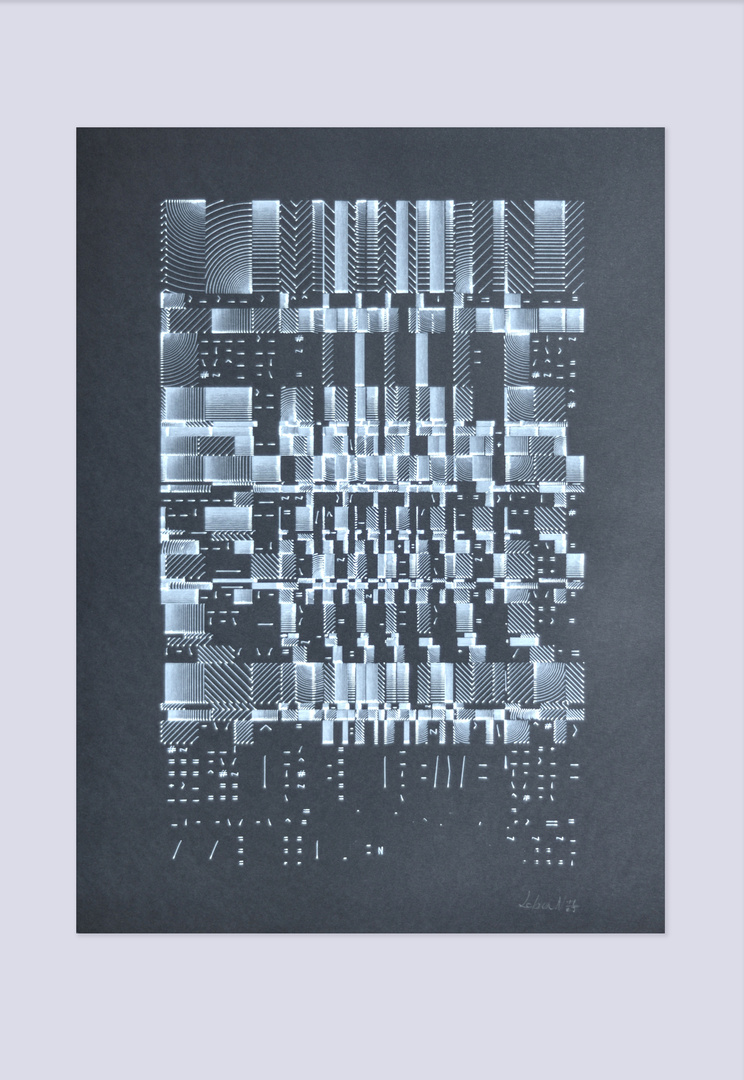
The composers are used to select letters and signs (punctuation marks, numbers, symbols…) and their order. It might seem trivial to entrust a mathematical function with the task of truncating text, but in reality it is not. Each of the thirty-four rule functions applies a pattern that is unique to it — for example, one might count the position of a sign and remove all those whose position falls on an even index; by making this rule more complex with additional thresholds and operations, one can begin to see repeating shapes, emerging patterns. It is no coincidence that this evokes looms and the punch cards of early computers — this work is rooted in the earliest or pioneering forms of Generative Art.

The second family of algorithms, the animators, handle changing the size of each letter based on its position and time (counter). They interface between the font and the grid, taking advantage of the fact that the font can be stretched in two dimensions and that the grid, whatever happens, will maintain its dimensions. In a sense, they disrupt the grid, triggering shifts in columns or rows — they do not change position as such, only size, but this, coupled with the grid’s auto-resizing function, produces movement: a cascade reaction. Size changes in one cell affect all the cells in its row and column, as well as their positions.

There is an autopoietic dimension here; one can view the different parts of this mechanism as an ecosystem that evaluates conditions and reacts to stimuli while maintaining its organisation and structure. The grid distributes the forces created by the animators across its columns and rows — the structure is preserved, but sometimes, when the loads are too great, when there is too much turbulence, this regulation happens at the expense of certain cells’ integrity, rendering them invisible.

The animators have one constraint: they evolve the dimensions over a period, ensuring that the sizes at the end of the period and at the beginning are identical, so as to create a perfect loop, a cycle like a breath.

Lexicon and collection — the grid as an element multiplied across several layers

In programming, the grid is the underlying element (screen pixels, database tables…) but it is also a rigid structure that the artist attempts to deform under the action of simulated forces.

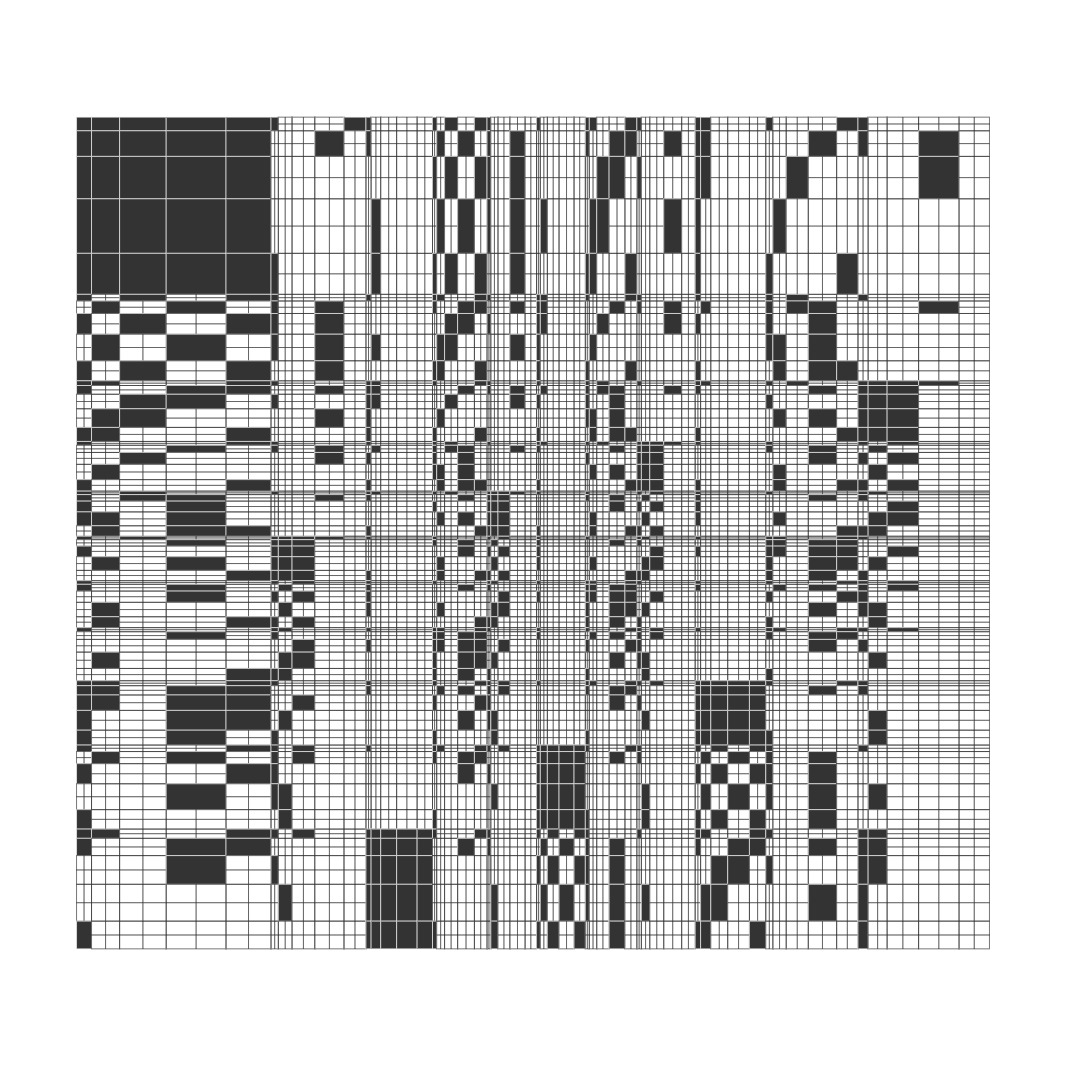
Although other elements in this series introduce variations — such as the different colour palettes and the choice of words used — a large part of the visual result comes from the choice of a composer and an animator. One can therefore mentally structure the possible variations of the series in the form of a grid: on the vertical axis, the thirty-four composers, and on the horizontal axis, the thirty-three animators — at each intersection one finds one of the one thousand and fifty-six possible visuals.

These two lists of composers and animators reflect a need to catalogue possibilities, to enumerate and annotate them. Creating a directory of forms and expressions is, in a sense, mapping the visible — not to exhaust it, but to reveal its internal logic. Each composer, each animator is an entry in a dictionary of behaviours, a way of naming what the program can do, even before it does it.

This collecting approach is not unlike a certain scientific tradition: that of the naturalist who classifies species, the linguist who catalogues morphemes, the chemist who builds the periodic table. There is in this act of cataloguing a form of systematic curiosity — the intuition that richness lies not in a single masterwork but in the ordered proliferation of possibilities, in the tension between rule and variation.
Grid on grid

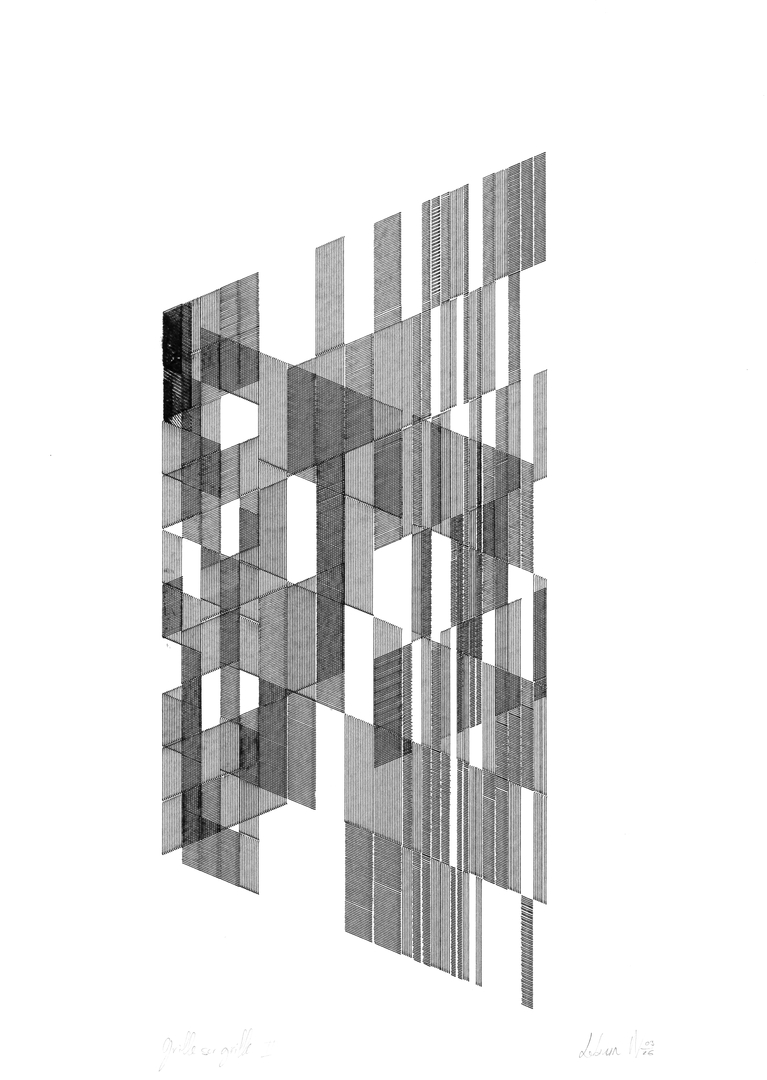
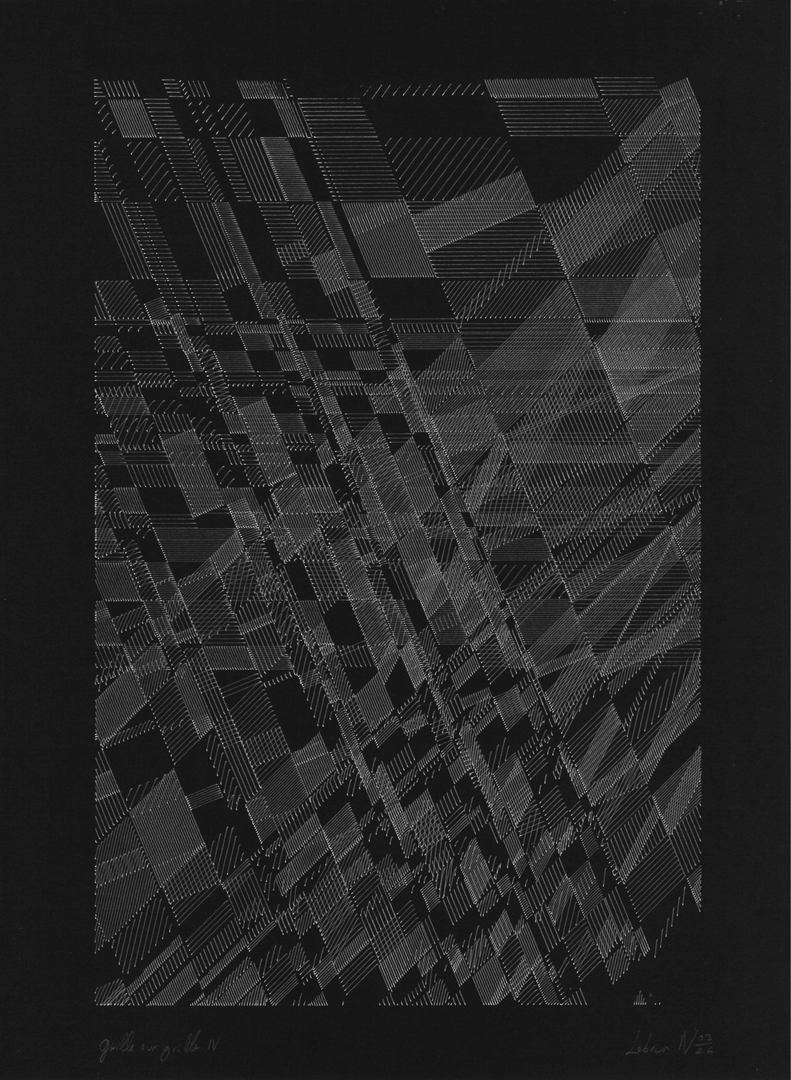
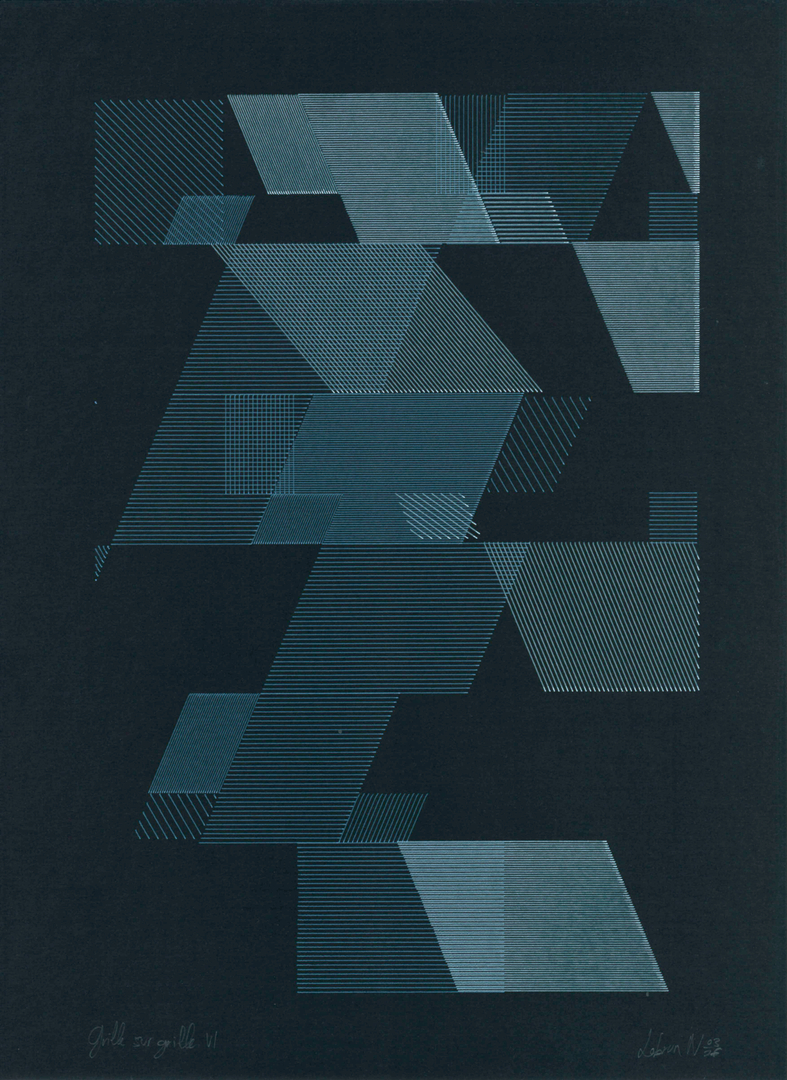
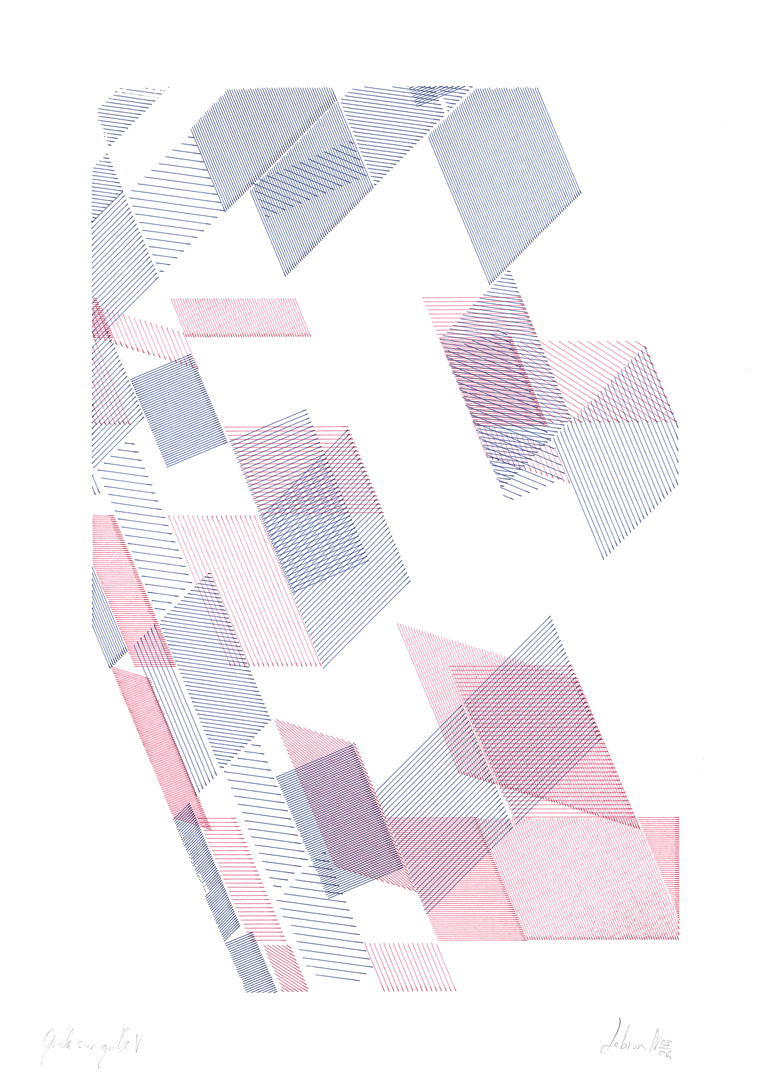
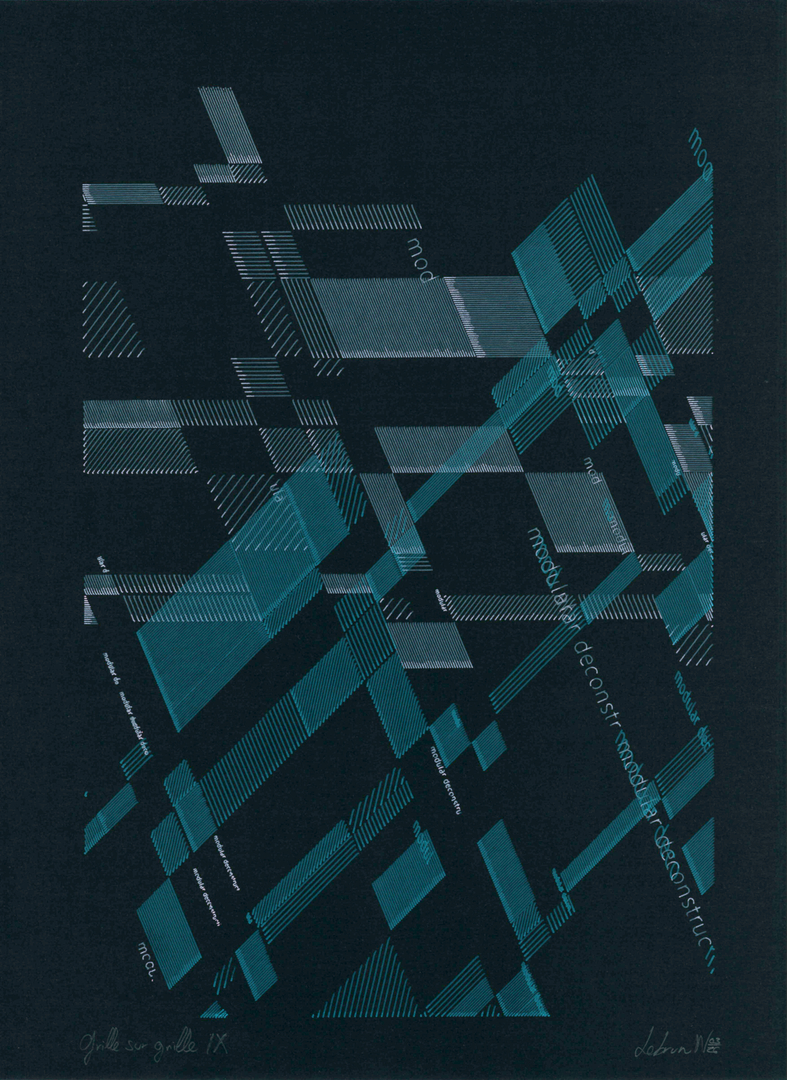
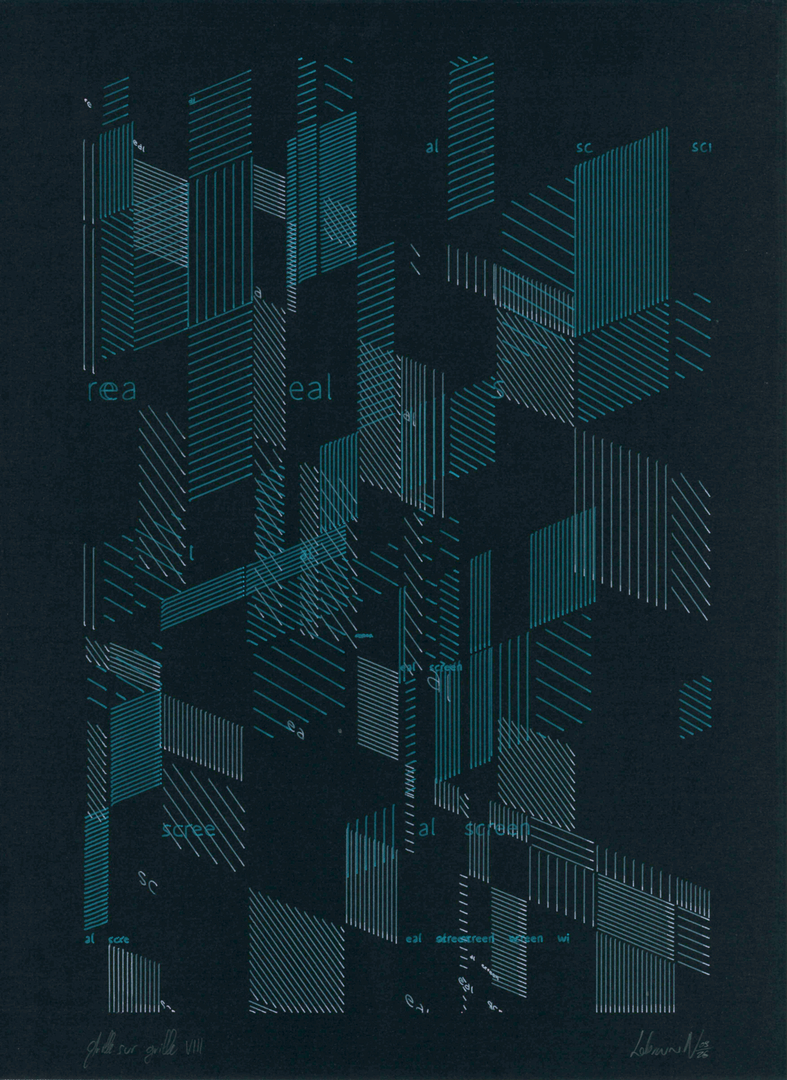
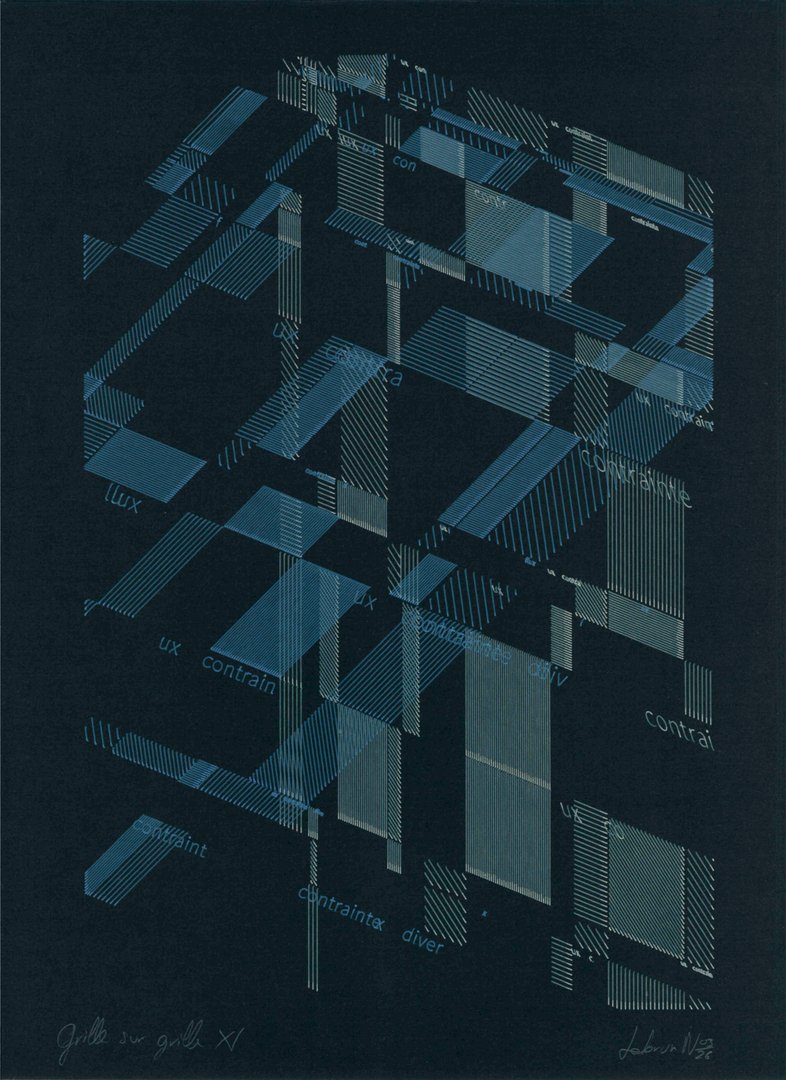
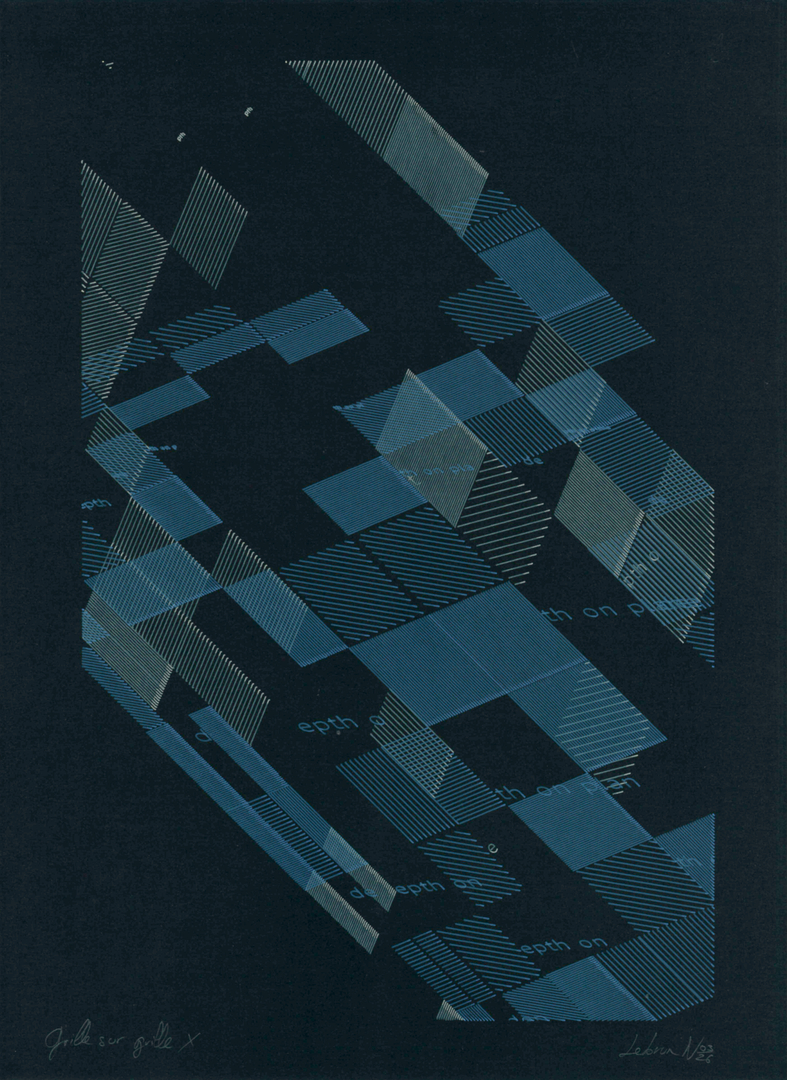
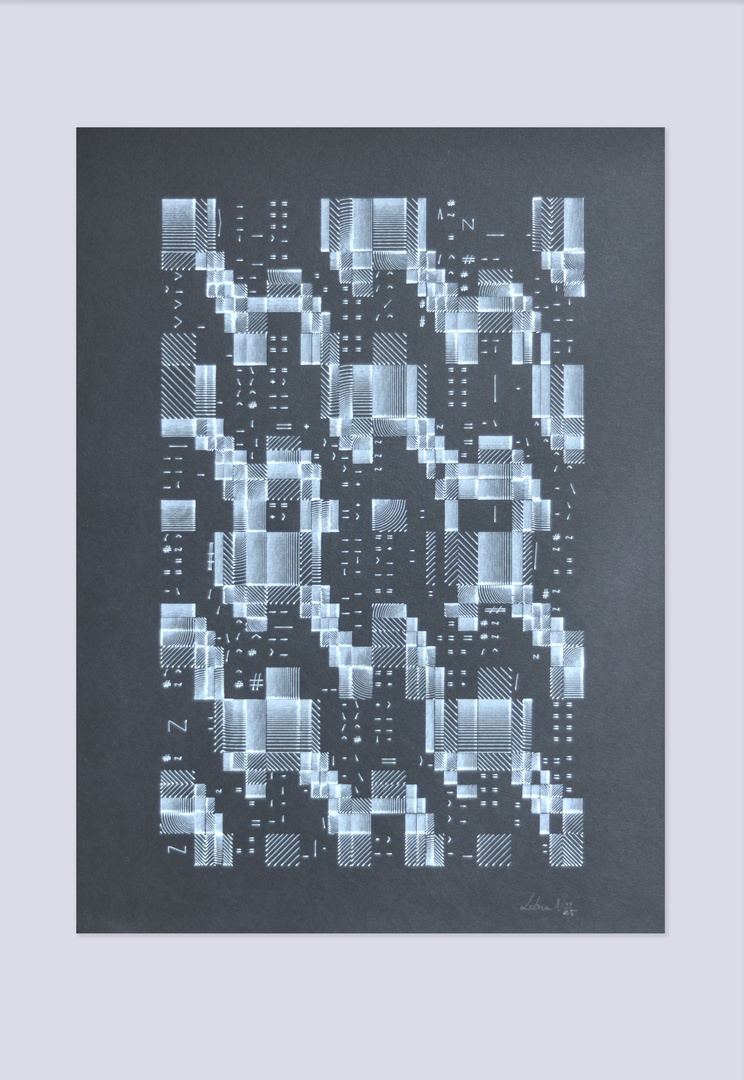
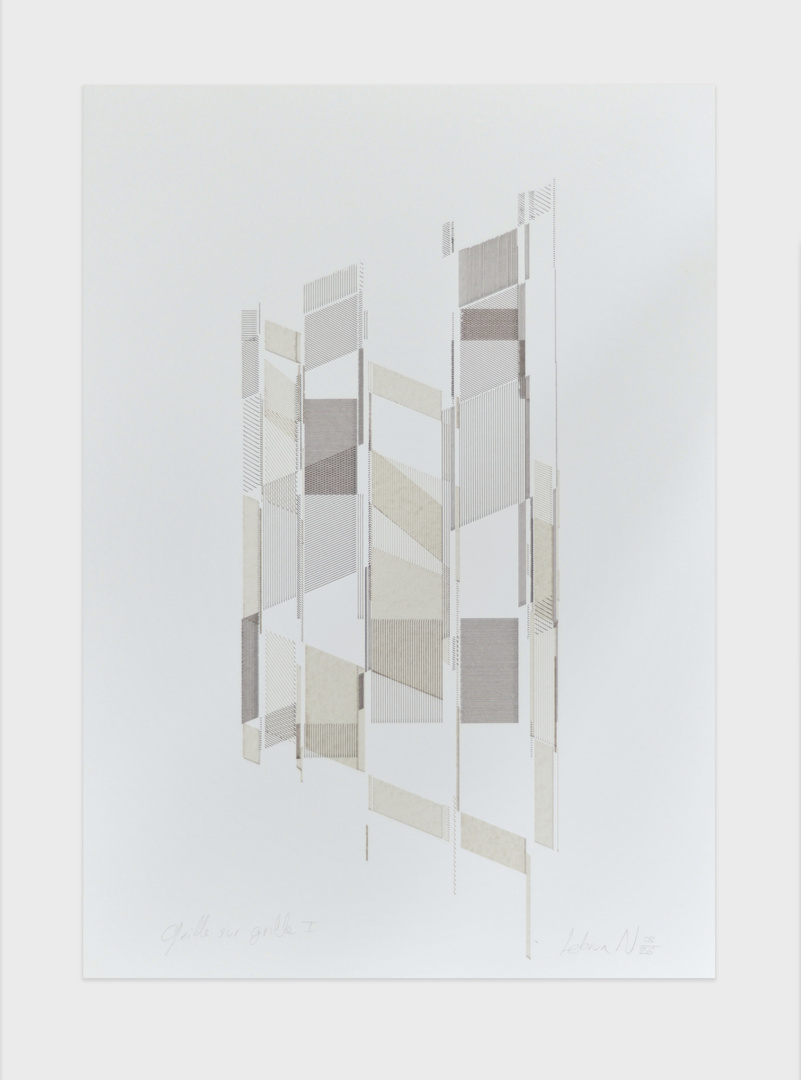
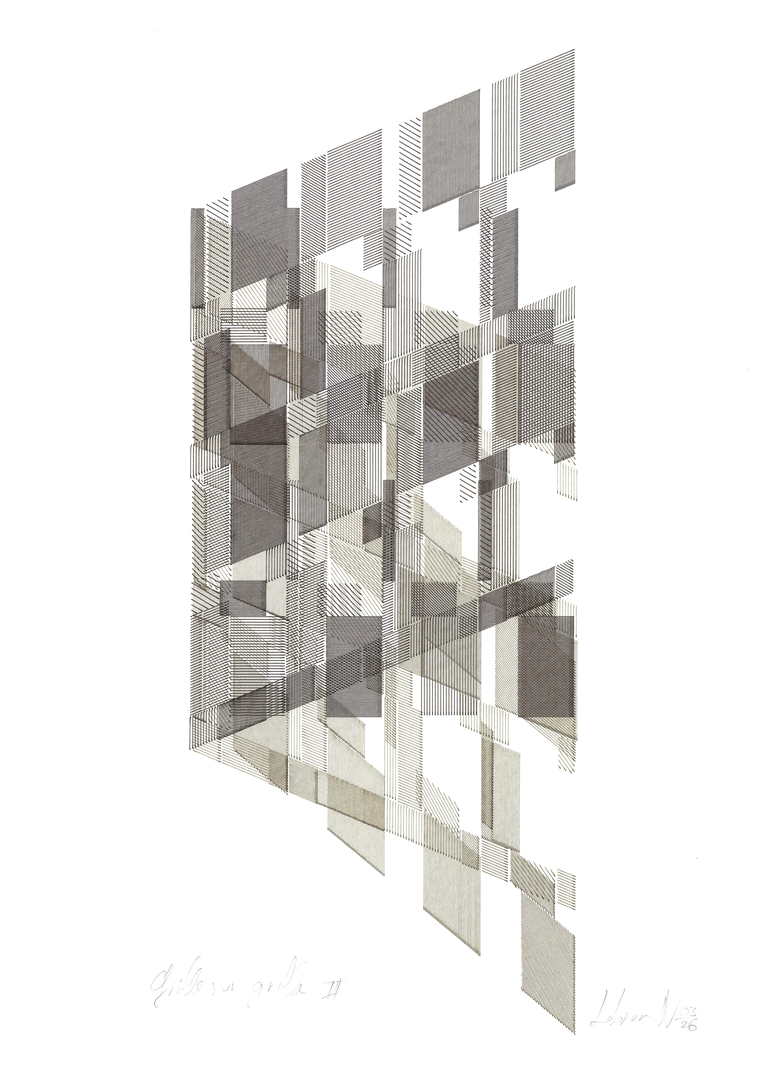
This project is, as its name suggests, a visual game of superimposition. The grid is superimposed on itself: the same grid is reproduced twice, or the cells of the original grid are redistributed randomly onto its copy, or onto itself. The two grids share the same construction, but the voids of one are the solids of the other — they overlap or interlock perfectly, like two complementary states of the same binary system.

The title alone summarizes this experimentation: a structure (the grid) and an operation (superimposition). The rest of the protocol that generates these compositions is entirely determined by this initial choice. Each grid and each cell are randomly tilted, inscribed in a plane of their own or belonging to that of their parent grid. These simple tilts are enough to produce a third dimension — they suggest depth, and more formally, introduce dynamics and void between elements. One thinks here of the research into axonometry in concrete art, of the way Theo van Doesburg, or later the members of Unismo, explored the capacity of two-dimensional drawing to simulate space without resorting to traditional perspective. But where these movements sought total compositional control, here the protocole introduces randomness as co-author: the tilt is random, and it is precisely this controlled irregularity that gives each edition its singular character.

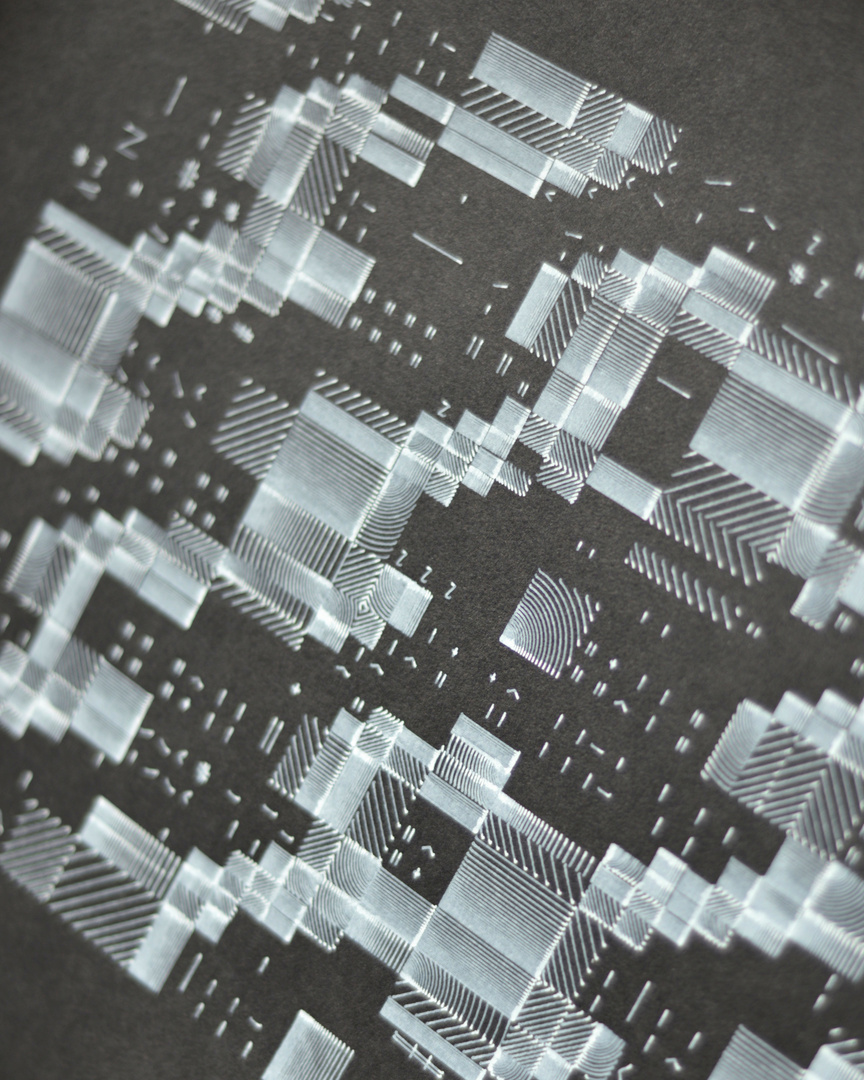
Hatching serves to indicate the presence of the grid’s cells and recalls, through repetition, the structure that carries them. The grid here is not a motif but an epistemology: a way of organizing space, of cutting it into addressable units, of applying rules to it. This is the founding gesture of computation — the discretization of the continuous, the transformation of space into an array of values. Each cell operates according to its own rhythm in the orientation and spacing of the hatching, producing variable densities that optically create tonal values where there is only black on white — or white on black. This principle of the hatch pattern as a producer of tonal value was already explored by Bridget Riley in her early optical works of the 1960s, but here without the pursuit of an immediate retinal effect: the vibration is slower, more architectural.

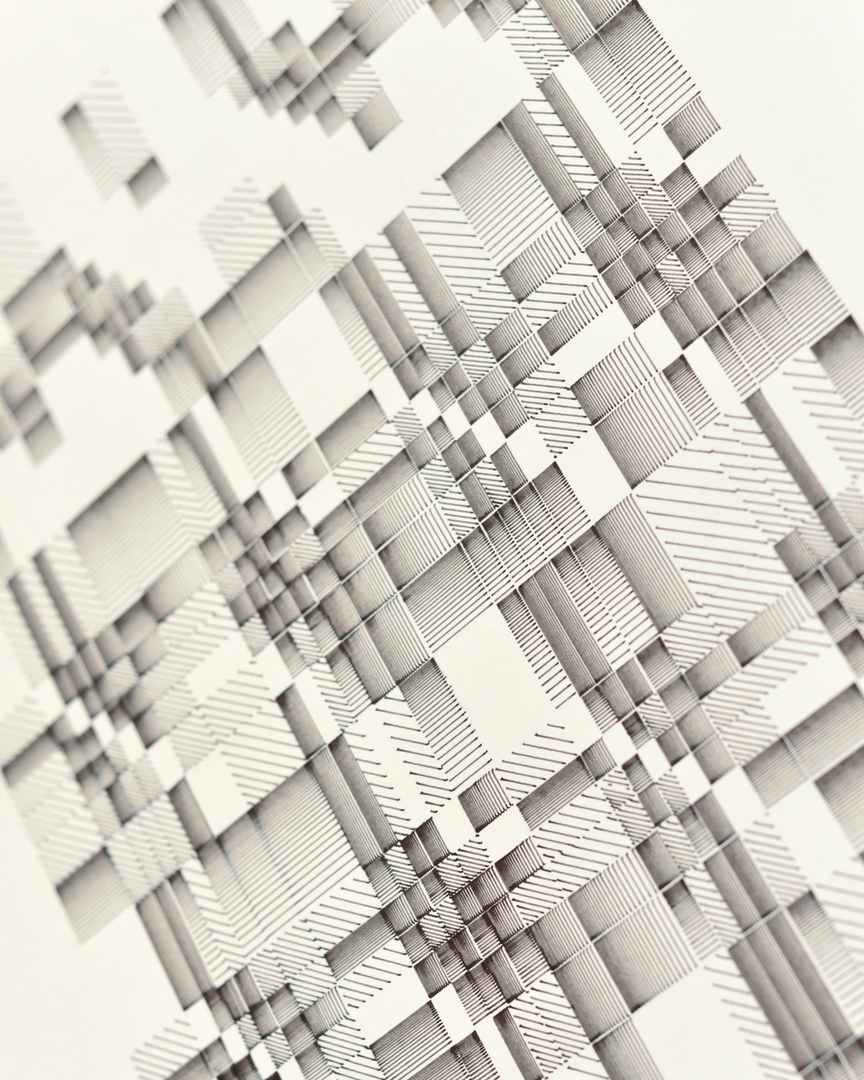
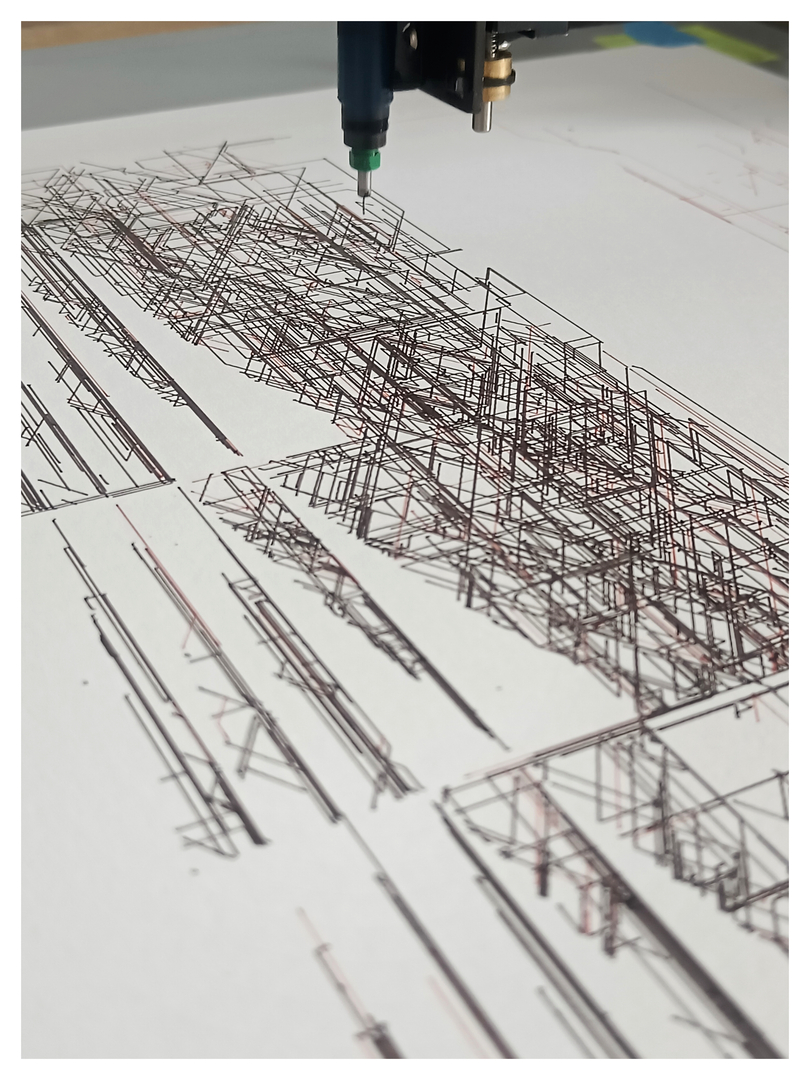
The hatching also reveals the process by which an algorithmic calculation materializes. The plotter is the right instrument to show this, because, unlike the screen, it cannot lie about its own physicality. When hatch lines cross, they genuinely accumulate in the fiber of the paper. When one rectangle overlaps another, their zone of intersection is genuinely denser — light passes through it less. Opacity is not simulated; it is constructed, line by line, by a mechanical arm that leaves traces: slight irregularities of pressure, hesitant stroke beginnings, corners where the ink has slightly bled. These are not flaws — they are proof that something happened physically, that the drawing was made rather than rendered.

This is perhaps the most interesting aspect of the series: what resembles depth, volume, perspective, is nothing but accumulation. The grid does not organize space — it occupies it. And it is in the gap between organization and occupation that the artifice lies — and, in a certain way, all the beauty of the process.
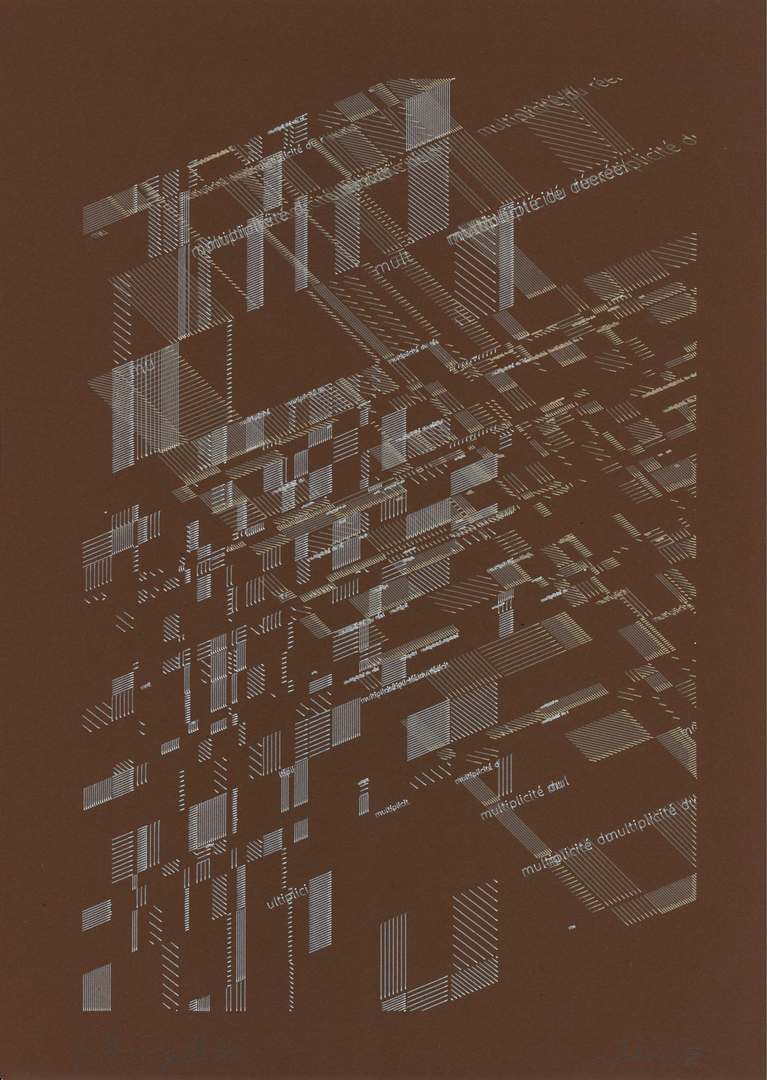
Some editions include text. These words are rarely whole, never centered, never legible at a single glance. The grid cuts them apart, distributing them as orphaned syllables, isolated letters. It is also already present in earlier projects like Barrage, where text circulates through the compositions without ever settling.

Here, the words are superimposed formally on the other marks, but also symbolically, since the chosen terms describe precisely what the piece is doing formally. Moduler déconstruire, contrainte, or fragments that resemble JavaScript code — real, offscreen, screen — insert themselves into the various editions as if the protocol were rising to the surface of the render, as if the program wanted to make itself visible in what it produces. This superimposition of metalanguage onto image raises a question that runs through all creative coding practice: where does the origin of creation reside? Is it in the protocol that generates the editions — itself evolving, modified throughout the development of the series — or in the final render, the signed and numbered physical object? The series does not resolve this. It holds both levels simultaneously legible, like its two grids: neither one nor the other, but their superimposition.
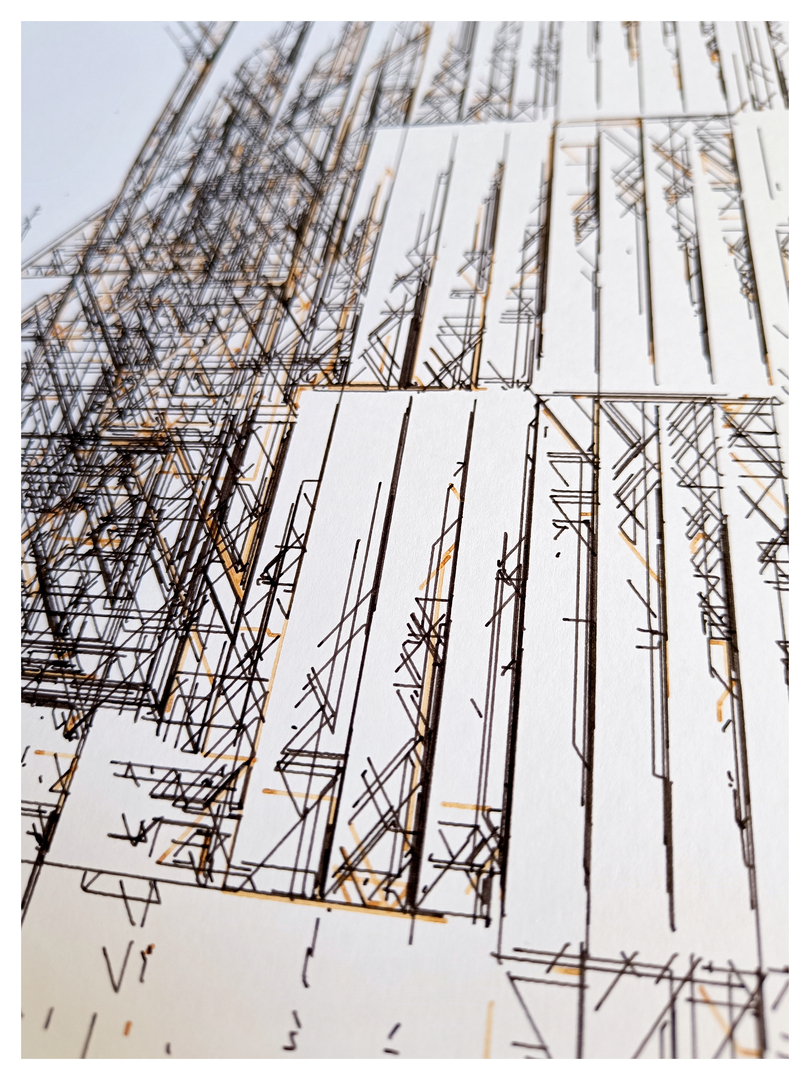
Grid rules drawn

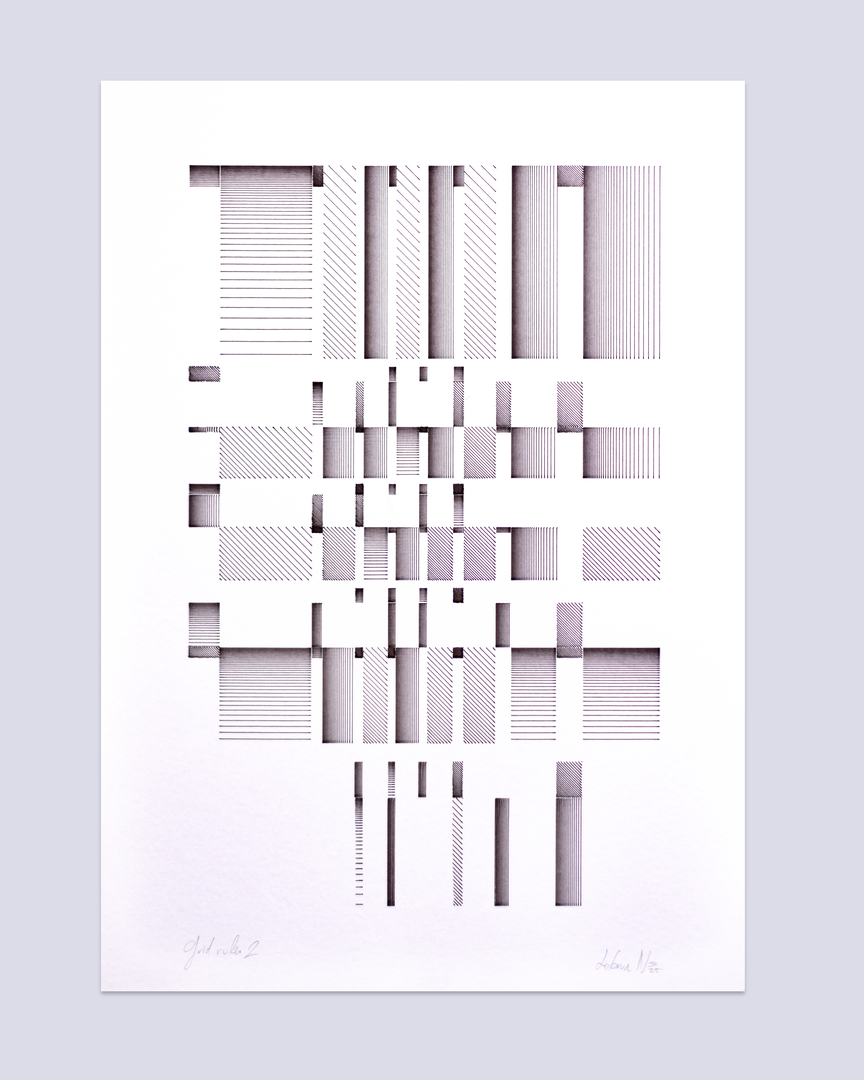
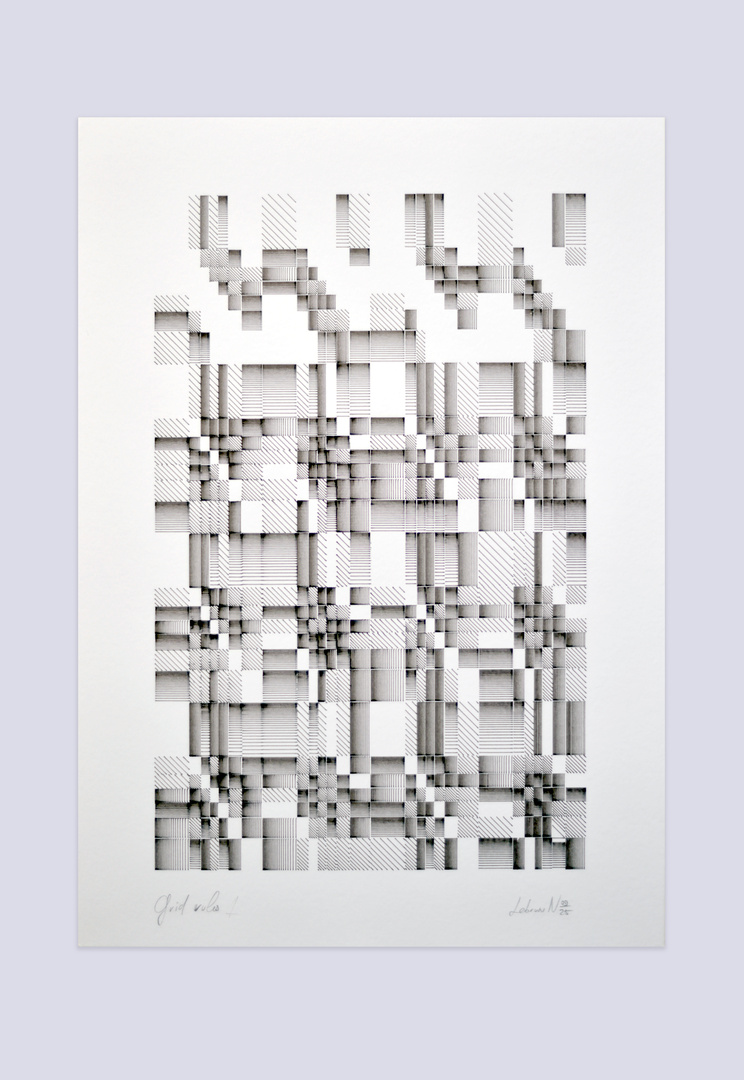
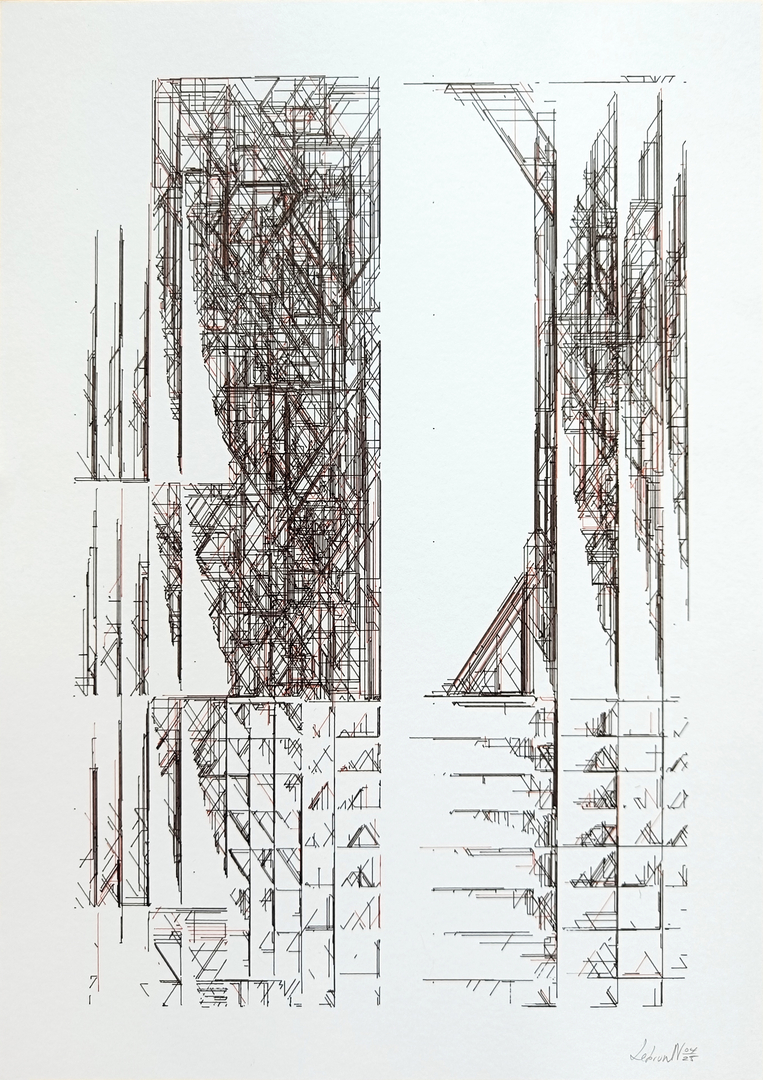
This work, created using a plotter, translates digital calculations into physical form through the mechanical precision of ink on paper. Part of the “G–R–I–D_-_RULES” series, this piece employs algorithmic functions—binary operations, trigonometric transformations, modular arithmetic—to generate patterns that oscillate between digital texture and organic form.

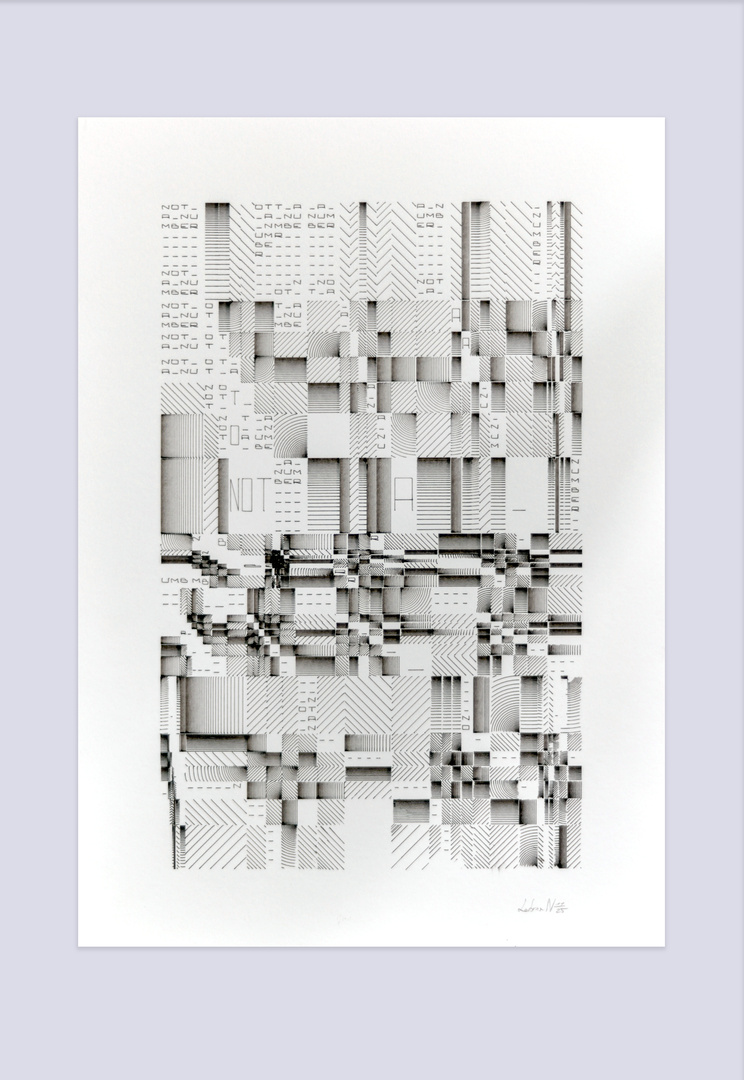
The transition from the digital version to the paper version gives rise to new compositional rules. In the original series, each cell could only be filled with black or white; in this version, hatching replaces the black and white rectangles. This hatching can take different forms and orientations, and its spacing increases exponentially. Another difference from the original series is that text is inserted into the grid’s squares; these are short phrases such as advertising slogans or references to art or the code that drives the composition.
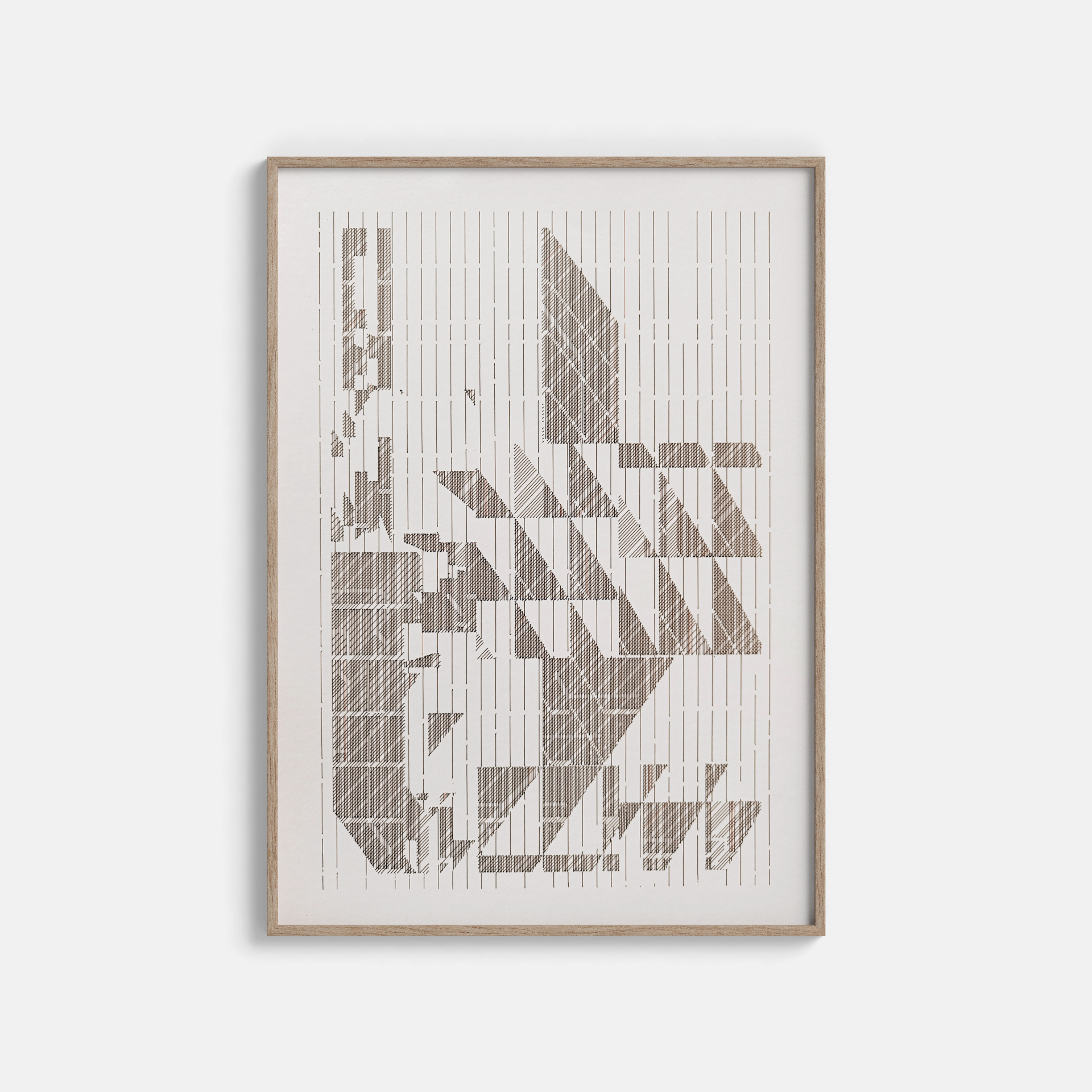
The grid imposes a spatial logic indifferent to semantic coherence. Words fragment in the middle of a syllable; letters repeat until meaning dissolves into the texture. The result is neither legible text nor an abstract pattern, but an unstable oscillation between the two—a liminal state where language hovers on the edge of legibility.

This work reveals language as a substrate: stripped of its communicative function, the text becomes pure distribution, rhythm, and material accumulation. A visual archaeology of the loop.
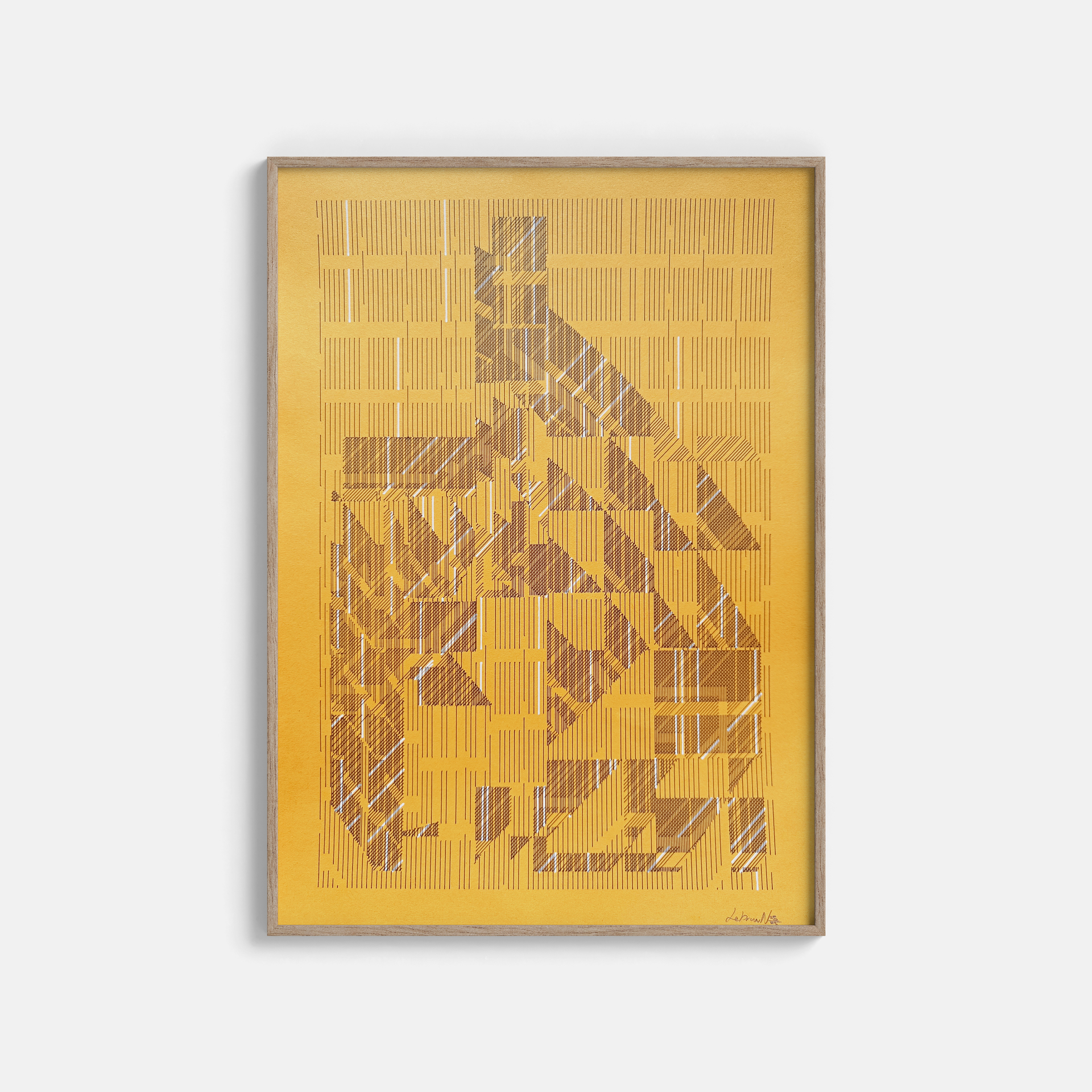
In between

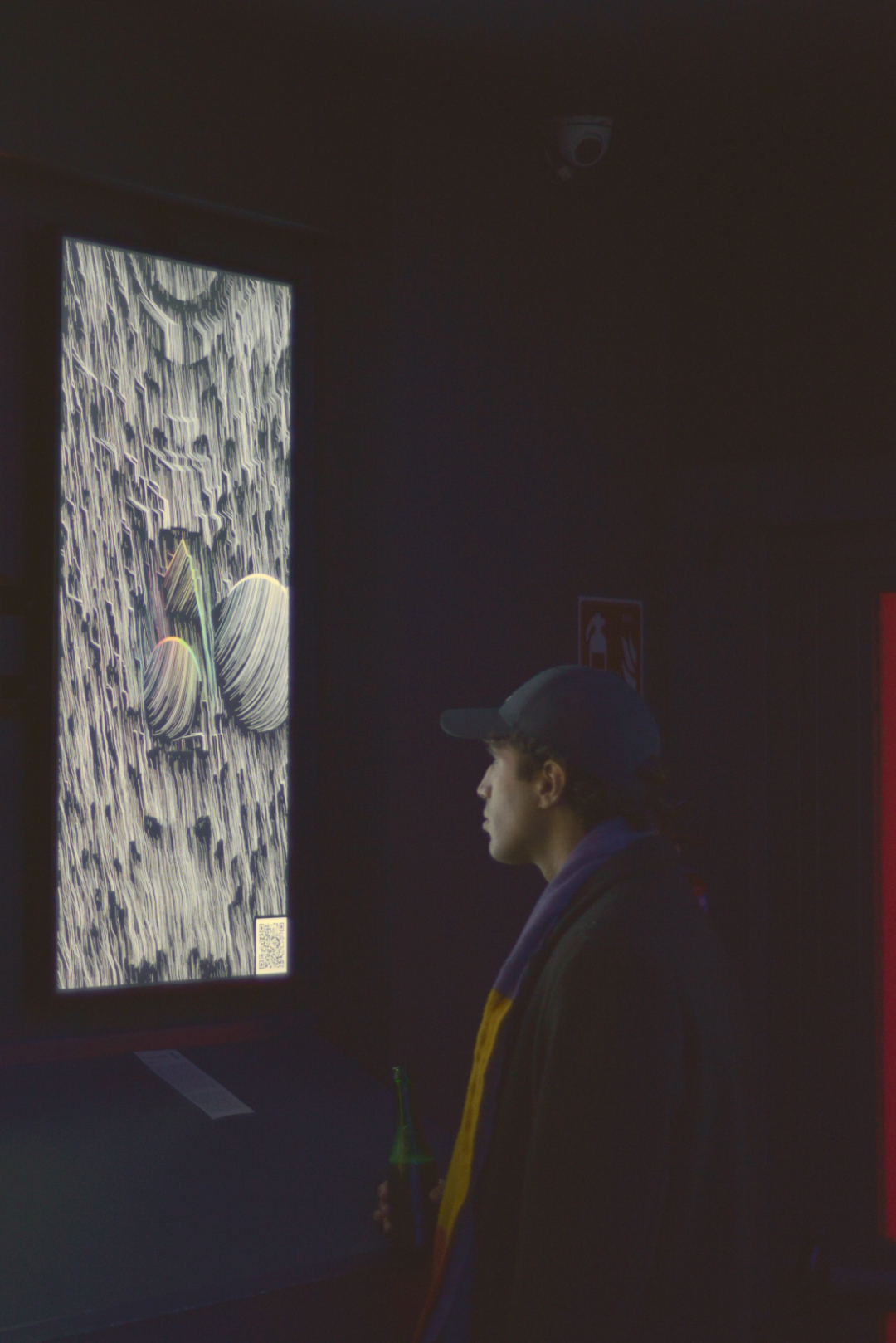
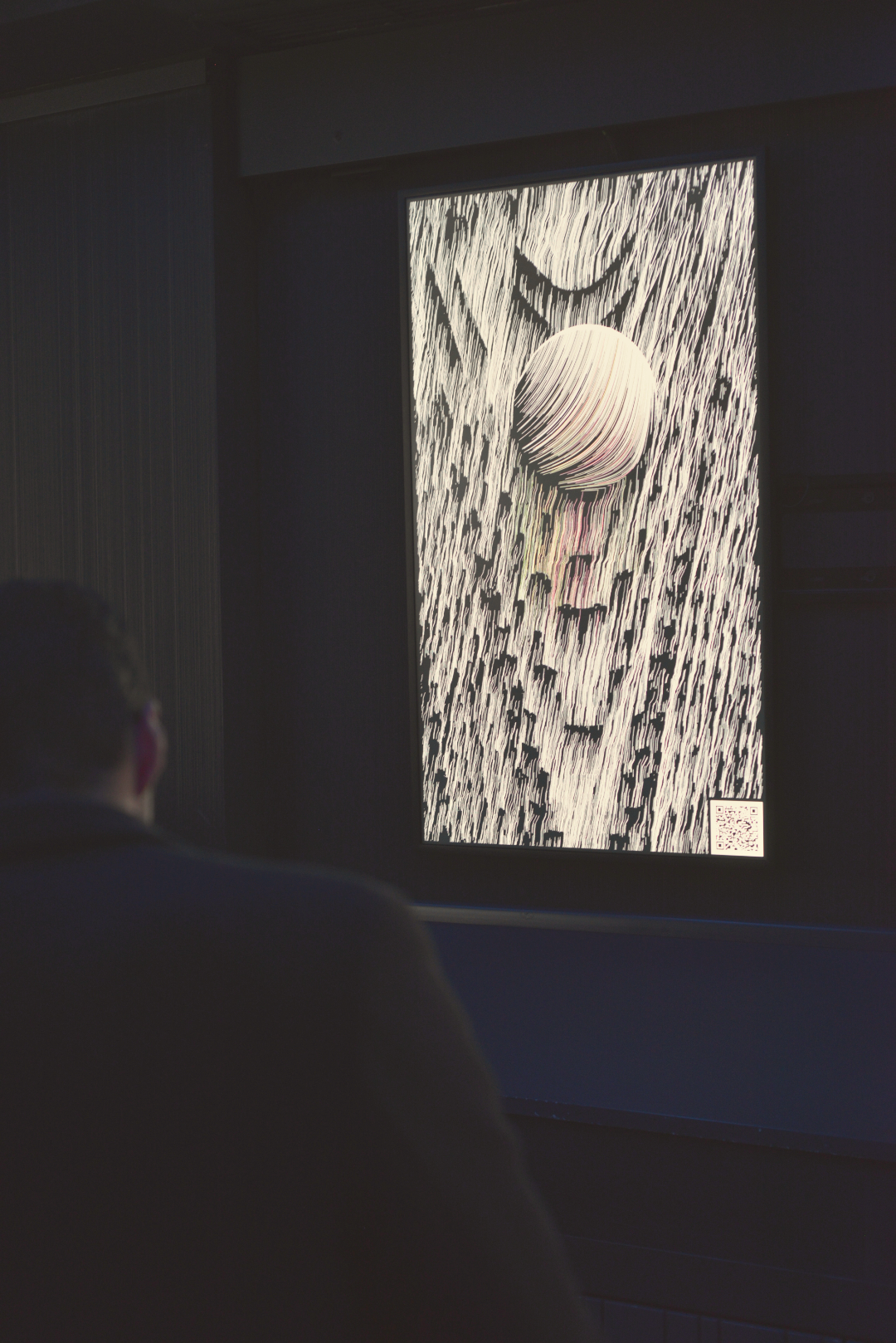
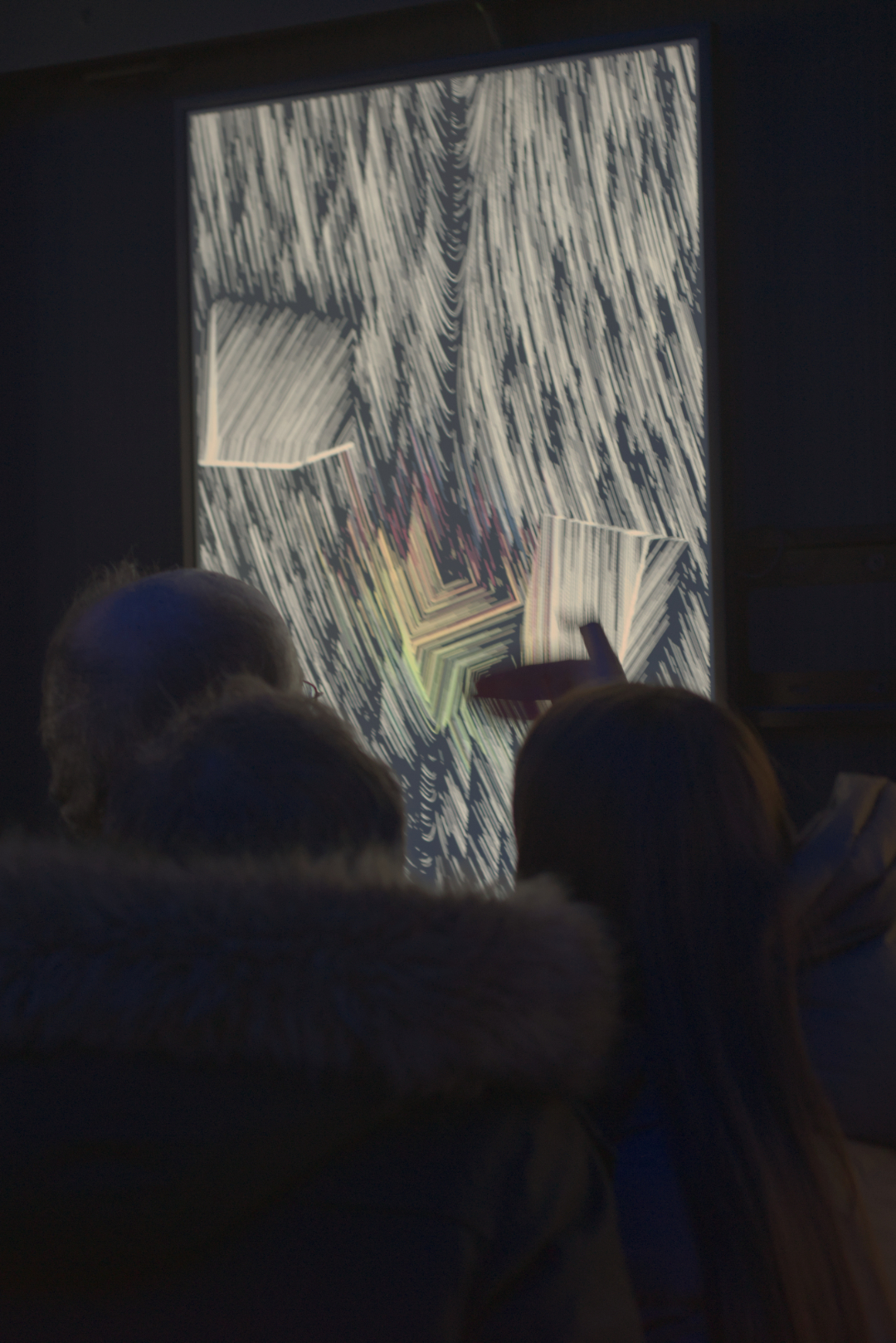
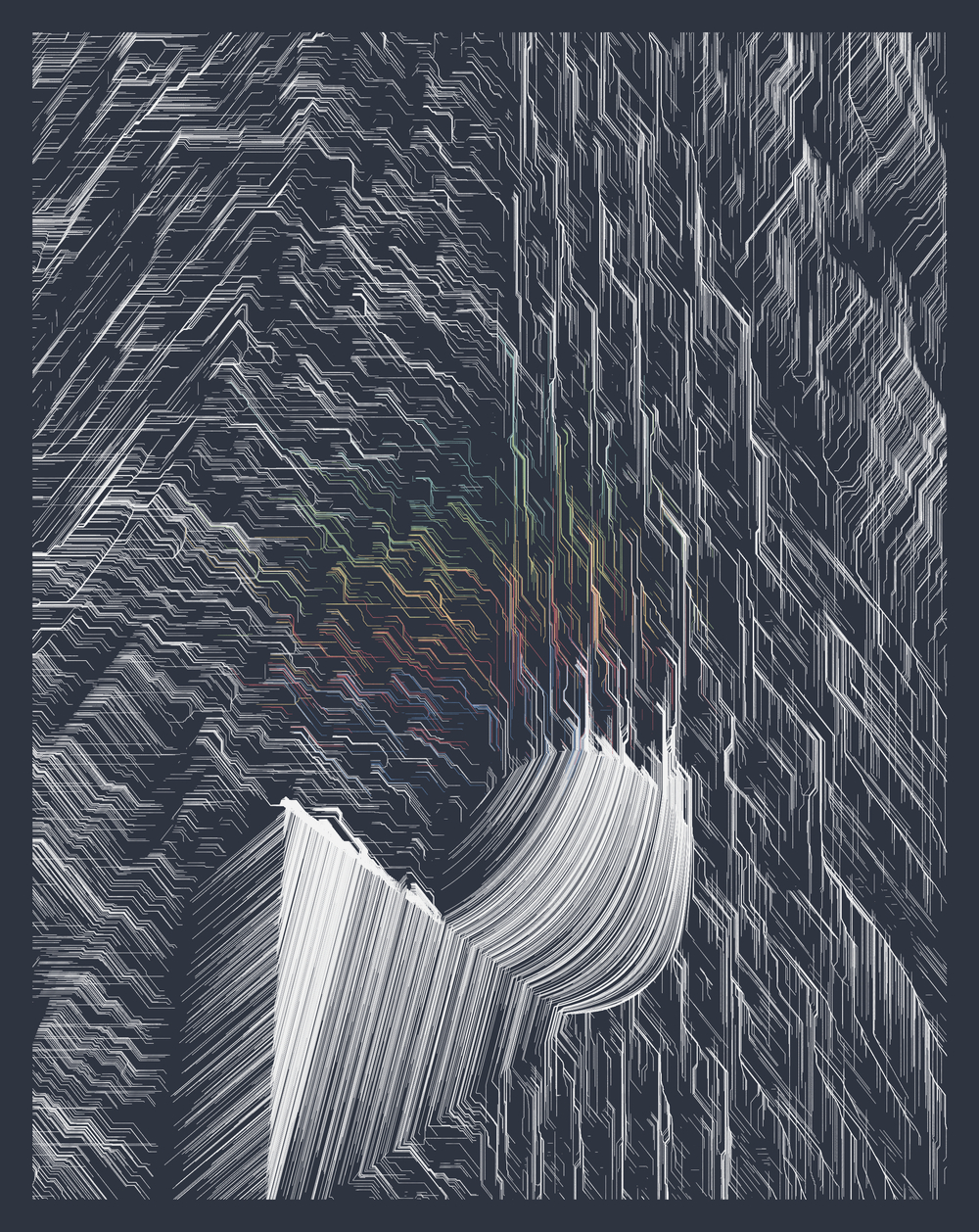
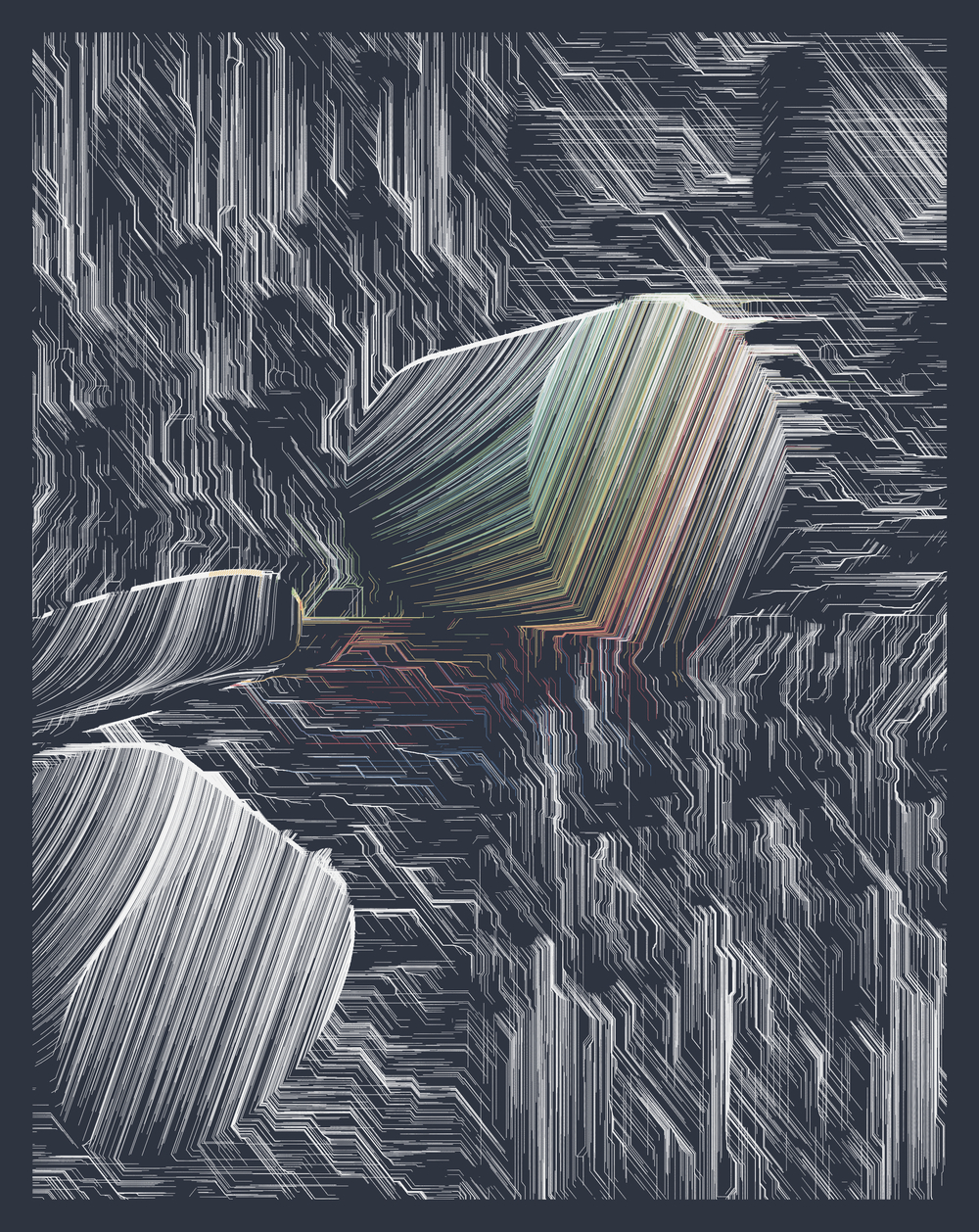
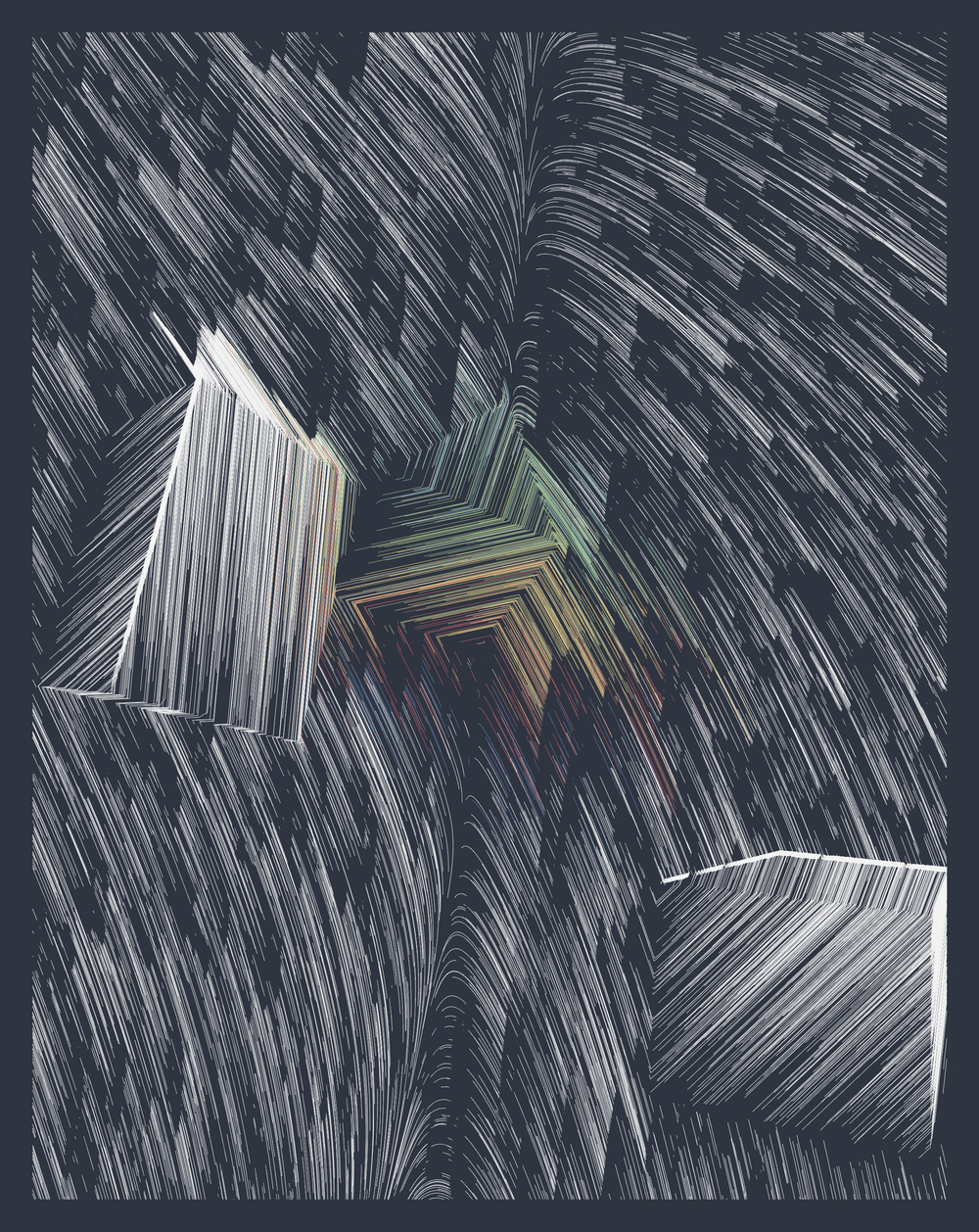
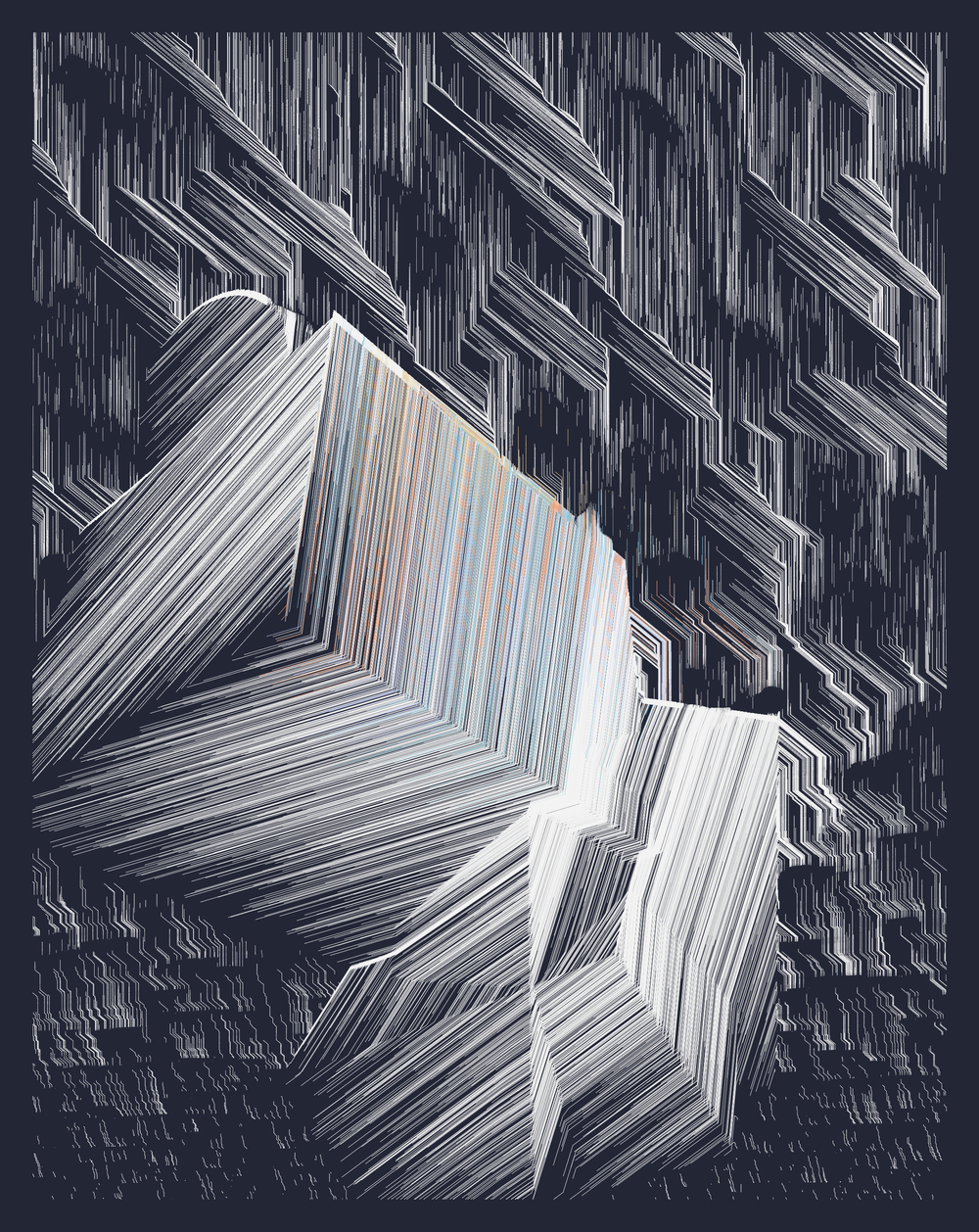
This series orchestrates the encounter of two computational spaces with distinct logics. The first, two-dimensional, governs the movement of particles subject to strange attractors—mathematical equations that produce trajectories that are simultaneously chaotic and predictable. The second, three-dimensional, calculates an invisible topography from which geometric volumes emerge. The particles drift freely across the plane until they encounter these volumes; they then follow their surfaces, as if a phantom relief were structuring their movement.

This mechanism materializes an ontological pluralism: two radically different ways of modeling space coexist without ever merging. On one side, the deterministic unpredictability of dynamic systems, where small initial variations produce divergent trajectories. On the other, Euclidean geometry, that space organized into perfectly defined volumes. Their interaction is neither fusion nor compromise, but collision: each system operates according to its own logic up to the point of contact, where their incompatibility becomes visible.

The compositions oscillate between organic flux and diagram. The trajectories draw fluid textures evocative of magnetic fields or atmospheric currents. When they encounter the geometries, they progressively reveal their contours through accumulation, bringing forth forms that seem to both emerge from chaos and remain foreign to it. This apparition evokes the wireframe renders of primitive 3D modeling, but also the phenomena of self-organization where order arises from disorder.

In this dialectic between flux and structure, chaos and geometry, freedom and constraint, these compositions are neither windows opening onto a unified world, nor opaque screens that would totally separate us from it. They are vibrating surfaces upon which is inscribed the fundamental tension of our era: that of a singular reality perceived through a fragmented prism of models and representations that, far from converging toward a common truth, continue to diverge, overlap, and contradict one another in a movement that seems endless.

G–R–I–D_-_RULES

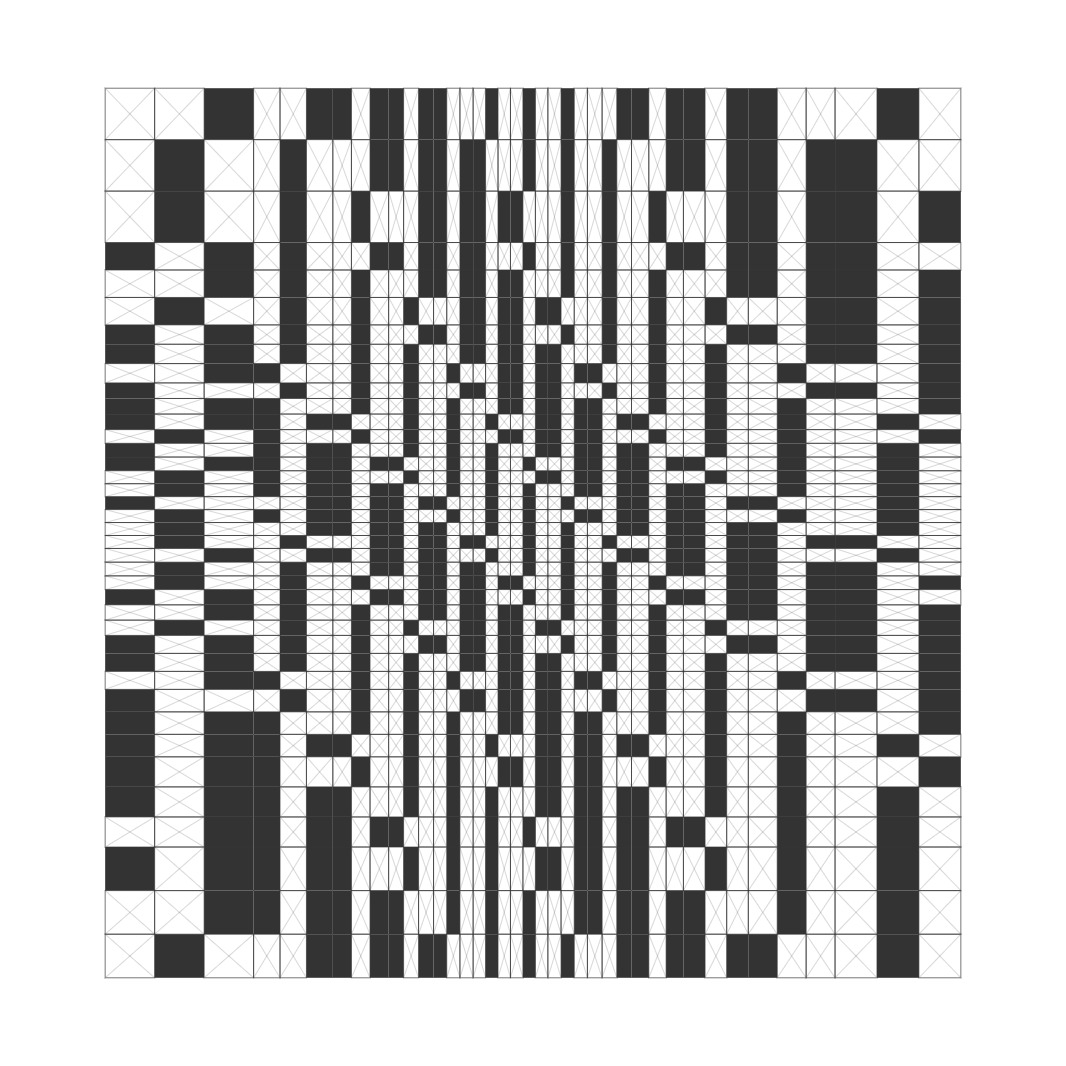
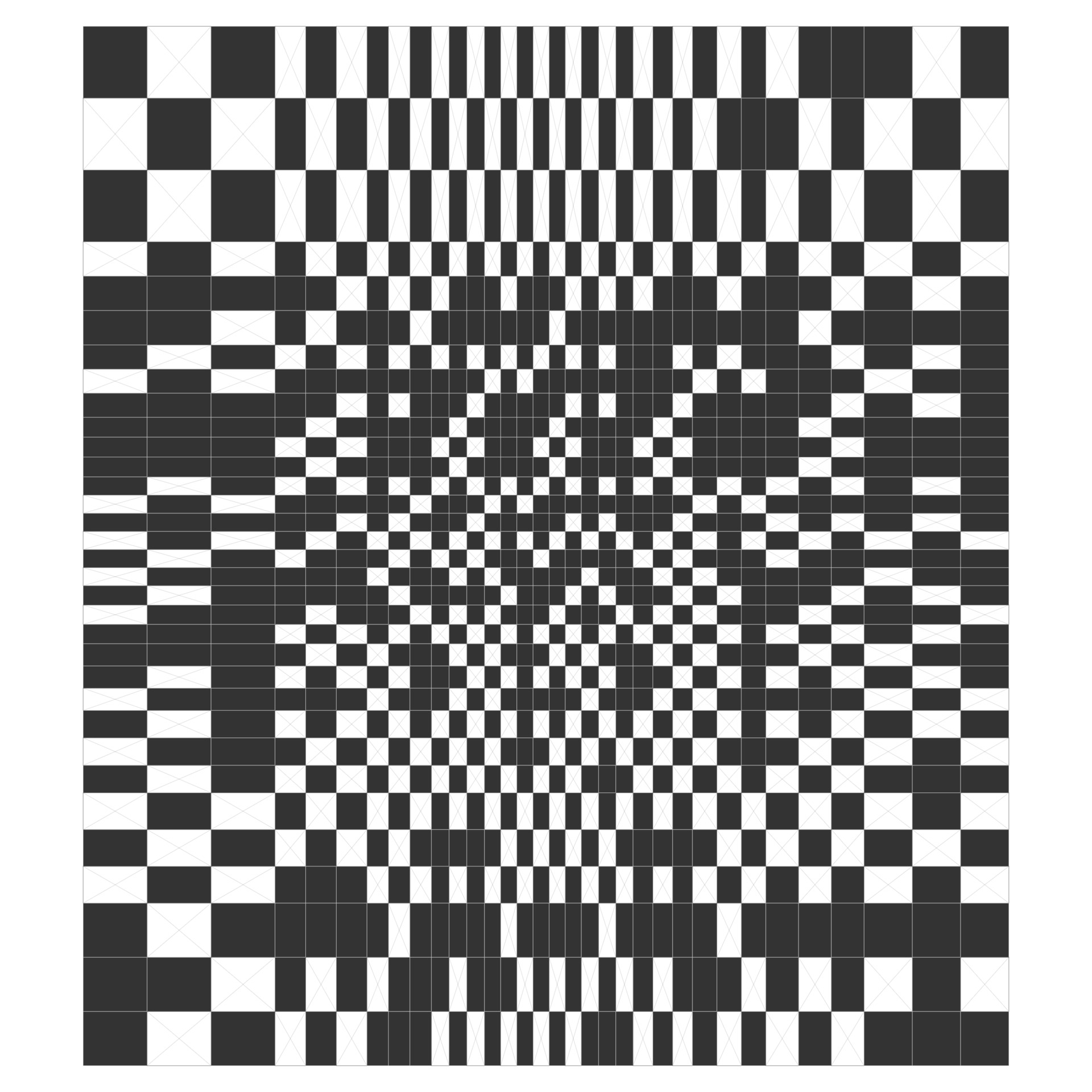
“G–R–I–D_-_RULES” explores the intersection of mathematics and visual aesthetics through computational pattern generation. Each piece is created using a unique combination of mathematical rules that transform simple grid coordinates into complex, organic patterns.
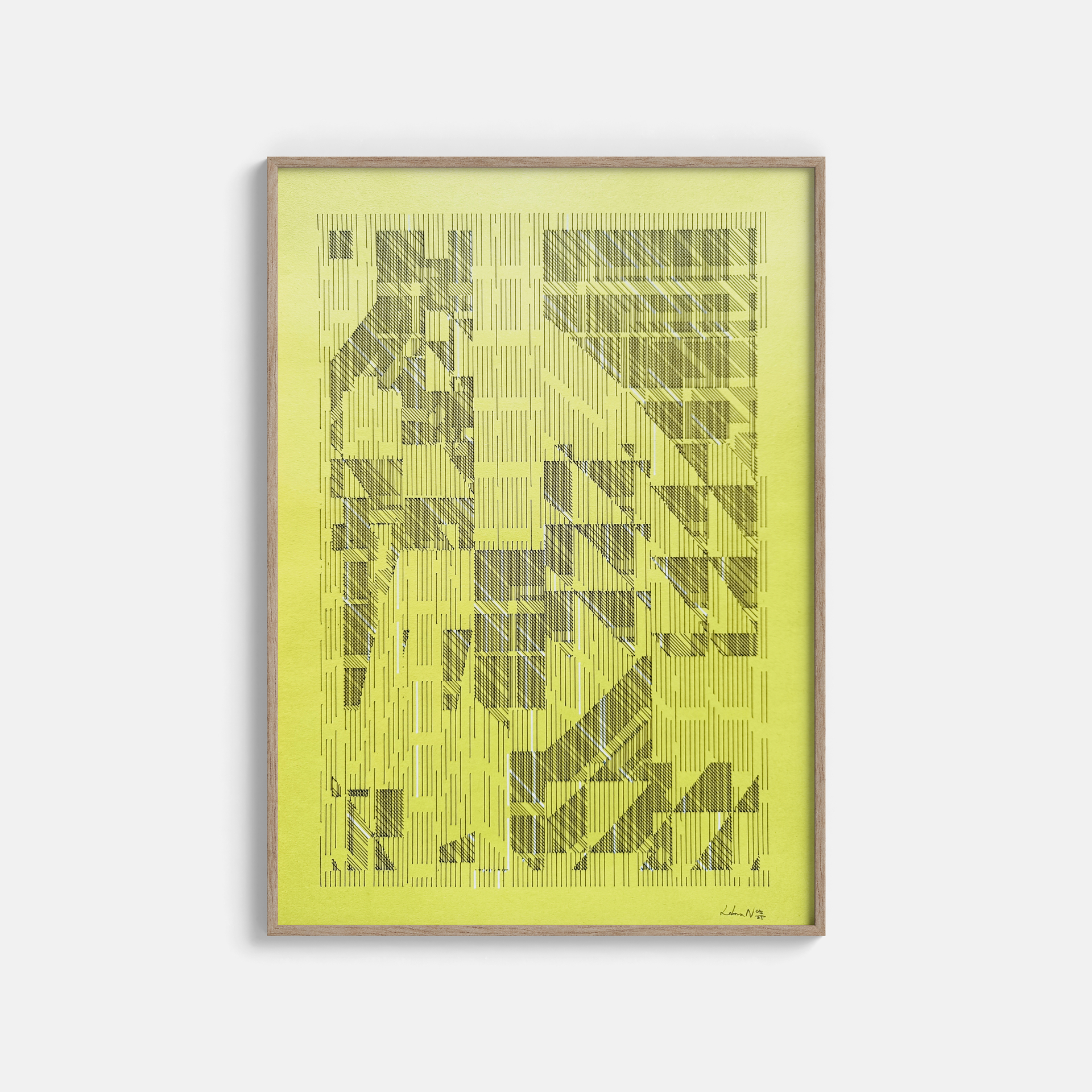
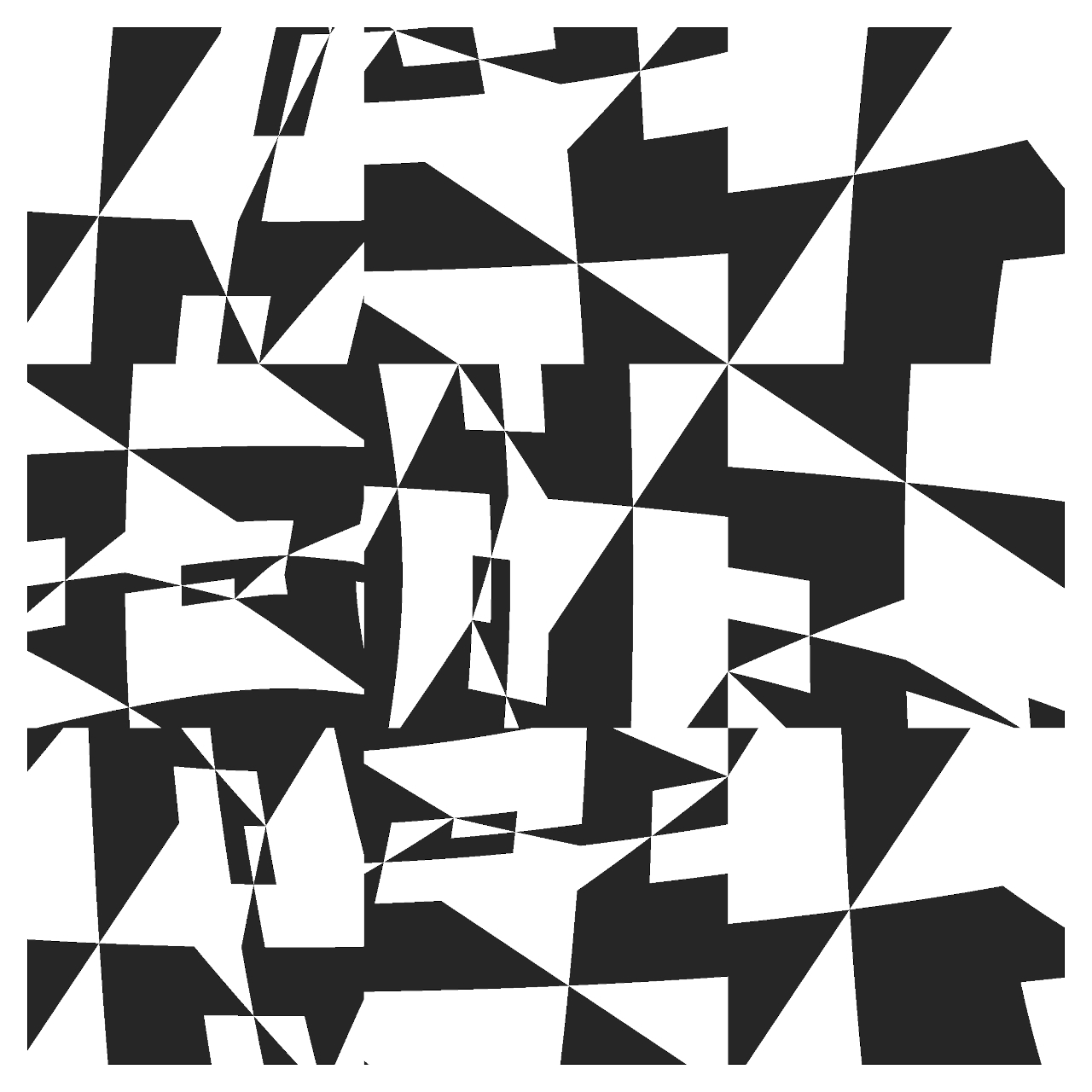
The artwork employs over 40 distinct algorithmic functions, including:

  • Bitwise operations creating sharp, digital textures
  • Trigonometric functions generating flowing, wave-like formations
  • Fractal mathematics producing self-similar, recursive structure
  • Modular arithmetic establishing rhythmic, periodic designs
  • Prime number sequences introducing controlled randomness
  • Cellular automata principles mimicking natural growth patterns

Each token represents a unique mathematical fingerprint, where simple coordinate pairs are transformed through complex logical operations into visual poetry. The binary black-and-white aesthetic emphasizes the pure mathematical nature of the generation process, recalling the work of pioneers like Frieder Nake or Georg Nees, while the intricate patterns reveal the surprising beauty hidden within computational logic.

Most of the patterns create an alternation of empty and filled spaces that suggest possibilities for interlocking and nesting. This modularity invites the viewer to engage in a kind of visual puzzle, attempting to decode the underlying mathematical relationships, a quality that transforms passive viewing into active intellectual engagement.

The collection demonstrates how rigid algorithmic rules can produce surprisingly organic and visually compelling results, bridging the gap between computational precision and artistic expression.

Entangled Realities

Entangled Realities is an experimental video work that orchestrates the encounter between two seemingly irreconcilable worlds: the organic marine environment and the algorithmic digital environment. This creation unfolds according to a sophisticated narrative architecture, built on a dual temporality that evolves in crescendo, carried by a musical composition generated algorithmically via Strudel software (whose interface and composition algorithms are revealed at the outset, immediately establishing the transparency of the creative process).

The work is based on a remarkably coherent tripartite technical infrastructure. The first program constitutes the generative heart of the experience: it deploys a million particles whose movements are governed by attractors, creating dynamic formations that spontaneously evoke certain marine species. This fortuitous resemblance served as a conceptual catalyst for the entire project, revealing the unsuspected correspondences between digital simulation and biological morphologies.

The second program materializes the aesthetics of technological control through the interface of a fictional dashboard, populated with data readings, evolutionary curves, and real-time indicators. This meta-reflexive dimension questions our relationship with systems for measuring and quantifying living organisms.

Finally, the third program, musical, does not merely provide the soundtrack: it rhythmically structures the entire work, creating a pulse that governs the alternation between algorithmic sequences and real images of jellyfish.

The central ambition of Entangled Realities lies in its attempt to hybridize these two image regimes. The underwater sequences undergo visual treatments that deconstruct their naturalistic representation, while superimposition phenomena attempt to anchor the generative animations in a space that regains a more organic, more “natural” appearance.

This strategy of creating tension reveals a profound questioning of the very nature of our contemporary representations. By overlapping two realities from different dimensions—one captured, the other calculated—the work fundamentally questions our relationship to images and reality in a context where the boundary between natural and artificial is becoming increasingly porous.

By superimposing realities from different sources—captured images and calculated images—the video examines the relationship between digital representation and the perception of nature. The rhythmic alternation between these two types of images, coupled with processes of visual hybridization, questions the traditional boundaries between the artificial and the organic in our contemporary visual environment.

vct.4

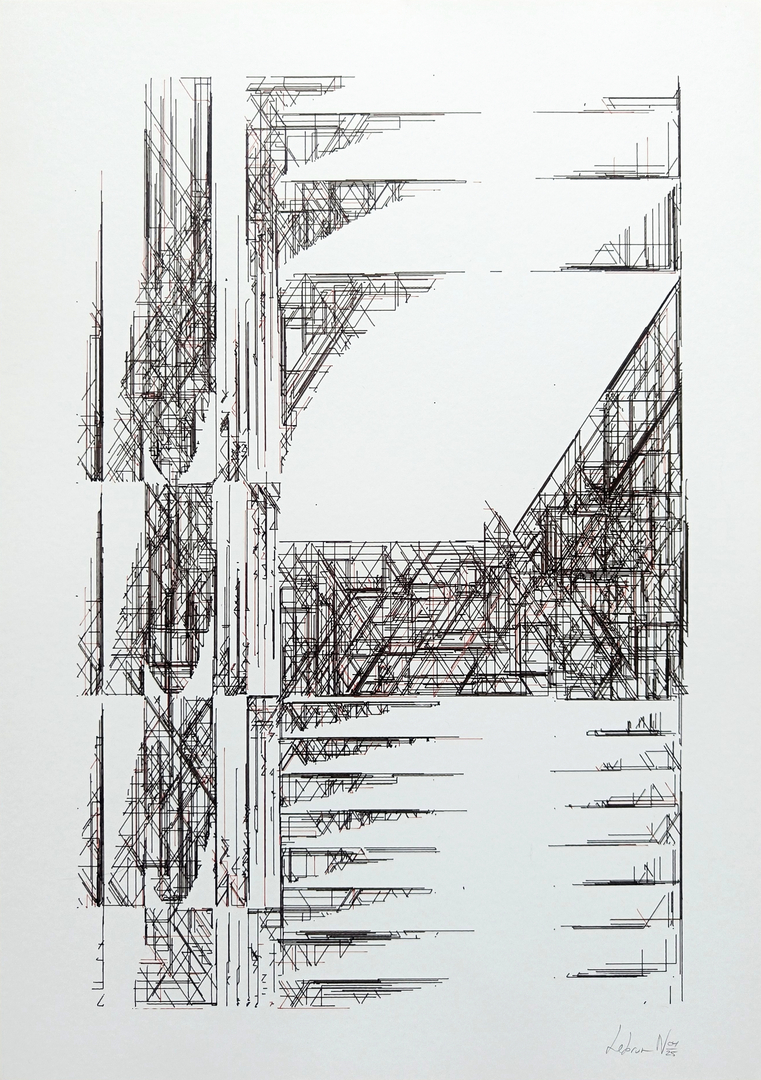
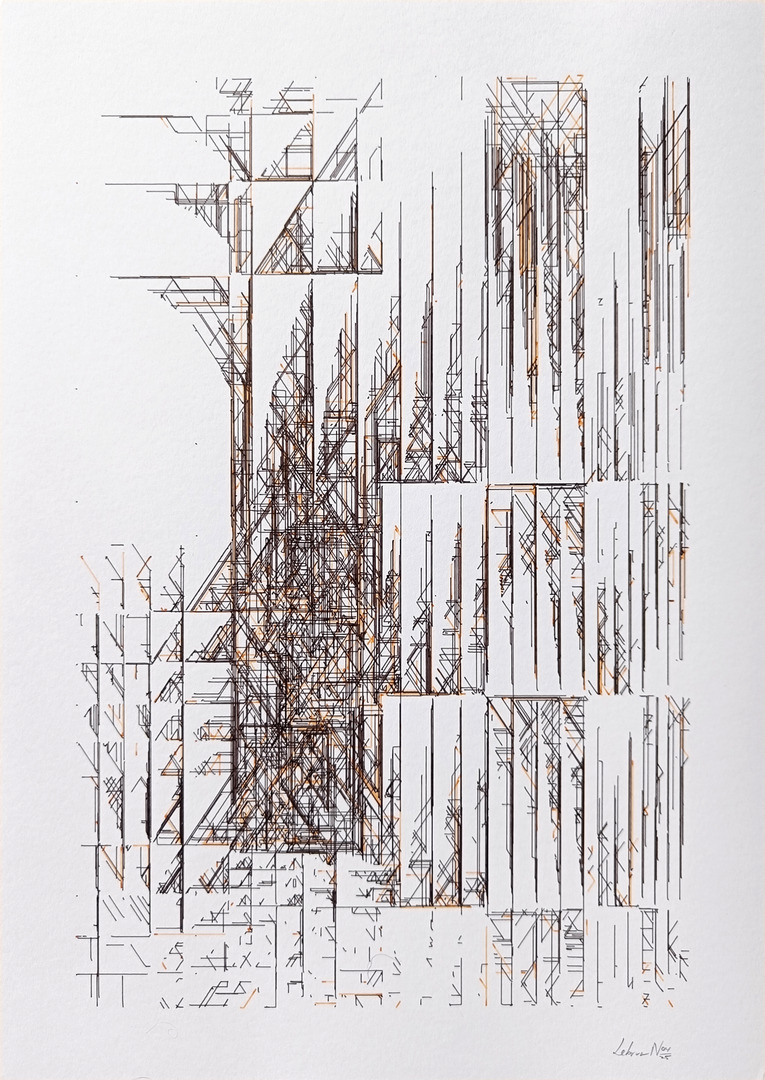
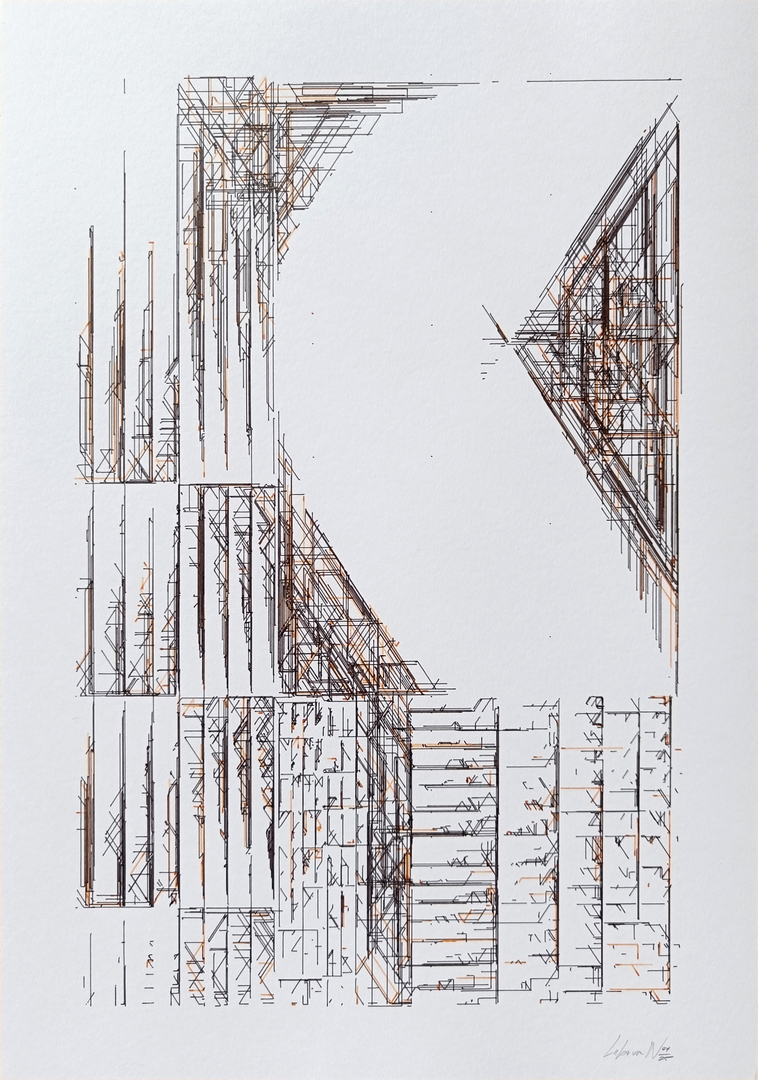
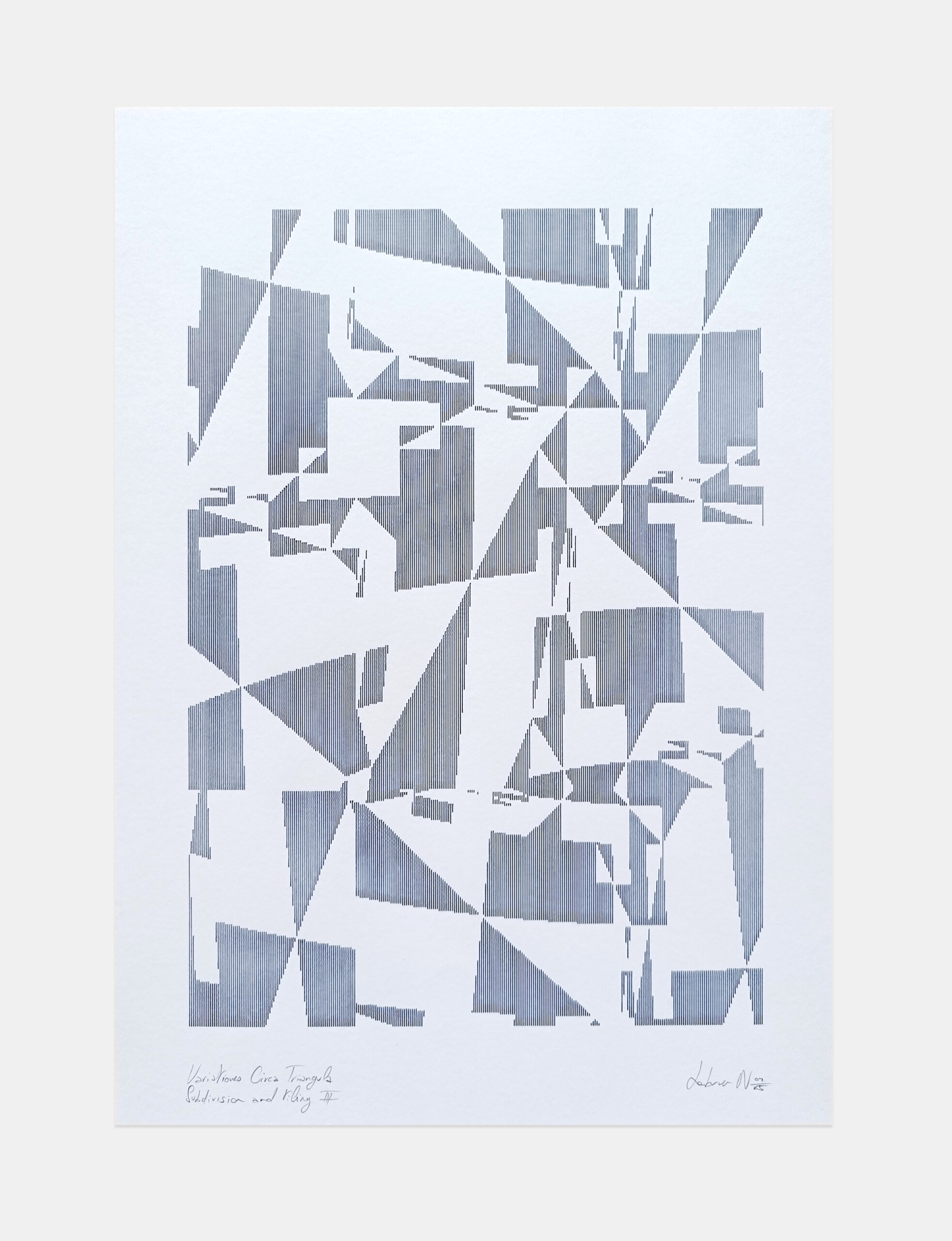
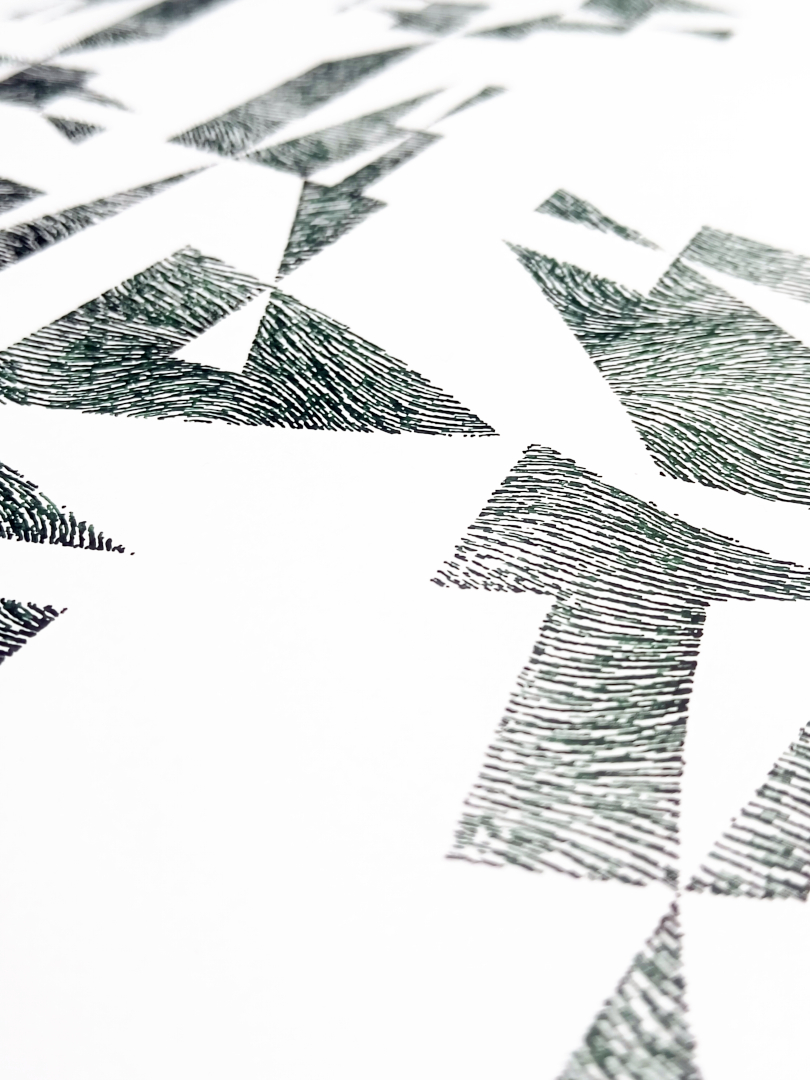
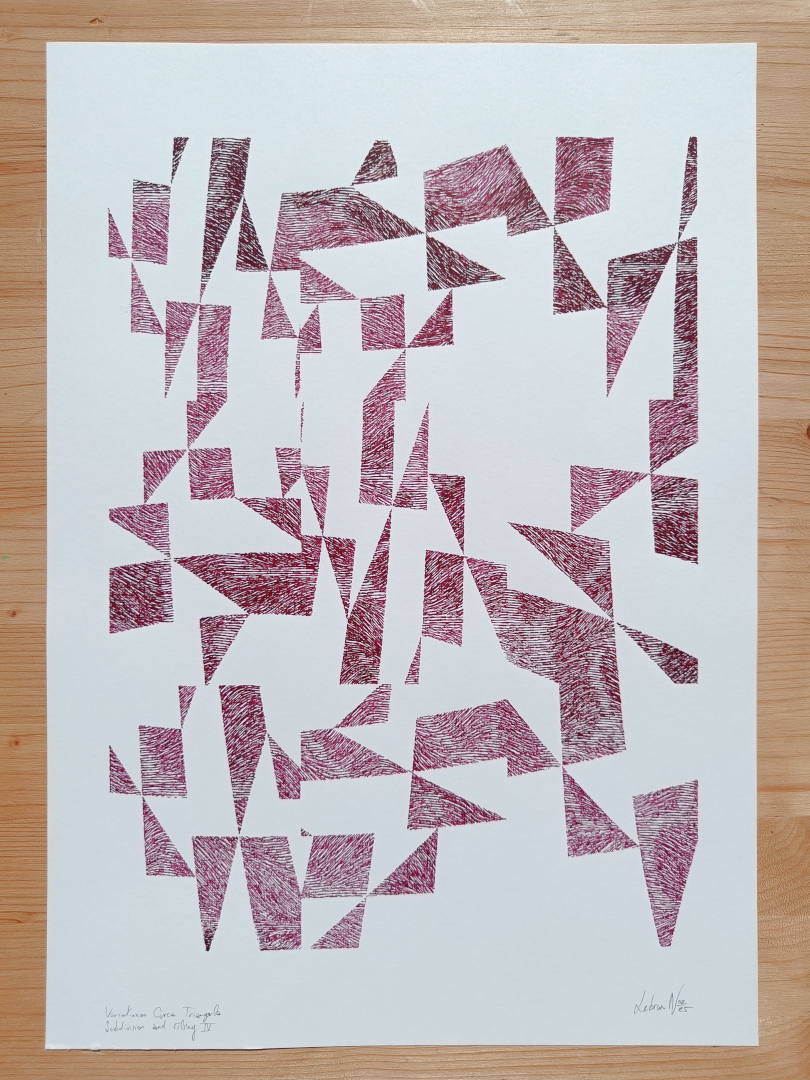
This project is the fourth evolution of the Variaciones Circa Triangula protocol, which gives rise to different series that all use the same graphic element, the triangle. Like the other series in this body of work, this generative project is based on a central element, the modular grid, whose cells differ in height and width.


Using this grid, and within each cell, the program will trace a succession of triangles, varying their heights and widths. This composition, made up of triangles filled with black on a white background, will be captured and then interpreted during subsequent program execution.

To fill in the previously generated shapes, the program will place points equidistant from each other. Using an algorithm called the random walker, these points will be able to move like a queen on a chess board. For all these points, a maximum movement distance is set, and an axis is chosen for each move. Here, the checkerboard is replaced by the previously generated composition, and the points can only move on dark squares, where triangles have been previously drawn. If, in the interval between its point of origin and its point of arrival, it encounters an unbroken surface, its progress stops and it can try again to move on another axis a certain number of times before coming to a definitive halt.

Although the program does not use artificial intelligence to draw up the paths, the program’s degree of autonomy and the fact that it interprets the result of an initial calculation itself give this project a self-reflexive dimension. This two-stage implementation, with two distinct processes, gives the program the ability to analyze and reinterpret its own work.

vct.3

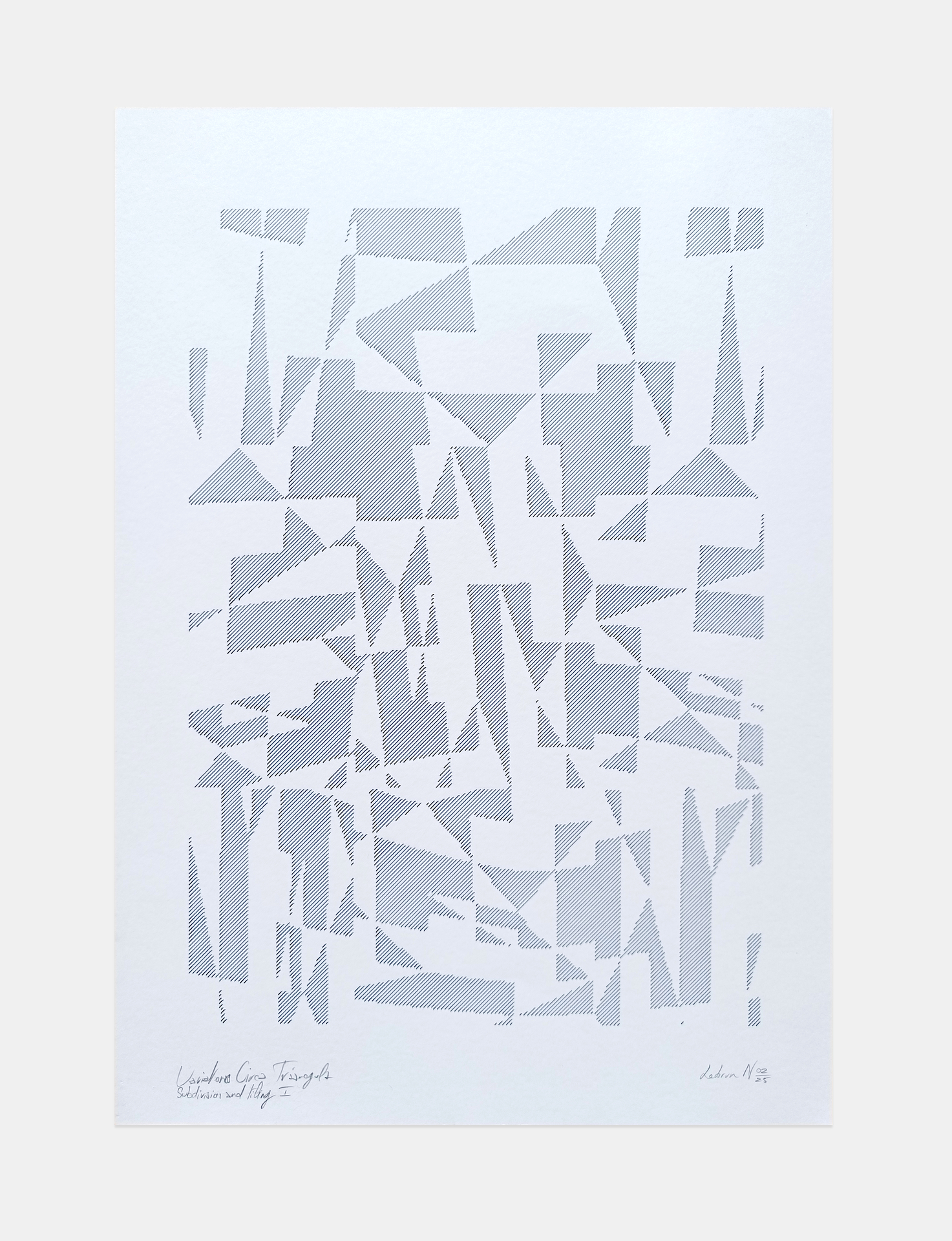
The third in the Variationes Circa Triangula corpus, this research takes as its starting point the constraint of creating a composition from triangles, with each series showing an evolution or modification of the protocol.
Inspired by works from the 60s and 70s (Op Art, GRAV, Sol Lewitt…) using simple geometric forms, this series reinterprets this style with a system of grids or rasters. The composition is crossed by a series of straight lines in different directions: vertical, horizontal and diagonal.


The composition is created in two stages, with the first part of the program initializing the composition with solid black shapes and empty zones. The painting is built around a modular grid, by successive division of the composition space. A scale and rotation are determined for each cell, and a triangle is drawn within each cell. The main effect of scale variations is to produce croppings within the triangle, or conversely to create repetition when the cropping area is larger than the cell surface. The various rotations will vary the shape of the triangle as if a horizontal or vertical mirror were applied.

Once this first structure has been created, it is saved as a stencil. The program will reinterpret it according to the color of each pixel. The next step in the protocol is to draw lines above this stencil structure. As it draws these lines, the program checks point by point whether they reach the surface of a triangle, making them visible or erasing them if necessary. At the same time as revealing the initial composition, the program reveals its system of reading or interpretation by creating intersecting grid patterns. This creates a rhythm in the length and spacing of each stroke, and this treatment is not confined to the pre-existing composition, but overflows and covers the entire compositional space.
This interplay of line spacing is complemented by another variation: color. The program counts the lines and each time it encounters a multiple, it decides to change the color of the line. Is it to check that the process is working properly, that there are a certain number of lines? Or is it a purely decorative, painterly gesture?

vct.2

This series of generative drawings, like all Variationes Circa Triangula works, is based on compositions of triangles.

The program uses two grids to draw compositions.

The first, a regular grid, is used to deform the space, applying a progressive enlargement that bends the space in one direction or another within the composition. Each point in the composition has its own magnification value, calculated according to the point’s distance from a random point. Just as in a geodesic construction, where the edges of the faces are aligned with the center of the structure, here the magnification effect is determined in relation to a random center. In addition to this curvature, each grid cell is rotated. Depending on its order, the cell will be rotated by forty-five, ninety, one hundred and thirty-five or 0 degrees.

The second grid is simpler, modular: like a Mondrian painting, it contains cells that can themselves contain several cells. This second grid is used to place triangles, to create solids and voids, since the program will reuse the width and height of each cell to draw triangles.

These two grids don’t participate in the same way in the creation of the composition: the first modifies depth, or even space, while the second is used to place elements on top, to draw a pattern.

This first protocol creates an image that serves as the basis or matrix for other programs.

Their principles are to fill solid shapes with successive lines, and to do this, two different strategies will be implemented.

The first protocol consists of using straight lines (horizontal, vertical and diagonal) to run through the composition, and as if using a stencil, the lines are drawn over the solids, leaving the margins and voids untouched.

The second process uses much the same system, except that the lines are curved and shorter. To draw the lines, the program uses a flow or force field in which particles criss-cross and trace paths, giving the lines a more organic appearance, as if they had been produced by hand.

Variationes circa triangula

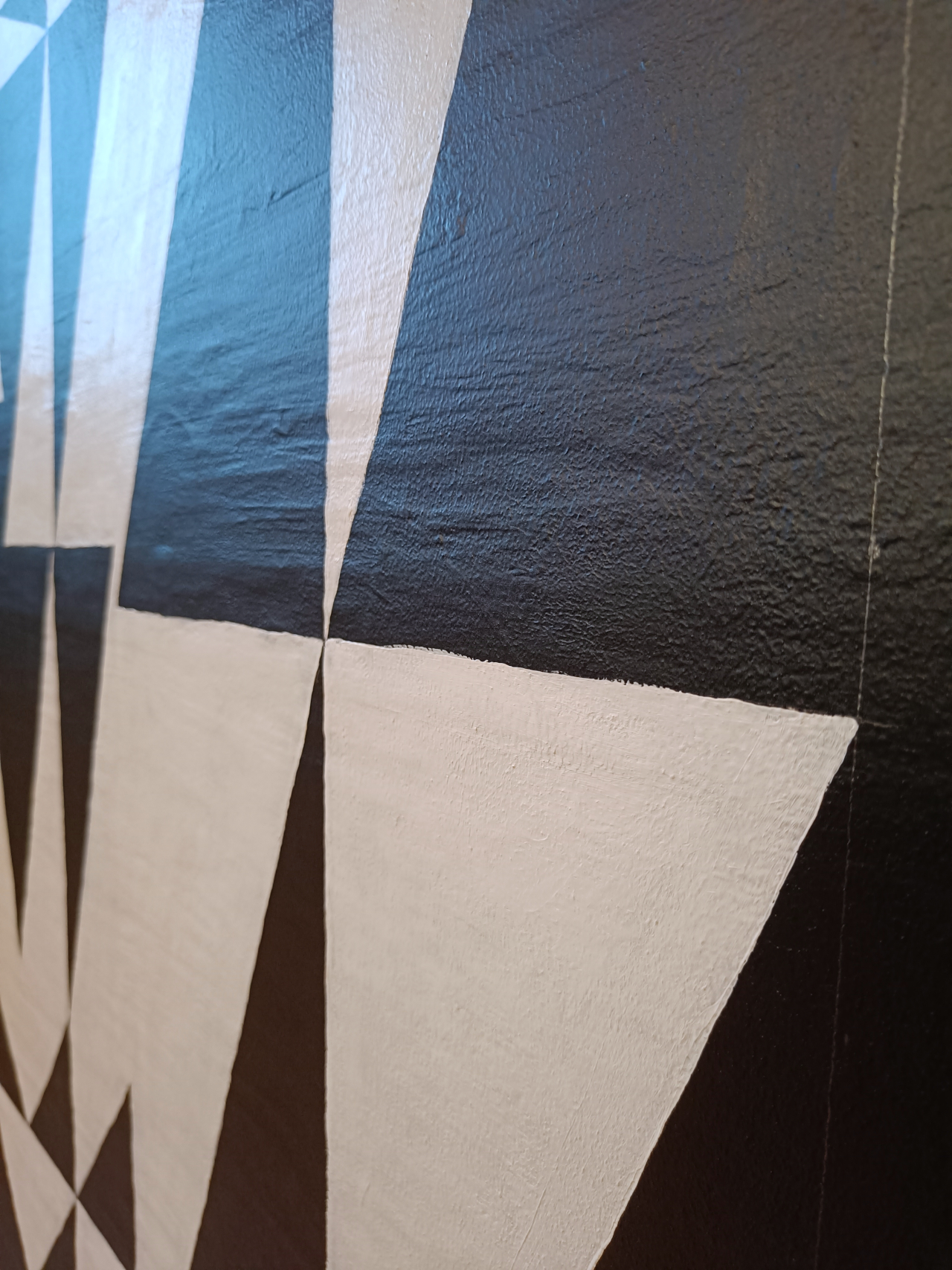
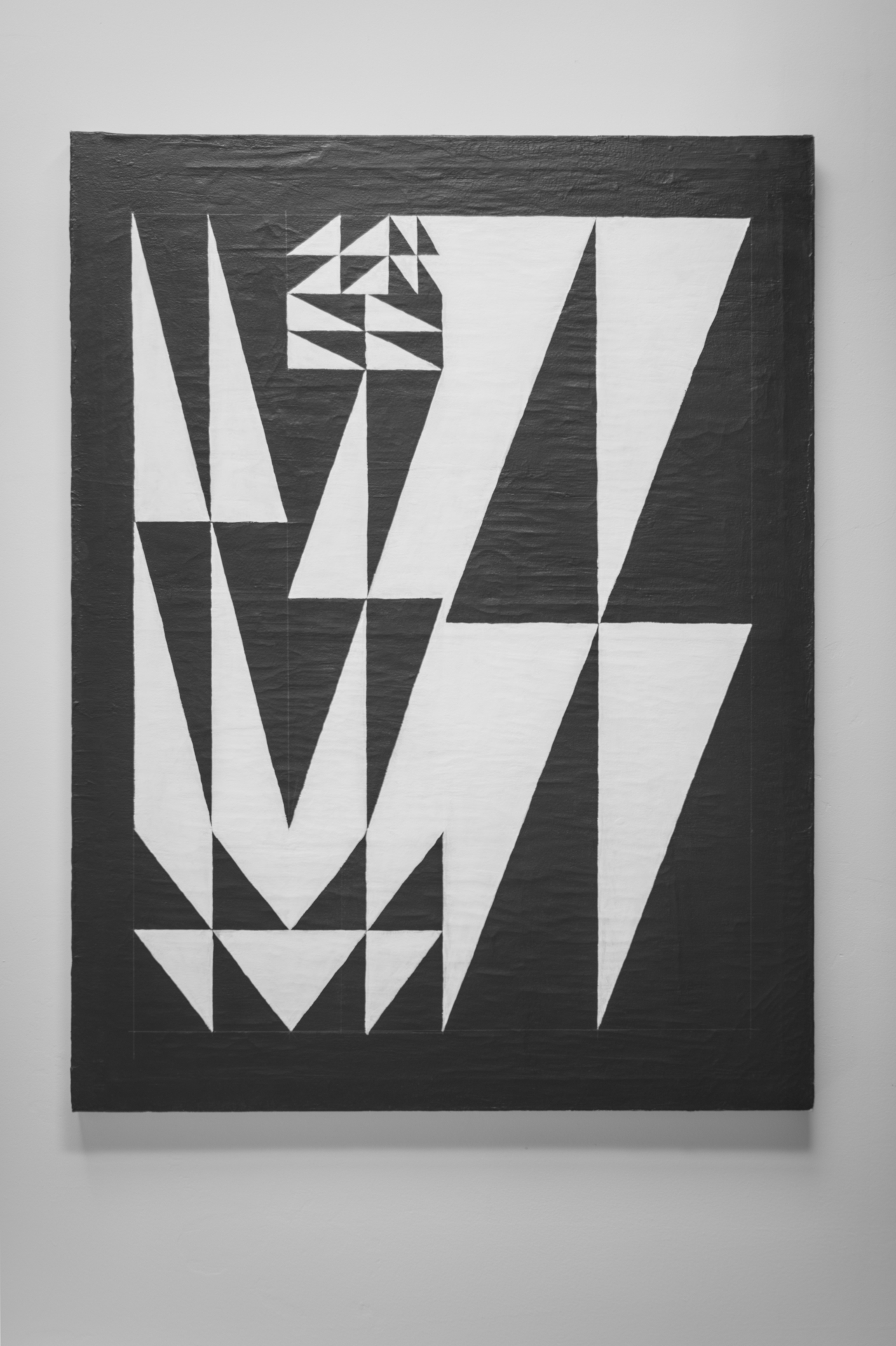
This painting is part of a series of programs exploring possible compositions using triangles.
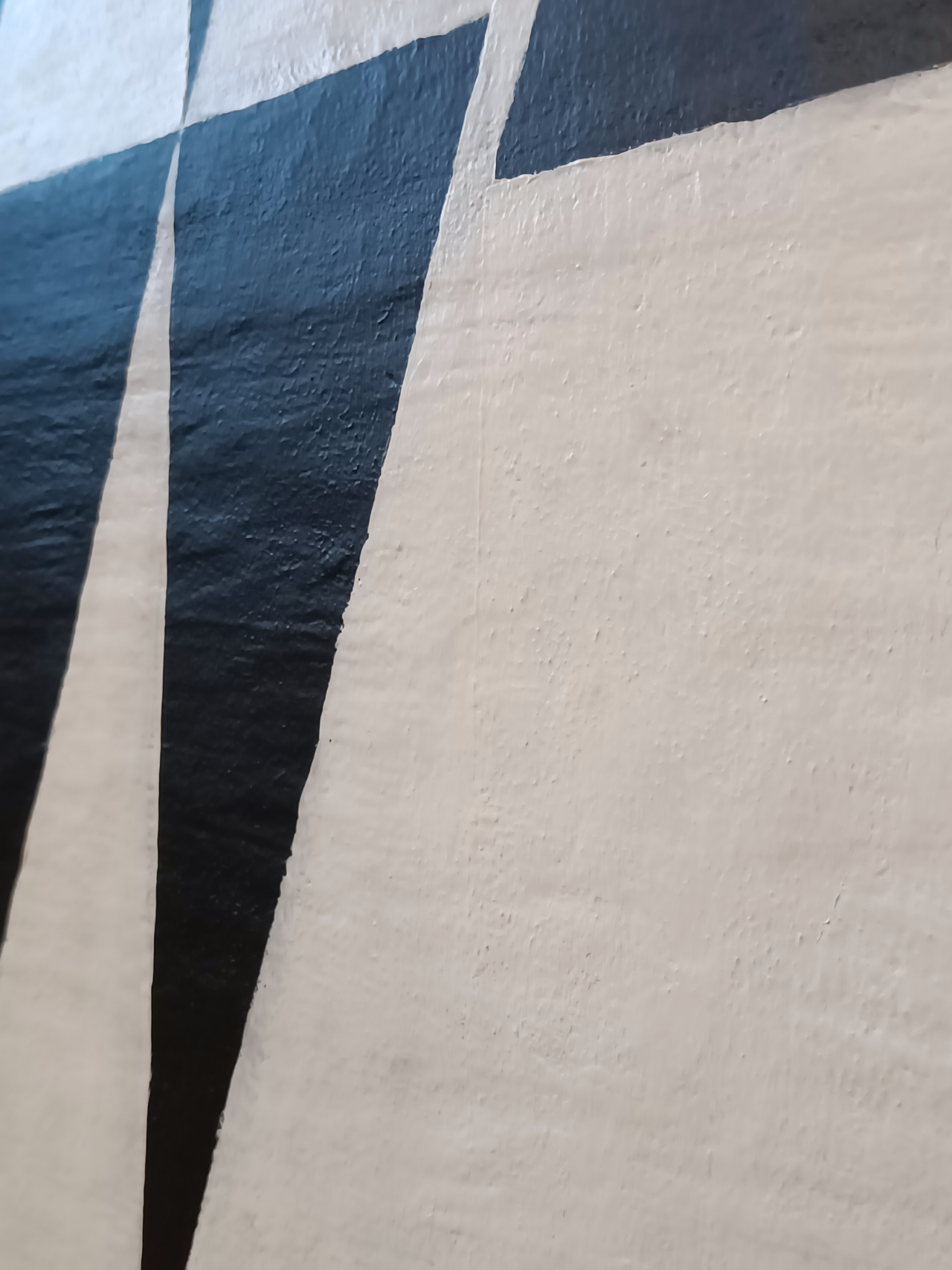
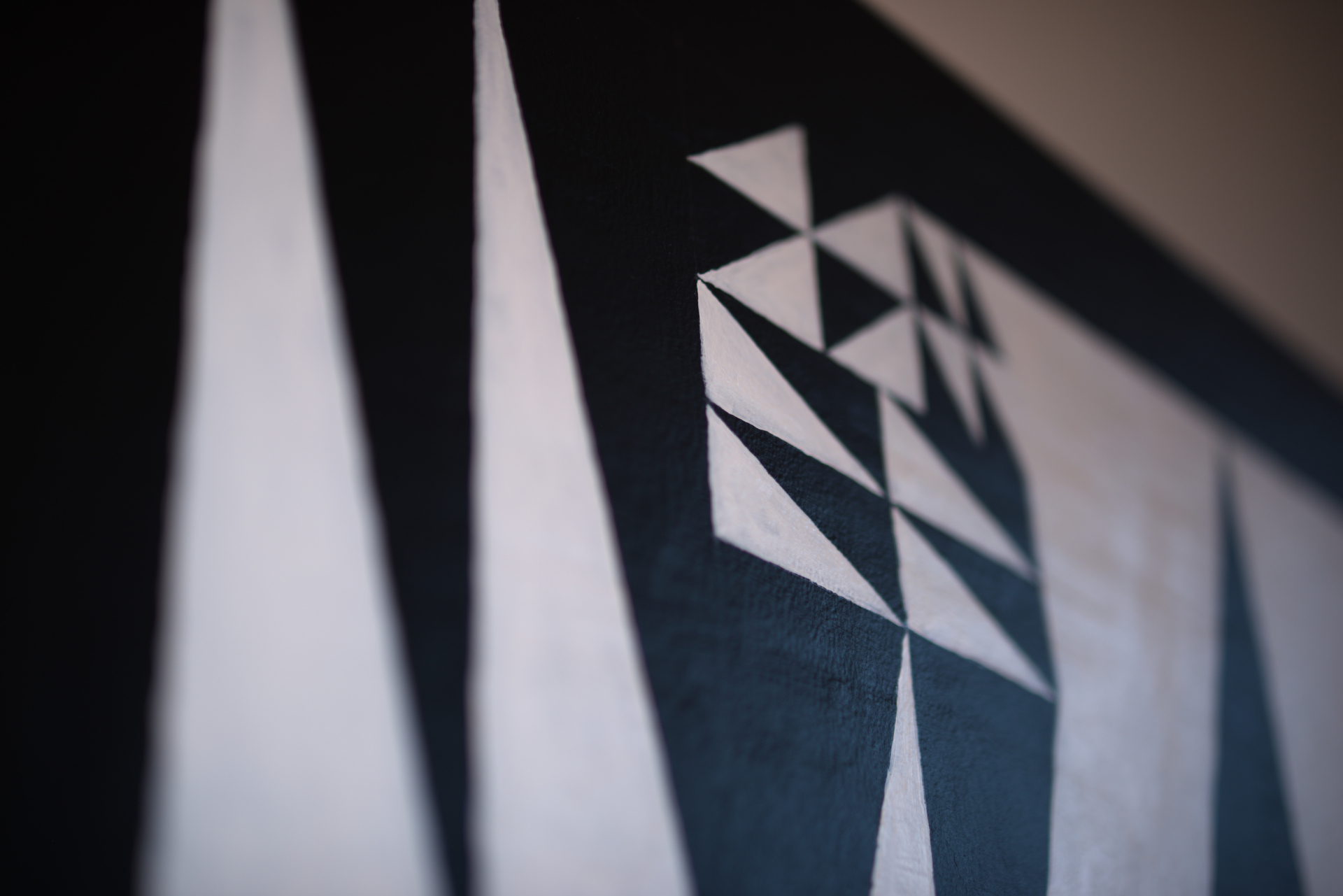
The composition is created on the basis of a grid, in which each square can be randomly divided in two, repeatedly (recursion). The rest of the protocol is fairly straightforward, placing triangles in each of the squares. Through this simplicity and radicalism, we can perceive the influences of the Op Art movement, the GRAV group and the work of Lia Drei.